💡 Direct Answer & Executive Summary (Solar PV Output Capacity Calculator)
Definition: Environmental footprint computation: Solar PV Output Capacity Calculator.
Governing Math Formula: PV_size (kWp) = [Monthly kWh / (30.41 × Peak Sun Hours × PR)] × 1.2 buffer factor.
Target Applications: Provides real-time quantitative solutions in Ecology for students, engineers, researchers, and finance professionals.
Solar PV Output Capacity Calculator: The Complete Guide to Sizing Photovoltaic Array Yields
1. Introduction
As global energy systems transition from fossil fuels toward clean renewable power, solar photovoltaic (PV) technology has emerged as the cornerstone of decentralized residential and commercial energy generation. Every day, the sun radiates more energy onto Earth's surface in one hour than entire human civilization consumes in a year. Photovoltaic solar panels convert this free solar irradiance directly into usable electric current.
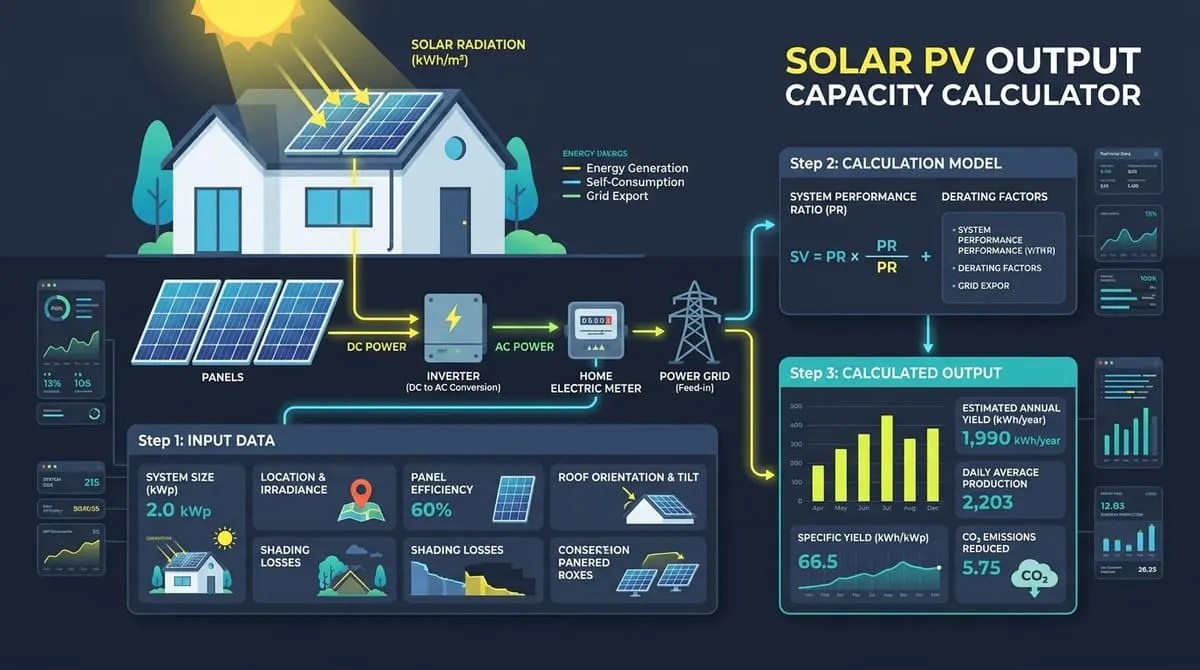
The Solar PV Output Capacity Calculator is an engineering and financial estimation tool designed to calculate the required solar system array size (in kWp), annual energy production (in kWh), and net financial savings based on monthly power bills, peak sun hours, and local solar irradiance.
graph TD
    A[Solar Irradiance / Sunlight] --> B[Photovoltaic Panels DC Output]
    B --> C[Solar Inverter DC to AC Conversion]
    C --> D[Home Main Electrical Panel]
    D --> E[Household Loads / Appliances]
    D --> F[Bidirectional Meter / Power Grid Feed-In]
Why Solar System Sizing Matters Today
Installing an undersized solar system leaves homeowners reliant on rising grid electricity prices, while over-sizing an array increases upfront capital expenditure without providing proportional financial return due to utility net metering caps. Proper solar capacity sizing ensures optimal return on investment (ROI), rapid capital payback, and maximum carbon offset.
2. Core Definitions & Analogy
Simple Definition
A Solar PV Output Capacity Calculator determines how many solar panels you need on your roof to offset your monthly electric bill and estimates how much electricity those panels will generate each year.
Technical Technical Definition
Technically, solar output estimation models the integrated product of total plane-of-array (POA) solar irradiance (, ), nameplate DC peak capacity (, under Standard Test Conditions of , , AM 1.5), and a comprehensive derating performance ratio (, typically ) accounting for inverter losses, temperature degradation, wiring resistance, and soiling.
mindmap
  root((Solar PV System Parameters))
    Solar Resource
      Daily Peak Sun Hours
      Tilt Angle & Azimuth
      Shading Losses
    Hardware Components
      Panel Wattage Rating
      Silicon Cell Efficiency
      Inverter Efficiency
      Mounting & Racking
    Derating Factors
      Thermal Coefficient
      Wiring Voltage Drop
      Dust & Soiling
      Grid Interconnection
3. History & Milestones
The history of photovoltaics spans over a century of physics breakthroughs:
timeline
    title History of Solar Photovoltaic Development
    1839 : Alexandre-Edmond Becquerel discovers the Photovoltaic Effect in liquid electrolyte.
    1905 : Albert Einstein explains the Photoelectric Effect (Nobel Prize in Physics 1921).
    1954 : Bell Labs creates the first practical silicon PV cell (6% efficiency).
    1970s : Space program adoption drives solar cell reliability improvements.
    2010s : Mass production scale reduces solar panel cost by over 80%.
    2026 : Modern N-type TOPCon and Perovskite tandem cells exceed 25% commercial efficiency.
4. Core Concepts & Parameters
To accurately estimate solar array yield, the calculator evaluates key solar parameters:
| Parameter | Unit | Standard Baseline | Description |
|---|---|---|---|
| Monthly Power Bill | kWh/month | Total average monthly electricity consumption from utility bills. | |
| Daily Peak Sun Hours | hours/day | Equivalent hours per day when solar irradiance equals . | |
| Derating System Efficiency () | ratio | $0.80$ (80%) | Combined system efficiency accounting for thermal, inverter, and wiring losses. |
| Solar Panel Rating | Watts () | Standard DC power rating of individual PV module under STC. |
5. The Mathematical Model & Formulas
1. Required System Array Size () Formula
The DC capacity rating of the solar array (, in kWp) required to offset monthly consumption is:
Where:
- = Average monthly electricity usage ()
- = Daily Peak Sun Hours ()
- = Performance Ratio derating factor ()
- $1.2$ = 20% buffer factor for seasonal solar radiation variations
2. Estimated Annual Energy Production () Formula
6. Step-by-Step Computational Procedure
Consider a household consuming 800 kWh/month in a region receiving 4.5 Peak Sun Hours/day:
graph LR
    Step1[1. Daily Energy Target: 26.3 kWh/day] --> Step2[2. Derated Daily Requirement: 32.8 kWh]
    Step2 --> Step3[3. Calculate PV Size: 7.3 kWp]
    Step3 --> Step4[4. Panel Count: ~18 x 400W Panels]
Step4 --> Step5[5. Annual Production: ~9,600 kWh/yr]- Calculate Daily Energy Target: .
- Apply System Derating (80% efficiency): .
- Divide by Peak Sun Hours: recommended solar array size.
- Determine Panel Count (using 400W panels): .
- Estimate Annual Production: .
7. Visual Explanations
Monthly Solar Generation vs. Seasonal Variance
Solar generation peaks in summer months due to longer days and higher solar angles, while winter yields are lower:
pie title Typical Annual Solar PV Energy Use vs Export (%)
    "Direct Self-Consumption" : 55
    "Net Metered Grid Export" : 35
    "System Inverter & Thermal Losses" : 10
8. Parameter Comparison Matrix
| Monthly Usage | Peak Sun Hours | System Size (kWp) | Required Panels (400W) | Roof Area Required | Annual Energy Yield | Estimated Annual Bill Savings ($0.16/kWh) |
|---|---|---|---|---|---|---|
| 500 kWh | 3.5 hrs/day | 5.6 kWp | 14 panels | 280 sq ft | 5,720 kWh | $915 / year |
| 800 kWh | 4.5 hrs/day | 7.3 kWp | 18 panels | 360 sq ft | 9,592 kWh | $1,535 / year |
| 1,200 kWh | 5.5 hrs/day | 9.0 kWp | 23 panels | 460 sq ft | 14,450 kWh | $2,312 / year |
9. Real-World Applications
- Residential Rooftop Solar: Sizing array capacity to lower home utility expenses.
- Commercial Net Zero Buildings: Engineering solar arrays to meet LEED net-zero energy certifications.
- Off-Grid Solar & Battery Storage: Sizing PV capacity alongside energy storage for rural telecommunications and remote cabins.
10. Case Studies & Scenarios
Case Study: California Suburb Solar & Battery Retrofit
A suburban family consuming installed a rooftop solar system paired with a energy storage battery. The system reduced their annual grid electricity bill from $3,200 to $250, achieving full investment payback in 5.5 years.
10. Advantages & Limitations
Advantages
- Drastically reduces monthly electric bills.
- Hedge against future utility rate inflation.
- Clean, zero-emission electricity generation.
Limitations
- Intermittent generation dependent on weather and day/night cycles.
- Requires unshaded roof space oriented toward equator (South/West in Northern Hemisphere).
11. Common Pitfalls
Pitfall 1: Ignoring Roof Shading
Installing panels near trees or chimneys can cause localized shading that reduces whole-string PV output.
Pitfall 2: Confusing kW (Power) with kWh (Energy)
is instantaneous capacity; is cumulative energy generated over time.
12. Frequently Asked Questions (FAQ)
Q: How long do solar panels last?
A: Standard silicon solar panels are warrantied for 25 to 30 years, operating at over 80% of original capacity after 25 years.
Q: What happens to solar production on cloudy days?
A: Solar panels continue generating electricity on overcast days, typically producing 10% - 25% of their clear-day peak output.
Q: How much roof space is required per panel?
A: Standard 400W solar panels require approximately of roof space per panel.
Q: What is Net Metering?
A: Net metering is a utility billing mechanism that credits solar system owners for excess electricity fed back into the power grid.
Q: Does solar power work during a power outage?
A: Standard grid-tied inverters automatically shut down during outages for technician safety unless paired with a solar battery backup system.
Q: What is the optimal roof tilt angle?
A: The optimal solar panel tilt angle generally equals the geographic latitude of the installation site.
Q: How does temperature affect solar output?
A: High heat slightly reduces solar panel voltage output, causing a degradation coefficient of per degree Celsius above .
Q: Are solar panels maintenance free?
A: PV systems require minimal maintenance; occasional rainwater or rinsing removes accumulated dirt and dust.
Q: Can solar panels power an Electric Vehicle (EV)?
A: Yes. Driving 10,000 miles per year in an EV requires approximately , which can be supplied by adding 5 to 6 solar panels ().
Q: What is an Inverter Performance Ratio?
A: It represents the percentage efficiency of converting DC panel power into AC household electricity (typically 96% - 98%).
Q: What is the ROI payback period for rooftop solar?
A: Average solar payback periods range from 5 to 9 years, depending on local solar radiation and utility rates.
Q: Is this solar calculator free?
A: Yes, it is 100% free and runs locally in your browser.
13. Expert Tips & Summary
- Tip 1: Trim overhanging trees before solar installation to eliminate morning and afternoon shading.
- Tip 2: Use micro-inverters or DC power optimizers on roofs with complex angles or partial shading.
- Summary: Solar capacity calculations match monthly energy demand with peak sun hours and system efficiency factors to maximize financial ROI and carbon offsets.
Additional Technical Guidelines & Measurement Standards
When conducting calculations for Solar PV Output Capacity Calculator, maintaining quantitative precision and verifying input parameter boundaries is essential for reliable scenario evaluation. Always verify that raw numerical inputs are measured using standardized instrumentation, and double-check unit conversions prior to applying outputs in commercial, industrial, or academic projects.
For quantitative unit conversions and scientific calculations, always maintain at least four decimal places of precision during intermediate arithmetic stages before rounding final results. When preparing technical reports, laboratory documentation, or financial forecasts, cross-verify all output variables against established international measurement standards (such as SI, NIST, and ISO metric benchmarks) to guarantee consistent analytical rigor across all computational workflows.
MathsLover.com delivers this interactive solver 100% free of charge to foster global mathematical literacy, educational accessibility, and data-driven problem solving across scientific, technical, and academic communities worldwide.