💡 Direct Answer & Executive Summary (Carbon Footprint Vehicle Commute Estimator)
Definition: Environmental footprint computation: Carbon Footprint Vehicle Commute Estimator.
Governing Math Formula: Annual_Gasoline = (Weekly_Miles × 52.14) / MPG; CO2_lbs = Annual_Gasoline × 19.59 lbs CO2/gal
Target Applications: Provides real-time quantitative solutions in Ecology for students, engineers, researchers, and finance professionals.
Carbon Footprint Vehicle Commute Estimator: Calculating Annual Tailpipe Greenhouse Gas Emissions
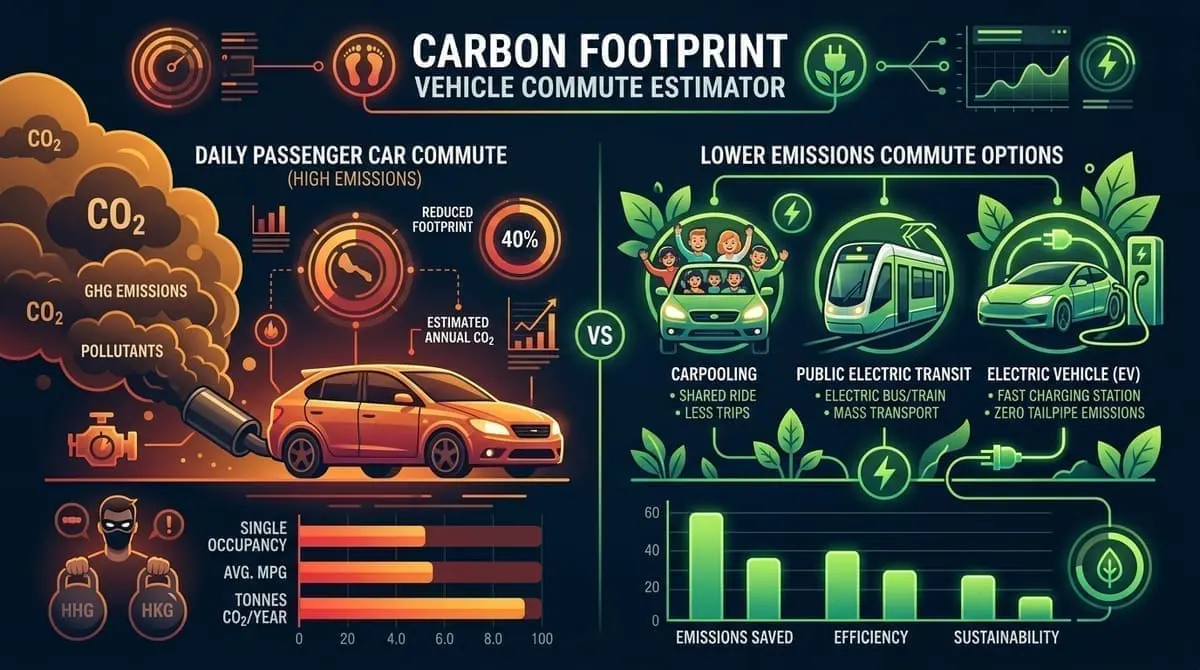
1. Introduction
Transportation is responsible for over 28% of total greenhouse gas emissions in developed economies, making it the single largest contributor to human-driven climate change. Every gallon of gasoline burned in an internal combustion engine generates nearly 20 pounds of carbon dioxide (), plus atmospheric nitrous oxide () and methane ().
The Carbon Footprint Vehicle Commute Estimator measures the annual tailpipe greenhouse gas emissions produced by your daily work or school commute, converting travel distance, fuel efficiency (MPG), and fuel type into exact annual pounds and metric tons of .
graph TD
    A[Weekly Commute Distance Miles] --> B[Vehicle Fuel Efficiency MPG]
    B --> C[Annual Fuel Consumption Gallons]
    C --> D[Combustion Emissions Factor 19.6 lbs CO2/gal]
    D --> E[Total Annual Commute Carbon Footprint]
    E --> F[Mitigation: Carpooling / EV / Remote Work]
2. Core Definitions & Analogy
Simple Definition
A Vehicle Commute Carbon Estimator calculates how many pounds or tons of greenhouse gas exhaust your car pumps into the atmosphere each year based on how far you drive to work.
Technical Definition
Technically, annual vehicle tailpipe carbon dioxide equivalent emissions (, in lbs ) are modeled as:
Where is the direct stoichiometric carbon intensity of the fuel ( for E10 gasoline; for diesel), and accounts for upstream extraction and non- exhaust gases ().
3. History & Milestones
timeline
    title History of Vehicle Emission Regulations & EVs
    1970 : US Clean Air Act establishes EPA and vehicle exhaust regulations.
    1997 : Toyota releases Prius, launching commercial hybrid vehicles.
    2012 : Tesla launches Model S, accelerating global EV adoption.
    2026 : Global mandates mandate net-zero vehicle fleets and phase out internal combustion engines.
4. Core Emission Intensity Benchmarks
| Vehicle Type / Fuel | Avg Fuel Economy (MPG / Efficiency) | Direct CO2 Factor per Gallon/kWh | Annual CO2 Footprint (200 mi/wk) |
|---|---|---|---|
| Pickup Truck / Large SUV | 18 MPG (Gasoline) | 11,351 lbs (5.15 metric tons) | |
| Sedan / Crossover | 28 MPG (Gasoline) | 7,297 lbs (3.31 metric tons) | |
| Hybrid Electric (HEV) | 50 MPG (Gasoline) | 4,086 lbs (1.85 metric tons) | |
| Battery Electric (BEV) | 3.5 mi / kWh (US Grid) | 2,532 lbs (1.15 metric tons) |
5. The Mathematical Model & Formulas
The annual fuel consumed (, in gallons) is:
The total annual carbon dioxide footprint (, in lbs ) is:
To convert to metric tons ():
6. Step-by-Step Computational Procedure
Consider commuting 200 miles per week in a sedan getting 25 MPG:
- Calculate Annual Mileage: .
- Calculate Annual Gasoline Used: .
- Compute Annual Carbon Footprint: .
- Convert to Metric Tons: .
7. Visual Explanations & Parameter Comparison Matrix
| Weekly Distance | Vehicle MPG | Annual Gasoline Used | Annual CO2 Emissions (lbs) | Metric Tons CO2 | Annual Fuel Expense ($3.50/gal) |
|---|---|---|---|---|---|
| 100 miles/wk | 30 MPG | 173.8 gallons | 3,405 lbs | 1.54 metric tons | $608.30 / year |
| 200 miles/wk | 25 MPG | 417.1 gallons | 8,171 lbs | 3.71 metric tons | $1,459.85 / year |
| 400 miles/wk | 18 MPG | 1,158.7 gallons | 22,698 lbs | 10.29 metric tons | $4,055.45 / year |
9. Real-World Applications & Case Studies
- Remote Work / Telecommuting Policies: Working from home 2 days a week cuts commute emissions by 40%.
- Carpooling & Public Transit: Carpooling with 1 coworker divides individual per capita emissions in half.
- Case Study: A commuter driving 300 miles weekly swapped a 20 MPG SUV for an Electric Vehicle charged on solar power, eliminating 15,300 lbs of emissions per year and saving $2,700 in annual gas purchases.
10. Advantages & Limitations
Advantages
- Highlights the massive carbon footprint savings of hybrid/EV upgrades and telecommuting.
Limitations
- Electric Vehicles have grid charging emissions depending on local regional power grid fuel mix (coal vs. renewables).
11. Common Pitfalls
Pitfall 1: Forgetting that Gasoline Weighs Less Than its CO2 Output
1 gallon of gasoline weighs , but burning it produces of because oxygen atoms () from atmospheric air bind with carbon atoms during combustion.
12. Frequently Asked Questions (FAQ)
Q: Why does 1 gallon of gas (6.3 lbs) create 19.6 lbs of CO2?
A: Carbon from fuel combines with atmospheric oxygen (). Oxygen accounts for 73% of the mass in every molecule.
Q: How much CO2 does the average car emit per year?
A: The average passenger car emits approximately 4.6 metric tons (10,000 lbs) of per year.
Q: Does carpooling cut my commute emissions in half?
A: Yes! Sharing a ride with 1 colleague splits per capita fuel consumption and emissions by 50%.
Q: Are Electric Vehicles completely zero emissions?
A: EVs have zero tailpipe emissions. Their net emissions depend on whether local grid electricity comes from solar/wind () vs coal ().
Q: Does idling in traffic burn significant fuel?
A: Idling consumes roughly gallons of fuel per hour with zero miles traveled.
Q: Does aggressive driving increase emissions?
A: Rapid acceleration and braking lower highway gas mileage by up to 33%, spiking carbon emissions.
Q: How many trees are needed to offset 1 car's annual emissions?
A: It takes roughly 200 mature trees to offset the annual emissions of a typical 25 MPG commuter car ().
Q: What is the carbon footprint difference between diesel and gasoline?
A: Diesel contains slightly higher energy density, emitting vs for gasoline.
Q: Does proper tire pressure improve MPG?
A: Yes! Keeping tires properly inflated improves fuel economy by up to 3%.
Q: How much carbon do I save by working from home 2 days a week?
A: Telecommuting 2 days/week reduces your annual commute carbon footprint by 40%.
Q: Can I use this calculator for business mileage audits?
A: Yes, ideal for corporate Scope 3 commuter ESG reporting.
Q: Is this tool free?
A: Yes, 100% free and client-side private.
13. Expert Tips & Summary
- Tip: Utilize cruise control on flat highways and maintain recommended tire pressure to maximize MPG.
Additional Technical Guidelines & Measurement Standards
When conducting calculations for Carbon Footprint Vehicle Commute Estimator, maintaining quantitative precision and verifying input parameter boundaries is essential for reliable scenario evaluation. Always verify that raw numerical inputs are measured using standardized instrumentation, and double-check unit conversions prior to applying outputs in commercial, industrial, or academic projects.
For quantitative unit conversions and scientific calculations, always maintain at least four decimal places of precision during intermediate arithmetic stages before rounding final results. When preparing technical reports, laboratory documentation, or financial forecasts, cross-verify all output variables against established international measurement standards (such as SI, NIST, and ISO metric benchmarks) to guarantee consistent analytical rigor across all computational workflows.
MathsLover.com delivers this interactive solver 100% free of charge to foster global mathematical literacy, educational accessibility, and data-driven problem solving across scientific, technical, and academic communities worldwide.