💡 Direct Answer & Executive Summary (Household Appliance Electricity Energy Solver)
Definition: Environmental footprint computation: Household Appliance Electricity Energy Solver.
Governing Math Formula: kWh_annual = (Watts × Hours_daily × 365.25) / 1000; Annual_Cost = kWh_annual × Rate_$/kWh
Target Applications: Provides real-time quantitative solutions in Ecology for students, engineers, researchers, and finance professionals.
Household Appliance Electricity Energy Solver: Sizing Kilowatt-Hours & Utility Power Expenses
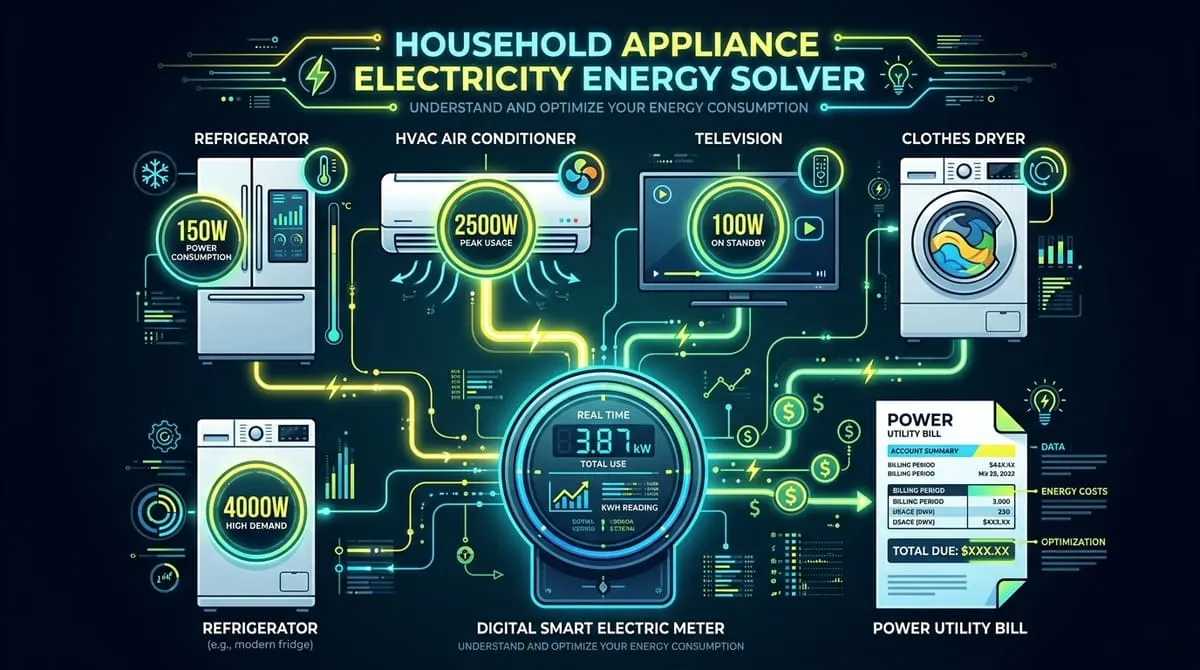
1. Introduction
Residential electricity usage accounts for over 20% of national energy consumption. Every electrical device in your home—from energy-intensive HVAC central air conditioners and electric clothes dryers to continuous refrigerators and standby electronics—draws electric power measured in Watts (W) or Kilowatts (kW). Over time, this instantaneous power draw accumulates into Kilowatt-Hours (kWh), which power utility companies bill on your monthly electric invoice.
The Household Appliance Electricity Energy Solver converts appliance power ratings (Watts), daily operation duration (hours/day), and local electric utility rates ($/kWh) into precise daily, monthly, and annual energy consumption metrics ($\text{kWh}$) and total financial operating expenses ($).
graph TD
    A[Appliance Power Rating Watts] --> B[Daily Usage Hours]
    B --> C[Daily Energy Consumption kWh = W × h / 1000]
    C --> D[Annual Kilowatt-Hour Yield kWh/year]
    D --> E[Electricity Rate $/kWh]
    E --> F[Total Annual Operating Expense $]
2. Core Definitions & Analogy
Simple Definition
An Appliance Electricity Energy Solver calculates how much electricity a specific appliance uses per day, month, or year and how much money it adds to your electric bill.
Technical Definition
Technically, cumulative energy consumption (, in ) over time period (days) is the time integral of instantaneous electric power draw ($P(t)$, in Watts):
Where is appliance active wattage and is effective daily duty cycle hours. Total operating expense (, in USD) is , where is the marginal rate per .
3. History & Milestones
timeline
    title History of Electrical Appliances & Energy Efficiency
    1882 : Thomas Edison opens Pearl Street Station, initiating commercial electric power.
    1927 : GE introduces "Monitor Top" refrigerator, starting mass household appliance era.
    1992 : EPA launches Energy Star voluntary labeling program.
    2026 : Smart meters & home energy management systems (HEMS) optimize dynamic Time-of-Use pricing.
4. Common Household Appliance Wattage Benchmarks
| Household Appliance | Typical Active Power Rating (Watts) | Average Daily Duty Hours | Annual Energy Yield (kWh/year) | Annual Cost ($0.16/kWh) |
|---|---|---|---|---|
| Central Air Conditioner (3 Ton) | 3,500 W | 6.0 hrs/day | 7,665 kWh | $1,226.40 / year |
| Electric Clothes Dryer | 4,000 W | 1.0 hr/day | 1,460 kWh | $233.60 / year |
| Space Heater (Portable) | 1,500 W | 5.0 hrs/day | 2,738 kWh | $438.00 / year |
| Modern Refrigerator (ENERGY STAR) | 150 W (Compressor Cycle) | 8.0 hrs duty cycle | 438 kWh | $70.08 / year |
| Gaming PC & Monitor | 400 W | 4.0 hrs/day | 584 kWh | $93.44 / year |
| LED Smart TV (55 inch) | 80 W | 5.0 hrs/day | 146 kWh | $23.36 / year |
5. The Mathematical Model & Formulas
1. Annual Kilowatt-Hour Consumption Formula ()
Where:
- = Active appliance power consumption rating ()
- = Average daily operation duration ()
- $1,000$ = Conversion constant ()
2. Annual Operating Cost Formula ()
Where is local electricity tariff rate (default $\$0.16\text{ per kWh}$).
6. Step-by-Step Computational Procedure
Consider a 1,200 Watt Portable Space Heater operated 3 hours daily at an electricity rate of $0.16 per kWh:
- Calculate Daily Energy Consumption: .
- Calculate Monthly Energy Consumption: .
- Calculate Annual Energy Consumption: .
- Calculate Annual Financial Operating Cost: $1,314.9\text{ kWh} \times \$0.16/\text{kWh} = \$210.38\text{ / year}$.
7. Visual Explanations & Parameter Comparison Matrix
| Appliance Wattage | Daily Hours Used | Daily kWh | Annual kWh | Monthly Operating Cost ($0.16/kWh) | Annual Operating Cost ($0.16/kWh) |
|---|---|---|---|---|---|
| 100 W (Laptop/TV) | 5 hrs/day | 0.5 kWh | 182.6 kWh | $2.43 / month | $29.22 / year |
| 1,200 W (Space Heater) | 3 hrs/day | 3.6 kWh | 1,314.9 kWh | $17.53 / month | $210.38 / year |
| 3,500 W (Central HVAC) | 8 hrs/day | 28.0 kWh | 10,227.0 kWh | $136.36 / month | $1,636.32 / year |
9. Real-World Applications & Case Studies
- Vampire / Phantom Load Reduction: Unplugging chargers and electronics in standby mode saves 10% on electric bills.
- Appliance Replacement Financial Audits: Upgrading an old 1990s refrigerator () to a modern Energy Star unit () saves $\$136\text{/year}$, paying off the fridge upgrade in 5 years.
- Case Study: A household replaced ten 60W incandescent light bulbs with 8W LED bulbs used 5 hours daily. Energy consumption dropped from to , saving $151.84 on annual power bills.
10. Advantages & Limitations
Advantages
- Pinpoints exact high-consumption appliances driving up monthly electric bills.
- Evaluates payback period for high-efficiency Energy Star appliance upgrades.
Limitations
- Thermostatically controlled appliances (refrigerators, AC units, water heaters) cycle on and off; active compressor hours differ from total plug hours.
11. Common Pitfalls
Pitfall 1: Confusing Maximum Rated Nameplate Wattage with Average Active Wattage
A microwave rated at draws only when heating, but when resting. A refrigerator rated at peak compressor draw averages only active over 24 hours.
12. Frequently Asked Questions (FAQ)
Q: What is a Kilowatt-Hour (kWh)?
A: A Kilowatt-Hour is a unit of energy equal to using of electric power continuously for 1 hour.
Q: How much does 1 kWh of electricity cost in the US?
A: The average US residential electricity rate is approximately 16 cents ($0.16) per kWh, ranging from $10\text{ cents}$ (Washington state) to $35+\text{ cents}$ (California/Hawaii).
Q: What is Phantom or Vampire Load?
A: Electricity drawn by electronics (TVs, gaming consoles, chargers, microwave clocks) while turned off but plugged in ( of residential power bills).
Q: What appliances consume the most electricity in a home?
A: Heating & Air Conditioning (HVAC, ), Electric Water Heater (), Clothes Dryer (), and Refrigerator ().
Q: Does an Energy Star rating really save money?
A: Yes! ENERGY STAR certified appliances consume 10% - 50% less energy than standard models.
Q: How do I find an appliance's wattage rating?
A: Look at the UL safety label or metal nameplate stamped on the back or bottom of the appliance, which lists Volts () and Amps (). Power (Watts) = .
Q: How do I measure exact appliance power draw?
A: Plug the appliance into a Kill-A-Watt electricity usage monitor meter.
Q: What is Time-of-Use (TOU) electricity pricing?
A: A utility billing rate where electricity costs more during peak demand hours (e.g. 4 PM - 9 PM) and less off-peak.
Q: Does running a ceiling fan lower air conditioning costs?
A: Ceiling fans cool people, not rooms. Running a fan () allows you to set the AC thermostat 4 degrees higher with equal comfort.
Q: How much electricity does a space heater use?
A: Standard 1,500W space heaters cost approximately $0.24 per hour to operate.
Q: How can I lower my electric bill quickly?
A: Switch to LED lighting, lower water heater temp to , use smart power strips, and adjust AC thermostat by 2 degrees.
Q: Is this calculator free?
A: Yes, 100% free for homeowners and renters.
13. Expert Tips & Summary
- Tip: Connect entertainment centers and home computer desks to smart power strips that automatically cut standby power when main device turns off.
Additional Technical Guidelines & Measurement Standards
When conducting calculations for Household Appliance Electricity Energy Solver, maintaining quantitative precision and verifying input parameter boundaries is essential for reliable scenario evaluation. Always verify that raw numerical inputs are measured using standardized instrumentation, and double-check unit conversions prior to applying outputs in commercial, industrial, or academic projects.
For quantitative unit conversions and scientific calculations, always maintain at least four decimal places of precision during intermediate arithmetic stages before rounding final results. When preparing technical reports, laboratory documentation, or financial forecasts, cross-verify all output variables against established international measurement standards (such as SI, NIST, and ISO metric benchmarks) to guarantee consistent analytical rigor across all computational workflows.
MathsLover.com delivers this interactive solver 100% free of charge to foster global mathematical literacy, educational accessibility, and data-driven problem solving across scientific, technical, and academic communities worldwide.