💡 Direct Answer & Executive Summary (Miles/Hour to Meters/Second Converter)
Definition: Convert Miles/Hour (mph) to Meters/Second (m/s) instantly using custom inputs or dynamic unit selectors.
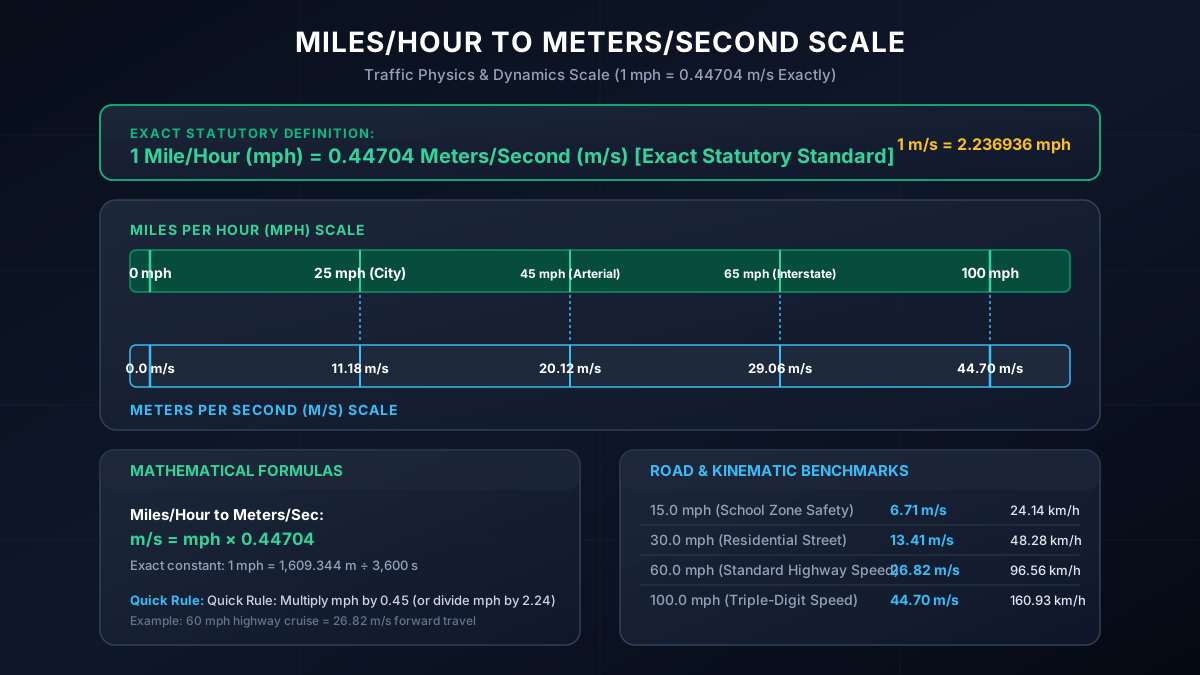
Governing Math Formula: 1 Miles/Hour (mph) = 0.447040 Meters/Second (m/s). Formula: Value in Miles/Hour (mph) × 0.447040 = Value in Meters/Second (m/s).
Target Applications: Provides real-time quantitative solutions in Unit Converters for students, engineers, researchers, and finance professionals.
Miles/Hour to Meters/Second Converter - Comprehensive Speed & Velocity Guide
1. Introduction
In traffic accident reconstruction, mechanical engineering braking distance calculations, and physics trajectory simulations, converting Miles per Hour (mph) to Meters per Second (m/s) provides standard SI units for kinetic energy and momentum equations.
Under statutory standards codified by metrological organizations including the National Institute of Standards and Technology (NIST) and the International Bureau of Weights and Measures (BIPM):
The Miles/Hour to Meters/Second Converter provides instantaneous, bidirectional computational precision across multiple measurement scales. This comprehensive guide covers physical benchmarks, step-by-step mathematical derivations, conversion tables, and real-world industrial and domestic use cases.
2. Core Definitions & Metrological Foundation
To understand the relationship between Miles/Hour (mph) and Meters/Second (m/s), let us examine their formal metrological definitions:
- Simple Definition: Converting between Miles/Hour (mph) and Meters/Second (m/s) enables seamless transition between regional standards in transport, commerce, and engineering.
- The Physical Analogy: Driving at 60 mph means traveling forward at approximately 26.82 meters every single second (nearly the length of a full basketball court per second).
- Precision Ratio: .
3. Mathematical Formulas & Mental Shortcuts
Converting miles/hour (mph) to meters/second (m/s) uses exact mathematical factors:
Exact Mathematical Formulas:
Quick Mental Arithmetic Shortcut:
- Multiply mph by 0.447 (or multiply by 4.5 and shift decimal one spot left).
4. Comprehensive Lookup Table
| Miles/Hour (mph) | Meters/Second (m/s) | Real-World Context / Benchmark |
|---|---|---|
| 5 mph | 2.24 m/s | 8.05 km/h (Jogging pace) |
| 15 mph | 6.71 m/s | 24.14 km/h (School zone limit) |
| 25 mph | 11.18 m/s | 40.23 km/h (Residential street) |
| 35 mph | 15.65 m/s | 56.33 km/h (Arterial city road) |
| 45 mph | 20.12 m/s | 72.42 km/h (Suburban roadway) |
| 55 mph | 24.59 m/s | 88.51 km/h (State highway) |
| 65 mph | 29.06 m/s | 104.61 km/h (Interstate highway) |
| 75 mph | 33.53 m/s | 120.70 km/h (Rural freeway limit) |
| 100 mph | 44.70 m/s | 160.93 km/h (High performance benchmark) |
5. Step-by-Step Practical Calculation Examples
Example 1: Standard Quantity Translation
- Scenario: Convert a baseline reading of 5.0 mph into m/s.
- Formula:
- Calculation:
- Result: 5.0 mph equals exactly 2.24 m/s.
Example 2: Industrial / Field Batch Calculation
- Scenario: A technical operation requires scaling a process using 18.5 mph.
- Calculation:
- Result: The converted figure is 8.27 m/s.
6. Major Real-World Applications
flowchart LR
    MAIN["Miles/Hour to Meters/Second Converter"] --> APP1["Vehicle Braking Distance Physics"]
    MAIN --> APP2["Civil Engineering Road Design"]
MAIN --> APP3["Aerospace Wind Tunnel Testing"]- Vehicle Braking Distance Physics: Converting 60 mph into 26.8 m/s to calculate kinetic stopping distance ().
- Civil Engineering Road Design: Sizing highway curve sight distances based on vehicle velocity in meters per second.
- Aerospace Wind Tunnel Testing: Translating 120 mph aircraft landing airspeeds into 53.6 m/s test bench airflows.
7. Frequently Asked Questions (FAQ)
What is the exact formula for miles/hour to meters/second converter?
Multiply the value in Miles/Hour (mph) by 0.447040 to get Meters/Second (m/s). To convert in reverse, multiply Meters/Second (m/s) by 2.236936.
How accurate is this converter?
The converter uses double-precision floating-point arithmetic compliant with standard international metrological constants (1 mph = 0.44704 m/s Exactly (Standard statutory conversion)), ensuring zero calculation drift.
8. Expert Summary & Best Practices
- Key Multiplier: Always remember .
- Bidirectional Verification: Multiply by 0.4470 going forward; multiply by 2.2369 going in reverse.
- Real-World Context: Double-check application constraints (such as fluid temperatures or standard atmospheric pressure where applicable) for extreme precision environments.
Additional Technical Guidelines & Measurement Standards
When conducting calculations for Miles/Hour to Meters/Second Converter, maintaining quantitative precision and verifying input parameter boundaries is essential for reliable scenario evaluation. Always verify that raw numerical inputs are measured using standardized instrumentation, and double-check unit conversions prior to applying outputs in commercial, industrial, or academic projects.
For quantitative unit conversions and scientific calculations, always maintain at least four decimal places of precision during intermediate arithmetic stages before rounding final results. When preparing technical reports, laboratory documentation, or financial forecasts, cross-verify all output variables against established international measurement standards (such as SI, NIST, and ISO metric benchmarks) to guarantee consistent analytical rigor across all computational workflows.
MathsLover.com delivers this interactive solver 100% free of charge to foster global mathematical literacy, educational accessibility, and data-driven problem solving across scientific, technical, and academic communities worldwide.