💡 Direct Answer & Executive Summary (Millimeters to Meters Converter)
Definition: Convert Millimeters (mm) to Meters (m) instantly using custom inputs or dynamic unit selectors.
Governing Math Formula: 1 Millimeters (mm) = 0.001000 Meters (m). Formula: Value in Millimeters (mm) × 0.001000 = Value in Meters (m).
Target Applications: Provides real-time quantitative solutions in Unit Converters for students, engineers, researchers, and finance professionals.
Millimeters to Meters Converter - Precision Metric Guide
1. Introduction
In mechanical manufacturing, architectural building drafting, civil structural design, 3D printing engineering, and physics laboratory calculations, converting Millimeters (mm) to Meters (m) is the primary conversion that transforms precision mechanical tolerances into SI base metric units.
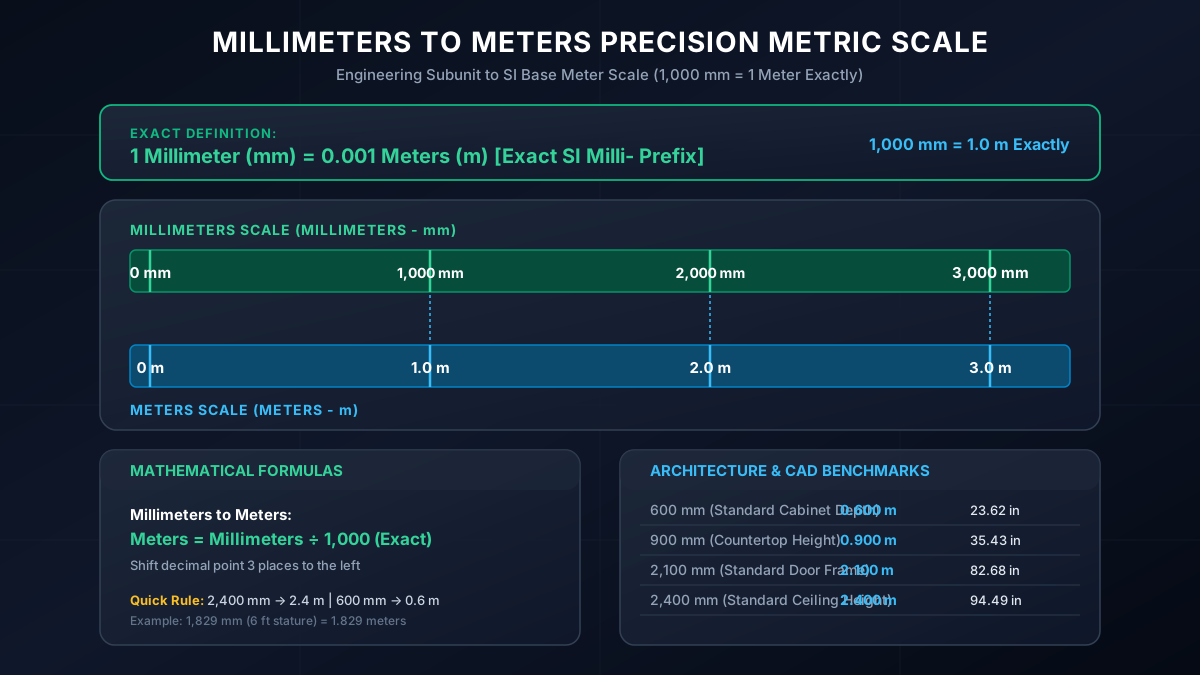
The Meter is the foundational base unit of length in the International System of Units (SI). The prefix Milli- represents an exact factor of one-thousandth () (). Therefore, converting millimeters to meters requires dividing by 1,000 (shifting the decimal point 3 places to the left).
The Millimeters to Meters Converter provides instant, bidirectional calculation across millimeters, meters, centimeters, inches, and feet. This comprehensive guide covers architectural CAD drafting standards, lumber dimensions, sheet goods specifications, fast mental math rules, and engineering tolerance matrices.
2. Core Definitions & Analogy
To develop an intuitive physical grasp of millimeter-to-meter scaling, let us review their core definitions:
- Simple Definition: A millimeter is a small metric unit of length (about the thickness of an ID card), while a meter is the metric base unit (roughly 3.28 feet). There are exactly 1,000 millimeters in 1 meter.
- Technical Definition: The Millimeter ():* Defined as ().The Meter ():* Defined as the distance traveled by light in a vacuum in $1 / 299,792,458$ seconds.
- The Meter Stick Tick Marks Analogy: Take a standard 1-meter wooden measuring stick. Along its edge, you will see 100 major centimeter marks. Between each centimeter mark are 10 tiny, razor-thin subdivisions. There are exactly 1,000 of those tiny subdivisions (millimeters) across the entire 1-meter stick.
3. The Base-10 Decimal Advantage
The metric system allows scaling without fractions or odd integer divisors:
flowchart LR
    MM["Millimeter (mm)
1/1,000 m (10⁻³ m)"] -->|× 10| CM["Centimeter (cm)
1/100 m (10⁻² m)"]
    CM -->|× 10| DM["Decimeter (dm)
1/10 m (10⁻¹ m)"]
    DM -->|× 10| M["Meter (m)
1 m (SI Base Unit)"]
Because 1 millimeter equals , converting millimeters to meters involves simply moving the decimal point three places to the left, guaranteeing zero arithmetic rounding errors.
4. The Mathematical Formulas
Converting millimeters to meters is direct, linear, and exact:
Exact Mathematical Formulas:
Fast Mental Arithmetic (Shift Left 3 Places):
- To convert any millimeter measurement to meters, shift the decimal point 3 positions to the left:Example (2,400 mm): (Standard ceiling framing!)*.Example (600 mm): (Cabinet depth!)*.Example (900 mm): (Kitchen countertop height!)*.Example (1,829 mm): (6 ft human stature!)*.
5. Comprehensive Millimeters to Meters Lookup Table
| Millimeters () | Meters () | Centimeters () | Inches () | Feet & Inches ($ft\ in$) | Architecture & CAD Context |
|---|---|---|---|---|---|
| 1 mm | 0.001 m | 0.1 cm | 0.0394 in | 0 ft 0.04 in | Credit card thickness |
| 10 mm | 0.010 m | 1.0 cm | 0.3937 in | 0 ft 0.39 in | Standard paperclip width |
| 100 mm | 0.100 m | 10.0 cm | 3.9370 in | 0 ft 3.94 in | 4-inch PVC pipe diameter |
| 304.8 mm | 0.3048 m | 30.48 cm | 12.0000 in | 1 ft 0 in (Exact) | 1 International Foot |
| 500 mm | 0.500 m | 50.0 cm | 19.6850 in | 1 ft 7.69 in | Half-meter baseline |
| 600 mm | 0.600 m | 60.0 cm | 23.6220 in | 1 ft 11.62 in | Standard kitchen base cabinet depth |
| 900 mm | 0.900 m | 90.0 cm | 35.4331 in | 2 ft 11.43 in | Standard kitchen countertop height |
| 1,000 mm | 1.000 m | 100.0 cm | 39.3701 in | 3 ft 3.37 in | 1 SI Base Meter |
| 1,200 mm | 1.200 m | 120.0 cm | 47.2441 in | 3 ft 11.24 in | Standard sheet goods width (4 ft = 1,219 mm) |
| 1,500 mm | 1.500 m | 150.0 cm | 59.0551 in | 4 ft 11.06 in | Standard bathtub length (5 ft = 1,524 mm) |
| 2,100 mm | 2.100 m | 210.0 cm | 82.6772 in | 6 ft 10.68 in | Standard residential interior door height |
| 2,400 mm | 2.400 m | 240.0 cm | 94.4882 in | 7 ft 10.49 in | Standard 8-foot ceiling framing height |
| 3,000 mm | 3.000 m | 300.0 cm | 118.1102 in | 9 ft 10.11 in | 3-meter commercial ceiling span |
| 6,000 mm | 6.000 m | 600.0 cm | 236.2205 in | 19 ft 8.22 in | Standard structural steel beam length |
6. Step-by-Step Practical Calculation Examples
Example 1: Architectural Blueprint Room Area
- Scenario: An architectural CAD drawing specifies a conference room with dimensions 7,500 mm in length by 4,200 mm in width. Calculate the floor area in square meters ().
- Step 1 (Convert mm to m):
- Step 2 (Calculate Floor Area):
Example 2: Structural Steel Beam Deflection
- Scenario: A structural beam has an allowable deflection limit of 15 mm. How is this deflection expressed in standard meters for finite element analysis software?
- Calculation:
7. Major Architectural & Engineering Applications
flowchart LR
    MM2M["Millimeters to Meters Conversion"] --> BIM["BIM & Architecture: Revit & AutoCAD floor plans (all callouts in mm) to site meters"]
    MM2M --> STRUCT["Structural Engineering: Beam deflection limits & rebar spacing"]
    MM2M --> MFG["Machining & Tooling: Component manufacturing drafts to assembly meters"]
MM2M --> FAB["Textiles & Plastics: Extrusion profile cross-sections to roll lengths"]- Architectural Drafting Conventions: In countries using the metric system (Europe, Australia, Asia), all architectural floor plans, door schedules, and window callouts are drawn strictly in millimeters () without writing the unit suffix ().
- Structural Rebar Spacing: Civil engineering drawings specify reinforcing steel bar spacing in millimeters (e.g. on-center), which structural estimators convert to linear meters of steel.
- Finite Element Analysis (FEA): Mechanical simulation software (ANSYS, SolidWorks Simulation) requires geometry converted to SI base meters to calculate stress in Pascals ().
8. Frequently Asked Questions (FAQ)
- How many meters is 2,500 millimeters?.
- Why do architects use millimeters instead of meters?Using millimeters eliminates all decimal points on blueprints (e.g., writing instead of $2.40$), reducing the risk of costly misreadings on construction sites.
- What is the formula to convert mm to meters?Divide millimeters by 1,000 ().
9. Expert Summary & Best Practices
- Divide by 1,000: Always divide millimeters by $1,000$ (or shift the decimal point 3 places left).
- Blueprint Literacy: Remember that on international architectural drawings, numbers without units represent millimeters.
- Exact Decimal Conversion: Because $1,000$ is an exact integer divisor, converting millimeters to meters never introduces rounding errors.
Additional Technical Guidelines & Measurement Standards
When conducting calculations for Millimeters to Meters Converter, maintaining quantitative precision and verifying input parameter boundaries is essential for reliable scenario evaluation. Always verify that raw numerical inputs are measured using standardized instrumentation, and double-check unit conversions prior to applying outputs in commercial, industrial, or academic projects.
For quantitative unit conversions and scientific calculations, always maintain at least four decimal places of precision during intermediate arithmetic stages before rounding final results. When preparing technical reports, laboratory documentation, or financial forecasts, cross-verify all output variables against established international measurement standards (such as SI, NIST, and ISO metric benchmarks) to guarantee consistent analytical rigor across all computational workflows.
MathsLover.com delivers this interactive solver 100% free of charge to foster global mathematical literacy, educational accessibility, and data-driven problem solving across scientific, technical, and academic communities worldwide.