💡 Direct Answer & Executive Summary (Millimeters to Inches Converter)
Definition: Convert Millimeters (mm) to Inches (in) instantly using custom inputs or dynamic unit selectors.
Governing Math Formula: 1 Millimeters (mm) = 0.039370 Inches (in). Formula: Value in Millimeters (mm) × 0.039370 = Value in Inches (in).
Target Applications: Provides real-time quantitative solutions in Unit Converters for students, engineers, researchers, and finance professionals.
Millimeters to Inches Converter - Precision Machining & Caliper Guide
1. Introduction
In mechanical manufacturing, computer numerical control (CNC) machining, automotive parts tooling, surgical instrument design, and 3D printing engineering, converting Millimeters (mm) to Inches (in) is the most common high-precision dimensional conversion performed worldwide.
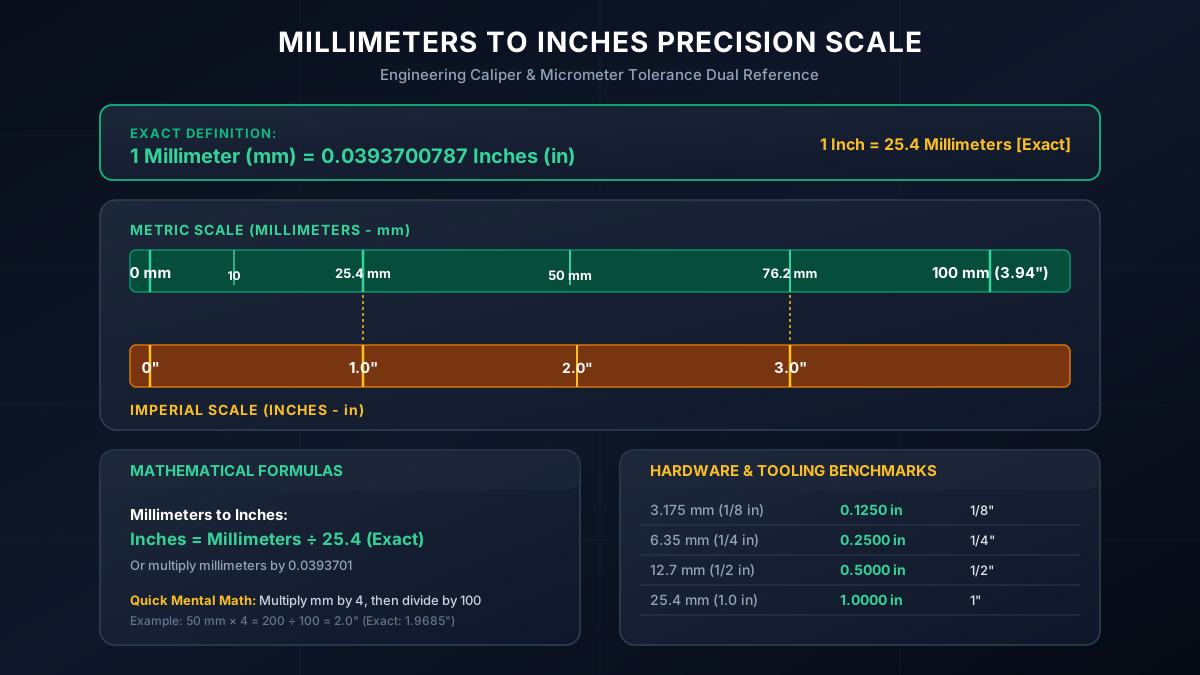
The Millimeter is the metric (SI) workhorse unit of engineering tolerance and mechanical drafts, representing one-thousandth () of a meter. The Inch is the cornerstone of US Customary engineering, subdivided into decimal thousandths (called "mils" or "thou", ) and fractional powers of two ($1/2, 1/4, 1/8, 1/16, 1/32, 1/64$).
Under the 1959 International Yard and Pound Agreement:
The Millimeters to Inches Converter provides instant, bidirectional micro-dimensional calculations across decimal millimeters, decimal inches, fractional inches, and engineering thousandths of an inch (thou/mils). This guide covers fastener threads, caliper measurements, PCB trace widths, mental arithmetic rules, and engineering tolerance standards.
2. Core Definitions & Analogy
To develop an intuitive physical grasp of tiny linear dimensions, let us review their core definitions:
- Simple Definition: A millimeter is a tiny metric unit of length (about the thickness of an ID card or credit card), while an inch is an imperial unit of length (about the width of an adult thumb). One millimeter equals roughly 0.039 inches (just under four-hundredths of an inch).
- Technical Definition: The Millimeter ():* A sub-multiple of the SI base unit meter ().The Inch ():* Defined internationally since 1959 as exactly .The Mil / Thou ():* Exactly ().
- The Credit Card Stack Analogy: Take a standard plastic credit card—its thickness is approximately 0.76 to 1.0 millimeter. If you stack 25 credit cards tightly on top of one another, the height of the entire stack will measure almost exactly 1 imperial inch ().
3. The Mathematical Formulas
Converting millimeters to inches is direct and exact:
Exact Mathematical Formulas:
Converting Millimeters to Fractional Inches ( Precision):
- Compute decimal inches:
- Extract whole inches:
- Compute fractional 64ths:
- Reduce the fraction to lowest terms (e.g. , , ).
Quick Mental Arithmetic Shortcut:
- Multiply mm by 4, then divide by 100 (0.04x estimate):Example (25 mm): (Exact: )*.Example (12 mm): (Exact: )*.
4. Comprehensive Millimeters to Inches Lookup Table
| Millimeters () | Decimal Inches () | Fractional Inches (Nearest 64th) | Mils / Thou () | Common Hardware & Tooling Context |
|---|---|---|---|---|
| 0.1 mm | 0.0039 in | 1/256 in | 3.94 mils | Thickness of a sheet of copy paper |
| 0.5 mm | 0.0197 in | 1/64 in | 19.69 mils | 0.5mm mechanical pencil lead |
| 1.0 mm | 0.0394 in | 3/64 in | 39.37 mils | 1 mm standard credit card thickness |
| 3.0 mm | 0.1181 in | 1/8 in | 118.11 mils | 3mm acrylic sheet / M3 machine screw |
| 3.175 mm | 0.1250 in | 1/8 in (Exact) | 125.00 mils | 1/8" audio headphone jack / drill bit |
| 5.0 mm | 0.1969 in | 3/16 in | 196.85 mils | 5mm LED component / M5 bolt |
| 6.350 mm | 0.2500 in | 1/4 in (Exact) | 250.00 mils | 1/4" guitar plug / hex socket bit |
| 9.525 mm | 0.3750 in | 3/8 in (Exact) | 375.00 mils | 3/8" socket drive ratchet |
| 10.0 mm | 0.3937 in | 25/64 in | 393.70 mils | 10mm automotive wrench socket |
| 12.700 mm | 0.5000 in | 1/2 in (Exact) | 500.00 mils | 1/2" copper plumbing pipe / bolt |
| 19.050 mm | 0.7500 in | 3/4 in (Exact) | 750.00 mils | 3/4" garden hose fitting / plywood |
| 25.400 mm | 1.0000 in | 1 in (Exact) | 1,000.00 mils | 1-inch standard bolt diameter |
| 50.0 mm | 1.9685 in | 1 31/32 in | 1,968.50 mils | 50mm camera lens focal length |
| 50.8 mm | 2.0000 in | 2 in (Exact) | 2,000.00 mils | 2-inch structural steel square tubing |
| 100.0 mm | 3.9370 in | 3 15/16 in | 3,937.01 mils | 100mm macro photography lens / 10 cm |
5. Step-by-Step Practical Calculation Examples
Example 1: Selecting a Drill Bit for an M8 Metric Bolt
- Scenario: A machinist needs to clear a hole for an 8.0 mm bolt using an imperial fractional drill bit set.
- Step 1 (Convert to Decimal Inches):
- Step 2 (Find Nearest 32nd):
- Verification: (a snug fit). A 21/64 in () bit provides standard clearance.
Example 2: PCB Circuit Board Trace Thickness
- Scenario: An electrical engineer specifies a standard copper layer weight of 1 oz/ft², which has a metric thickness of 0.035 mm (35 microns). What is this trace thickness in mils (thou)?
- Calculation:
6. Major Real-World Applications
flowchart LR
    MMTI["Millimeters to Inches Conversion"] --> MACH["Precision Machining: Translating ISO metric drawings to US imperial machine tools"]
    MMTI --> PCB["Electronics & PCB Design: Component lead spacing & PCB trace pitch (2.54mm = 0.1 in)"]
    MMTI --> MED["Medical Devices: Hypodermic needle gauge & catheter lumens"]
MMTI --> AUTO["Automotive: Wrench socket sizing (e.g. 13mm approx 1/2 in, 19mm approx 3/4 in)"]- CNC Mill Tool Offsets: CNC machinists programming Haas or Fanuc controllers routinely convert digital drawing millimeter callouts to imperial inch tool offsets when using inch endmills.
- Surface Mount Electronics (SMD): Integrated circuit packages use metric lead pitch (0.5 mm, 0.65 mm, 1.27 mm), where corresponds exactly to 50 mils (0.050 in).
- Automotive Socket Sizes: Mechanics know which metric and imperial wrench sockets cross-interchange:* ()* ()* ()* ()
7. Frequently Asked Questions (FAQ)
- Is 25.4 mm exactly equal to 1 inch?Yes. Under international law and physics standards, is an exact algebraic integer constant.
- How many millimeters are in 1 mil (thou)?.
- How do you convert millimeters to fractional inches on a tape measure?Divide millimeters by 25.4, multiply the decimal remainder by 16 (or 32), and round to the nearest whole number.
8. Expert Summary & Best Practices
- Never Round 25.4: In computer algorithms and CAD formulas, always use $25.4$ as a fixed constant.
- Double Check G20 vs G21: In G-code CNC machining, executing a program written in millimeters under G20 inch mode will crash the machine tool (25.4x scaling disaster).
- Use Digital Calipers with Dual Modes: Modern digital vernier calipers feature an instant metric/imperial toggle button that uses this exact internal $25.4$ conversion matrix.
Additional Technical Guidelines & Measurement Standards
When conducting calculations for Millimeters to Inches Converter, maintaining quantitative precision and verifying input parameter boundaries is essential for reliable scenario evaluation. Always verify that raw numerical inputs are measured using standardized instrumentation, and double-check unit conversions prior to applying outputs in commercial, industrial, or academic projects.
For quantitative unit conversions and scientific calculations, always maintain at least four decimal places of precision during intermediate arithmetic stages before rounding final results. When preparing technical reports, laboratory documentation, or financial forecasts, cross-verify all output variables against established international measurement standards (such as SI, NIST, and ISO metric benchmarks) to guarantee consistent analytical rigor across all computational workflows.
MathsLover.com delivers this interactive solver 100% free of charge to foster global mathematical literacy, educational accessibility, and data-driven problem solving across scientific, technical, and academic communities worldwide.