💡 Direct Answer & Executive Summary (Millimeters to Centimeters Converter)
Definition: Convert Millimeters (mm) to Centimeters (cm) instantly using custom inputs or dynamic unit selectors.
Governing Math Formula: 1 Millimeters (mm) = 0.100000 Centimeters (cm). Formula: Value in Millimeters (mm) × 0.100000 = Value in Centimeters (cm).
Target Applications: Provides real-time quantitative solutions in Unit Converters for students, engineers, researchers, and finance professionals.
Millimeters to Centimeters Converter - Precision Metric Guide
1. Introduction
In mechanical manufacturing, architectural floor plan reading, medical diagnostics, laboratory chemistry, carpentry, and 3D printing, converting Millimeters (mm) to Centimeters (cm) is the foundational decimal subunit scaling operation in the International System of Units (SI).
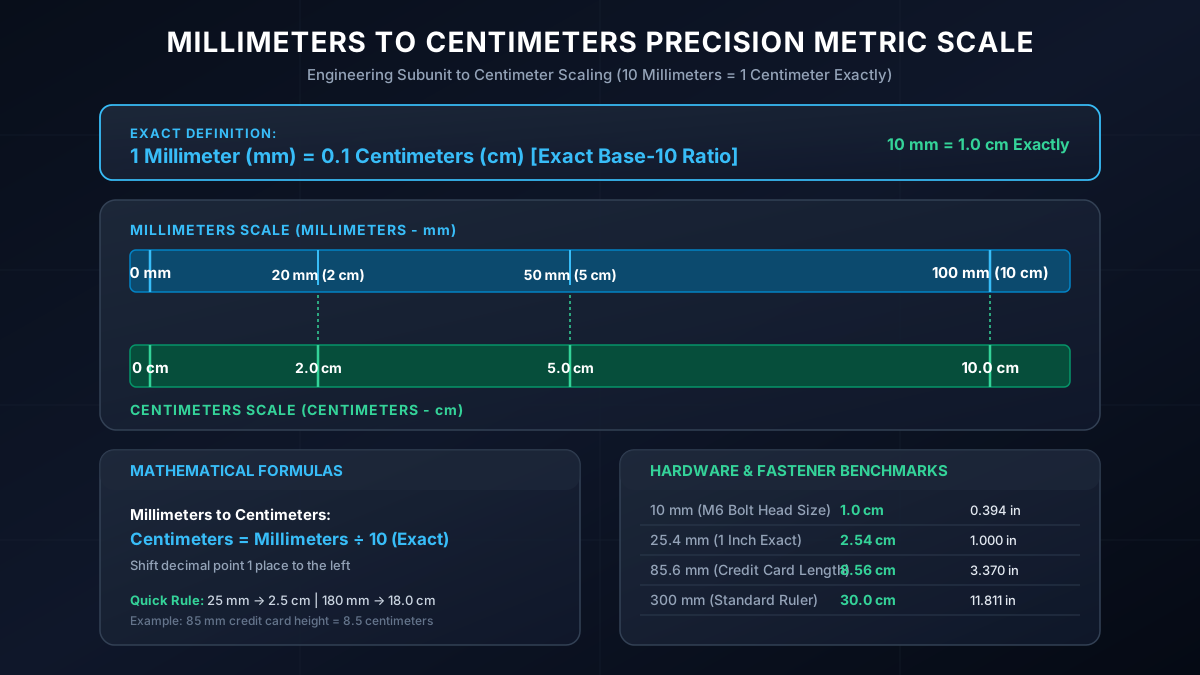
Because both units derive from the metric Meter (, ), there are exactly 10 millimeters in 1 centimeter. Therefore, converting millimeters to centimeters requires dividing by 10 (shifting the decimal point 1 place to the left).
The Millimeters to Centimeters Converter provides instant, bidirectional calculation across millimeters, centimeters, meters, and inches. This guide explores hardware bolt diameters, school ruler increments, garment sizing, fast mental math rules, and engineering tolerance specifications.
2. Core Definitions & Analogy
To understand decimal subunit scaling in the SI metric system, let us review their core definitions:
- Simple Definition: A millimeter is a tiny unit of length (about the thickness of an ID card), while a centimeter is a larger unit equal to 10 millimeters (about the width of a paperclip). To find how many centimeters are in a given number of millimeters, you divide by 10.
- Technical Definition: The Millimeter ():* Defined as ().The Centimeter ():* Defined as ().
- The Dime and Dollar Analogy: Think of millimeters like 10-cent dimes and centimeters like a single 1-dollar coin. Just as it takes 10 dimes to make $1, it takes 10 millimeters to make 1 centimeter. If you have 85 millimeters, you have 8.5 centimeters.
3. The Base-10 Decimal System
The metric system eliminates awkward fractions:
flowchart LR
    MM["Millimeter (mm)
1 mm (10⁻³ m)"] -->|÷ 10| CM["Centimeter (cm)
10 mm = 1 cm (10⁻² m)"]
    CM -->|÷ 100| M["Meter (m)
100 cm = 1 m (SI Base Unit)"]
Because 1 centimeter equals exactly , converting millimeters to centimeters involves simply moving the decimal point one place to the left, guaranteeing zero arithmetic rounding errors.
4. The Mathematical Formulas
Converting millimeters to centimeters is direct, linear, and exact:
Exact Mathematical Formulas:
Fast Mental Arithmetic (Shift Left 1 Place):
- To convert millimeters to centimeters, shift the decimal point 1 position to the left:Example (25.4 mm): (1 inch exact!)*.Example (85.6 mm): (Credit card length!)*.Example (300 mm): (1-foot ruler!)*.Example (1,000 mm): (1 meter!)*.
5. Comprehensive Millimeters to Centimeters Lookup Table
| Millimeters () | Centimeters () | Meters () | Inches () | Real-World Context |
|---|---|---|---|---|
| 1 mm | 0.1 cm | 0.001 m | 0.0394 in | Credit card thickness |
| 5 mm | 0.5 cm | 0.005 m | 0.1969 in | Standard pencil lead / notebook grid spacing |
| 10 mm | 1.0 cm | 0.010 m | 0.3937 in | Standard paperclip width |
| 20 mm | 2.0 cm | 0.020 m | 0.7874 in | M20 structural bolt size |
| 25.4 mm | 2.54 cm | 0.0254 m | 1.0000 in | 1 International Inch (Exact) |
| 50 mm | 5.0 cm | 0.050 m | 1.9685 in | 2-inch PVC plumbing pipe |
| 85.6 mm | 8.56 cm | 0.0856 m | 3.3701 in | Standard credit card length |
| 100 mm | 10.0 cm | 0.100 m | 3.9370 in | 1 decimeter |
| 150 mm | 15.0 cm | 0.150 m | 5.9055 in | 6-inch vernier caliper scale |
| 200 mm | 20.0 cm | 0.200 m | 7.8740 in | 8-inch chef's knife blade |
| 300 mm | 30.0 cm | 0.300 m | 11.8110 in | Standard 30 cm plastic school ruler |
| 500 mm | 50.0 cm | 0.500 m | 19.6850 in | Half-meter bench length |
| 1,000 mm | 100.0 cm | 1.000 m | 39.3701 in | 1 SI Base Meter |
6. Step-by-Step Practical Calculation Examples
Example 1: Medical Diagnostic Radiology Report
- Scenario: A clinical ultrasound report identifies a benign gallbladder polyp measuring 6.5 mm in maximum diameter. How is this recorded in centimeters for the patient's medical summary?
- Calculation:
Example 2: Carpentry Wood Joinery Sizing
- Scenario: A cabinetmaker cuts a tenon joint measuring 45 mm in depth. What is this measurement in centimeters on the metric tape rule?
- Calculation:
7. Major Engineering & Practical Applications
flowchart LR
    MM2C["Millimeters to Centimeters Conversion"] --> HARDWARE["Hardware: Converting bolt callouts (M10 = 10 mm = 1.0 cm) to drill sizes"]
    MM2C --> CLINICAL["Medicine: Ultrasound & pathology organ dimensions (mm to cm)"]
    MM2C --> SCHOOL["Education: Teaching primary metric decimal subdivisions on classroom rulers"]
MM2C --> PACK["Packaging: Consumer carton dimensions from manufacturing mm to retail cm"]- Hardware & Fasteners: Metric socket sets and wrench sizes are specified in millimeters (10 mm = 1 cm, 13 mm = 1.3 cm, 17 mm = 1.7 cm).
- Retail Packaging Specifications: Product manufacturing lines measure box dimensions in millimeters while retail eCommerce specs list dimensions in centimeters ().
- Apparel Tailoring: Garment fit guides convert sleeve millimeter seam allowances to centimeter pattern lines.
8. Frequently Asked Questions (FAQ)
- How many centimeters is 50 millimeters?.
- What is the formula to convert mm to cm?Divide the number of millimeters by 10 ().
- Why is dividing by 10 exact?Because the metric system is a base-10 positional system where 1 centimeter is defined as containing exactly 10 millimeters.
9. Expert Summary & Best Practices
- Divide by 10: Divide millimeters by (or shift the decimal 1 place left).
- Decimal Notation: Always include leading zeros for fractions of a centimeter ( rather than ) in engineering and medical documents.
- Exact Precision: Base-10 conversions maintain 100% precision without truncation or rounding error.
Additional Technical Guidelines & Measurement Standards
When conducting calculations for Millimeters to Centimeters Converter, maintaining quantitative precision and verifying input parameter boundaries is essential for reliable scenario evaluation. Always verify that raw numerical inputs are measured using standardized instrumentation, and double-check unit conversions prior to applying outputs in commercial, industrial, or academic projects.
For quantitative unit conversions and scientific calculations, always maintain at least four decimal places of precision during intermediate arithmetic stages before rounding final results. When preparing technical reports, laboratory documentation, or financial forecasts, cross-verify all output variables against established international measurement standards (such as SI, NIST, and ISO metric benchmarks) to guarantee consistent analytical rigor across all computational workflows.
MathsLover.com delivers this interactive solver 100% free of charge to foster global mathematical literacy, educational accessibility, and data-driven problem solving across scientific, technical, and academic communities worldwide.