💡 Direct Answer & Executive Summary (Milliliters to Cups Converter)
Definition: Convert Milliliters (mL) to Cups instantly using custom inputs or dynamic unit selectors.
Governing Math Formula: 1 Milliliters (mL) = 0.004227 Cups. Formula: Value in Milliliters (mL) × 0.004227 = Value in Cups.
Target Applications: Provides real-time quantitative solutions in Unit Converters for students, engineers, researchers, and finance professionals.
Milliliters to Cups Converter - Culinary Volume Guide
1. Introduction
In international culinary arts, baking formulation, meal preparation, dietary calorie tracking, and nutritional science, converting Milliliters (mL) to Cups translates decimal SI metric volume quantities into standard volumetric measuring cups used across domestic and commercial kitchens.
Because the cup is an informal customary measure that varies across geographic jurisdictions, standardizing the milliliter-to-cup relationship requires understanding the regional baseline:
The Milliliters to Cups Converter performs instant, high-precision bidirectional calculations between milliliters, US customary cups, metric cups, legal cups, liters, fluid ounces (fl oz), tablespoons (tbsp), and teaspoons (tsp). This comprehensive reference details everyday volume benchmarks (, , ), baking best practices, and mental division heuristics.
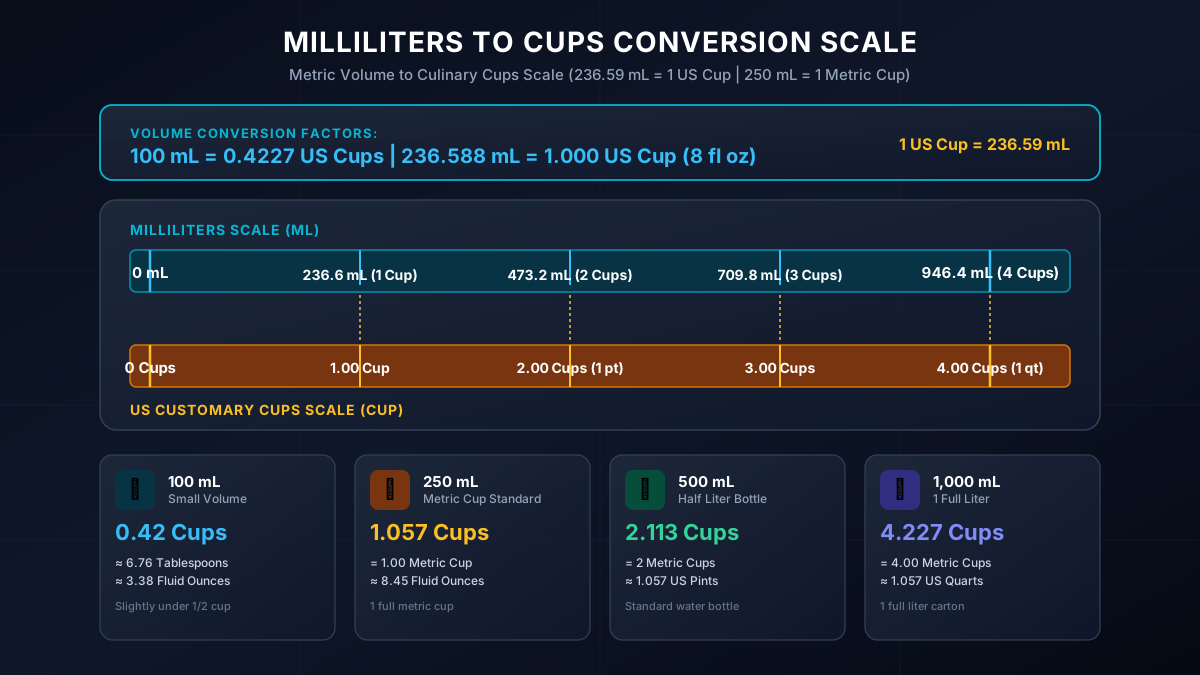
2. Core Definitions & Analogy
To understand liquid capacity conversion from milliliters to cups:
- Simple Definition: A milliliter is a small metric unit of liquid volume, while a cup is a standard kitchen measuring vessel. It takes approximately 237 milliliters to fill a single standard US measuring cup, or 250 milliliters to fill a global metric cup.
- Technical Definition:The Milliliter ():* Exactly .The US Customary Cup:* Defined as 8 US fluid ounces ().The Metric Cup:* Defined across Australia, New Zealand, Canada, and parts of the Commonwealth as ().
- The Shot Glass to Cup Analogy: If you take a standard 30 mL medicine cup or shot glass, pouring 8 full shot glasses into a measuring cup yields (almost exactly 1 full cup).
3. The Mathematical Formulas
Converting milliliters to US customary cups requires dividing by 236.588 (or 250 for metric cups):
Exact Mathematical Formulas:
Quick Mental Arithmetic (Divide by 240 or 250):
- To estimate quickly in the kitchen, divide milliliters by 240 (or divide by 250 for metric recipes):Example (120 mL): (Actual: 0.507 US cups)*.Example (180 mL): (Actual: 0.761 US cups)*.Example (500 mL): (Exact: 2.113 US cups)*.
4. Comprehensive Milliliters to Cups Lookup Table
| Milliliters () | US Customary Cups | Metric Cups | US Tablespoons () | US Fluid Ounces () | Common Cooking / Beverage Context |
|---|---|---|---|---|---|
| 15 mL | 0.063 cups | 0.060 cups | 1.0 tbsp | 0.51 fl oz | 1 standard tablespoon of vanilla / oil |
| 30 mL | 0.127 cups | 0.120 cups | 2.0 tbsp | 1.01 fl oz | 2 tablespoons (1/8 cup) / standard shot |
| 50 mL | 0.211 cups | 0.200 cups | 3.38 tbsp | 1.69 fl oz | Small miniature liquor bottle / espresso |
| 60 mL | 0.254 cups | 0.240 cups | 4.06 tbsp | 2.03 fl oz | 1/4 US Cup Benchmark |
| 80 mL | 0.338 cups | 0.320 cups | 5.41 tbsp | 2.71 fl oz | 1/3 US Cup Benchmark |
| 100 mL | 0.423 cups | 0.400 cups | 6.76 tbsp | 3.38 fl oz | Travel bottle liquid limit (TSA 3.4 oz) |
| 120 mL | 0.507 cups | 0.480 cups | 8.12 tbsp | 4.06 fl oz | 1/2 US Cup Benchmark (1 stick butter) |
| 150 mL | 0.634 cups | 0.600 cups | 10.14 tbsp | 5.07 fl oz | Standard teacup / small yogurt cup |
| 180 mL | 0.761 cups | 0.720 cups | 12.17 tbsp | 6.09 fl oz | 3/4 US Cup Benchmark |
| 200 mL | 0.845 cups | 0.800 cups | 13.53 tbsp | 6.76 fl oz | Standard juice box |
| 237 mL | 1.000 cup | 0.948 cups | 16.00 tbsp | 8.01 fl oz | Exact 1.000 US Customary Measuring Cup |
| 250 mL | 1.057 cups | 1.000 cup | 16.91 tbsp | 8.45 fl oz | Exact 1.000 Metric Cup / Standard Mug |
| 355 mL | 1.500 cups | 1.420 cups | 24.01 tbsp | 12.00 fl oz | Standard 12 fl oz soda can (1.5 cups) |
| 500 mL | 2.113 cups | 2.000 cups | 33.81 tbsp | 16.91 fl oz | Half-Liter Bottled Water (approx. 2 cups) |
| 750 mL | 3.170 cups | 3.000 cups | 50.72 tbsp | 25.36 fl oz | Standard 750 mL wine bottle (~3.17 cups) |
| 1,000 mL | 4.227 cups | 4.000 cups | 67.63 tbsp | 33.81 fl oz | 1 Full Liter / 1 Quart plus 3.5 tbsp |
5. Step-by-Step Practical Calculation Examples
Example 1: Measuring European Milk in US Measuring Cups
- Problem: An imported European dessert recipe calls for 350 mL of whole milk. You only have standard US measuring cups.
- Formula:
- Calculation:
- Result: 350 mL is almost exactly US Cups (1.48 cups).
Example 2: Converting a 650 mL Broth Can to Cups
- Problem: A can of condensed chicken broth contains 650 mL. How many US cups does this represent for soup preparation?
- Calculation:
- Result: The can provides US Cups (2.75 cups).
6. Frequently Asked Questions (FAQ)
How many cups is 500 mL?
500 mL equals 2.11 US Customary Cups (just over 2 cups and 2 teaspoons), or exactly 2.00 Metric Cups.
How many cups is 100 mL?
100 mL equals 0.42 US Cups (just under half a cup, or about 6 tablespoons + 2 teaspoons).
Why do European bakers use grams instead of cups?
Volumetric cups can vary significantly depending on how tightly dry ingredients (such as flour or brown sugar) are packed. Measuring in grams or milliliters provides exact, reproducible weight and volume precision across all recipes.
Additional Technical Guidelines & Measurement Standards
When conducting calculations for Milliliters to Cups Converter, maintaining quantitative precision and verifying input parameter boundaries is essential for reliable scenario evaluation. Always verify that raw numerical inputs are measured using standardized instrumentation, and double-check unit conversions prior to applying outputs in commercial, industrial, or academic projects.
For quantitative unit conversions and scientific calculations, always maintain at least four decimal places of precision during intermediate arithmetic stages before rounding final results. When preparing technical reports, laboratory documentation, or financial forecasts, cross-verify all output variables against established international measurement standards (such as SI, NIST, and ISO metric benchmarks) to guarantee consistent analytical rigor across all computational workflows.
MathsLover.com delivers this interactive solver 100% free of charge to foster global mathematical literacy, educational accessibility, and data-driven problem solving across scientific, technical, and academic communities worldwide.