💡 Direct Answer & Executive Summary (Miles to Feet Converter)
Definition: Convert Miles (mi) to Feet (ft) instantly using custom inputs or dynamic unit selectors.
Governing Math Formula: 1 Miles (mi) = 5280.000010 Feet (ft). Formula: Value in Miles (mi) × 5280.000010 = Value in Feet (ft).
Target Applications: Provides real-time quantitative solutions in Unit Converters for students, engineers, researchers, and finance professionals.
Miles to Feet Converter - Complete Land & Aviation Distance Guide
1. Introduction
In civil engineering, land surveying, athletic road racing, aviation flight path planning, and municipal transport design, converting Statute Miles (mi) to Feet (ft) is a standard calculation in the US Customary and Imperial measurement systems.
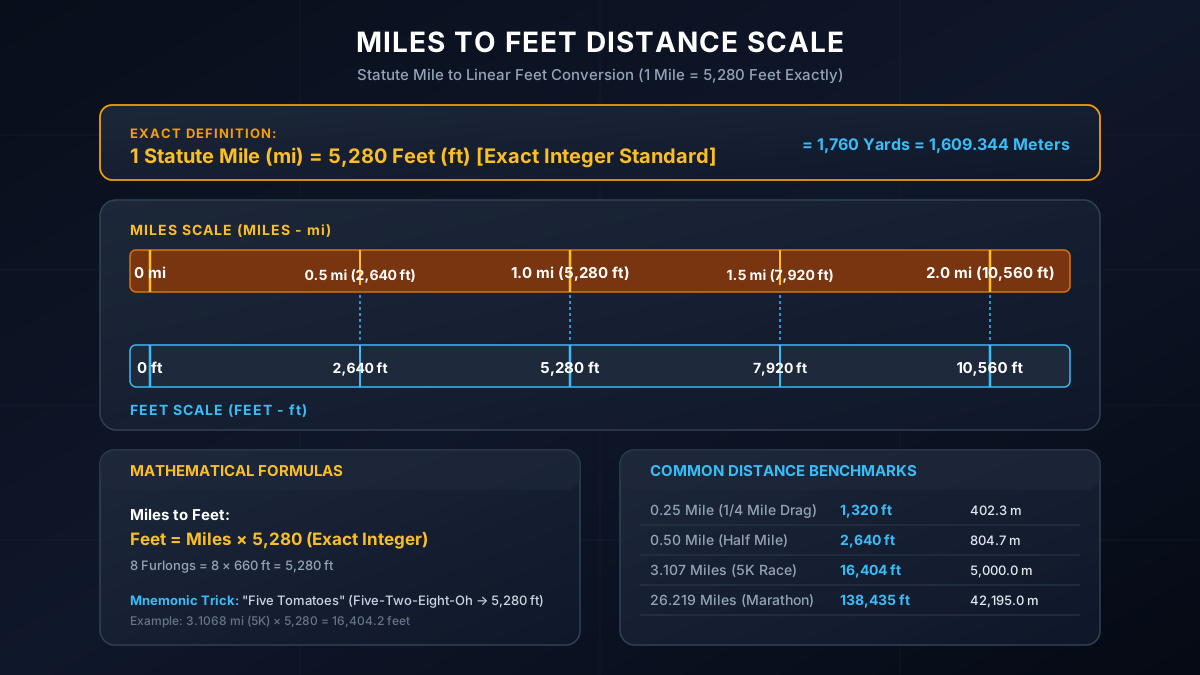
The Statute Mile is defined as containing exactly 5,280 feet (or 1,760 yards). This exact integer ratio connects large geographic travel distances down to fine feet-and-inches building dimensions and road right-of-way boundaries.
The Miles to Feet Converter provides instant, bidirectional distance calculations across statute miles, fractional miles ($1/4, 1/2, 3/4$), feet, yards, and metric equivalents ( and ). This guide explores the historical Elizabethan definition of the statute mile, highway milepost spacing, runway length standards, marathon elevation profiles, and fast mental arithmetic tricks.
2. Core Definitions & Analogy
To understand distance scaling between statute miles and linear feet, let us review their core definitions:
- Simple Definition: A mile is a large imperial unit of geographic distance (about 15 to 20 minutes of walking), while a foot is a basic linear unit (about the length of an adult shoe). One mile contains exactly 5,280 feet.
- Technical Definition: The Statute Mile ():* Codified under the 1959 International Yard and Pound Agreement as exactly ().The International Foot ():* Exactly ().
- The "Five Tomatoes" Mnemonic: To remember how many feet are in a mile, say the phrase "Five Tomatoes" aloud. It sounds like "Five - Two - Eight - Oh" !
3. History of the 5,280-Foot Statute Mile
The mile's length evolved from Roman legionary marches to English agricultural surveying:
flowchart TD
    A["Roman Empire: 1 Mille Passus = 1,000 double paces (5,000 Roman feet)"] --> B["1593: English Parliament under Queen Elizabeth I redefines Statute Mile = 8 Furlongs"]
    B --> C["1 Furlong = 660 Feet (40 rods) -> 8 Furlongs x 660 ft = 5,280 Feet Exactly"]
    C --> D["1959: International Agreement unifies 1 Mile = 5,280 ft = 1,609.344 m across US, UK & Commonwealth"]
In 1593, Queen Elizabeth I enacted a statute to prevent disputes between traditional Roman miles (5,000 ft) and agricultural land surveying units. By defining 1 mile as exactly 8 furlongs (where 1 furlong was the length of a plowed furrow, or 660 feet), the statutory mile became .
4. The Mathematical Formulas
Converting miles to feet involves exact integer multiplication:
Exact Mathematical Formulas:
Quick Mental Arithmetic (Multiply by 5.28k):
- To estimate quickly, multiply miles by 5,000, then add 5% plus a small adjustment:Example (2 miles): (Exact!)*.Example (0.5 miles): Half of 5,280 = (Exact!)*.Example (0.25 miles): Quarter of 5,280 = (1/4 mile drag strip!)*.
5. Comprehensive Miles to Feet Lookup Table
| Miles () | Feet () | Yards () | Meters () | Kilometers () | Real-World Benchmark |
|---|---|---|---|---|---|
| 0.10 mi | 528 ft | 176 yd | 160.93 m | 0.161 km | City block length |
| 0.25 mi | 1,320 ft | 440 yd | 402.34 m | 0.402 km | 1/4-Mile drag strip racing |
| 0.50 mi | 2,640 ft | 880 yd | 804.67 m | 0.805 km | Half-mile horse racing track |
| 0.75 mi | 3,960 ft | 1,320 yd | 1,207.01 m | 1.207 km | 3/4-mile distance |
| 1.00 mi | 5,280 ft | 1,760 yd | 1,609.34 m | 1.609 km | 1 Statute Mile (Historic Footrace) |
| 2.00 mi | 10,560 ft | 3,520 yd | 3,218.69 m | 3.219 km | Military PT fitness run |
| 3.107 mi | 16,404 ft | 5,468 yd | 5,000.00 m | 5.000 km | 5K Charity Road Race |
| 5.00 mi | 26,400 ft | 8,800 yd | 8,046.72 m | 8.047 km | 5-mile recreational training run |
| 6.214 mi | 32,808 ft | 10,936 yd | 10,000.00 m | 10.000 km | 10K Road Race |
| 10.00 mi | 52,800 ft | 17,600 yd | 16,093.44 m | 16.093 km | 10-mile road race |
| 13.109 mi | 69,218 ft | 23,073 yd | 21,097.50 m | 21.098 km | Official Half Marathon |
| 26.219 mi | 138,435 ft | 46,145 yd | 42,195.00 m | 42.195 km | Official Full Marathon |
| 50.00 mi | 264,000 ft | 88,000 yd | 80,467.20 m | 80.467 km | 50-mile ultra / long highway corridor |
| 100.00 mi | 528,000 ft | 176,000 yd | 160,934.40 m | 160.934 km | 100-mile endurance ultra |
6. Step-by-Step Practical Calculation Examples
Example 1: Commercial Airport Runway Length
- Scenario: An international airport runway measures 2.25 miles in length. What is this runway length in feet?
- Calculation:
- Analysis: Long commercial runways (such as Denver International 16R/34L, the longest commercial runway in North America at 16,000 ft) easily accommodate fully loaded widebody Boeing 777 and Airbus A380 aircraft.
Example 2: Land Surveying Acreage Grid
- Scenario: A standard square section of agricultural land measures 1 mile by 1 mile (640 acres). What is the perimeter of this section in feet?
- Calculation:
7. Major Real-World Applications
flowchart LR
    MTF["Miles to Feet Conversion"] --> SURVEY["Land Surveying: US Public Land Survey System (PLSS) 1-mile section grids"]
    MTF --> AVIAT["Aviation: Runway takeoff ground rolls & glideslope approach distances"]
    MTF --> ROAD["Civil Highways: Culvert spacing & guardrail linear footage requirements"]
MTF --> AUTO["Motorsports: 1/4-mile (1,320 ft) & 1/8-mile (660 ft) drag strips"]- US Public Land Survey System (PLSS): Township grids in the western and midwestern United States are divided into 1-mile square "sections" ().
- Drag Racing Strips: NHRA professional Top Fuel and Funny Car drag racing tracks measure either 1,000 feet () or the traditional 1/4 mile (1,320 feet).
- Denver "Mile High City": Denver, Colorado sits at an official elevation of 5,280 feet above sea level, marked on the 13th step of the Colorado State Capitol building.
8. Frequently Asked Questions (FAQ)
- Why is 1 mile equal to 5,280 feet instead of 5,000?Queen Elizabeth I redefined the statute mile in 1593 to equal 8 furlongs () so it would integrate evenly with agricultural land surveying chains and rods.
- How many feet are in a quarter mile?(or 440 yards).
- What is the mnemonic to remember 5,280 feet?"Five Tomatoes" (Five - Two - Eight - Oh = 5,280).
9. Expert Summary & Best Practices
- Multiply by 5,280: Always multiply decimal miles by $5,280$ for exact civil engineering calculations.
- Remember Furlong Divisions: 1 furlong = 660 ft; 1/4 mile = 1,320 ft; 1/2 mile = 2,640 ft.
- Avoid Survey Foot Confusion: For high-precision GIS geodetic boundary mapping, use the international foot () as officially standardized by NIST in 2023.
Additional Technical Guidelines & Measurement Standards
When conducting calculations for Miles to Feet Converter, maintaining quantitative precision and verifying input parameter boundaries is essential for reliable scenario evaluation. Always verify that raw numerical inputs are measured using standardized instrumentation, and double-check unit conversions prior to applying outputs in commercial, industrial, or academic projects.
For quantitative unit conversions and scientific calculations, always maintain at least four decimal places of precision during intermediate arithmetic stages before rounding final results. When preparing technical reports, laboratory documentation, or financial forecasts, cross-verify all output variables against established international measurement standards (such as SI, NIST, and ISO metric benchmarks) to guarantee consistent analytical rigor across all computational workflows.
MathsLover.com delivers this interactive solver 100% free of charge to foster global mathematical literacy, educational accessibility, and data-driven problem solving across scientific, technical, and academic communities worldwide.