💡 Direct Answer & Executive Summary (Meters to Yards Converter)
Definition: Convert Meters (m) to Yards (yd) instantly using custom inputs or dynamic unit selectors.
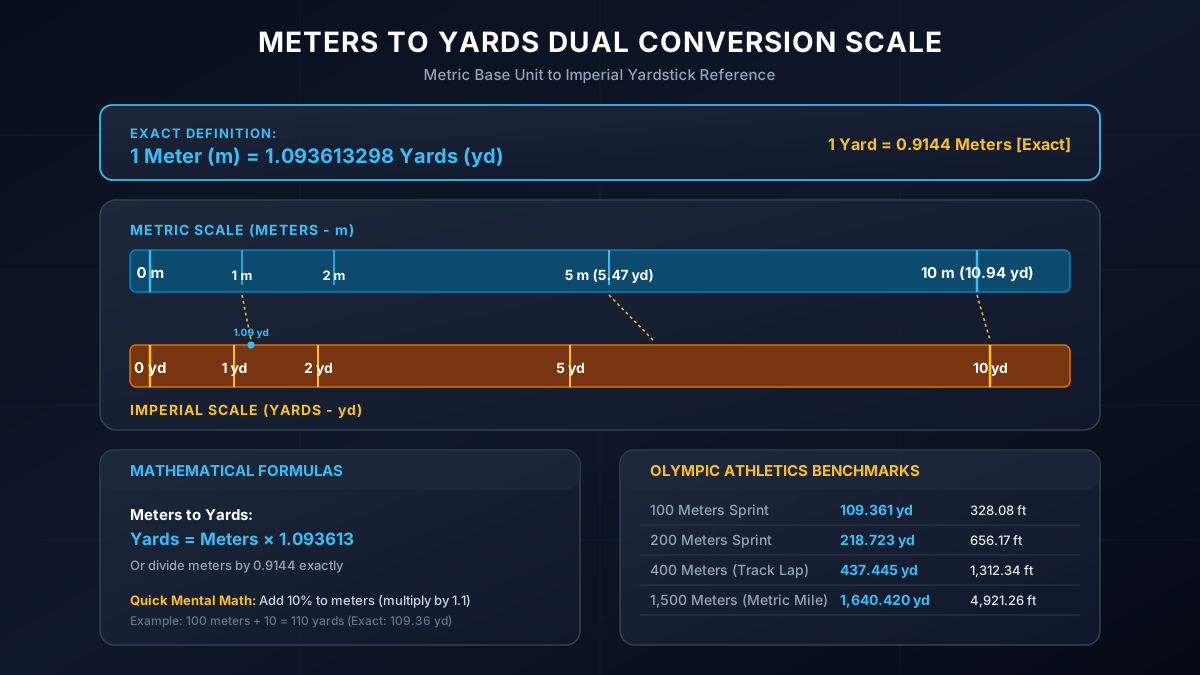
Governing Math Formula: 1 Meters (m) = 1.093613 Yards (yd). Formula: Value in Meters (m) × 1.093613 = Value in Yards (yd).
Target Applications: Provides real-time quantitative solutions in Unit Converters for students, engineers, researchers, and finance professionals.
Meters to Yards Converter - Complete Metric to Imperial Field Guide
1. Introduction
In international track and field, Olympic swimming, textile fabrication, golf course mapping, and landscape architecture, converting from the metric Meter (m) to the imperial Yard (yd) is an essential calculation connecting global standards to North American sporting and industrial markets.
The Meter is the primary base unit of length in the International System of Units (SI), recognized by scientists and engineers worldwide. The Yard remains the statutory standard for measuring American football gridirons, golf courses, fabric bolts, and residential lawn sod in the United States and the United Kingdom.
Under the 1959 International Yard and Pound Agreement:
The Meters to Yards Converter provides instant, bidirectional dimensional calculation with high decimal precision. This guide explores the legal definition of the metric yard, Olympic athletics sprint standards (100m, 200m, 400m, 1500m), swimming pool length translations, fast mental calculation tricks, and real-world industrial case studies.
2. Core Definitions & Analogy
To understand length transformation between meters and yards, let us review their core definitions:
- Simple Definition: A meter is the metric base standard of length (roughly 39.37 inches, slightly longer than a yard), while a yard is an imperial unit of length equal to 36 inches (3 feet). One meter equals roughly 1.094 yards (or 1 yard, 3 inches, and 3/8 inch).
- Technical Definition: The Meter ():* The SI fundamental unit of length, defined as the distance traveled by light in a vacuum in $1 / 299,792,458$ seconds.The International Yard ():* Defined under international treaty as exactly ().
- The Yardstick Plus Handbreadth Analogy: If you hold a standard 36-inch American yardstick in your hands, you have 0.9144 meters. To reach a full 1 meter, you must add approximately 3.37 inches (about the width of four fingers held together).
3. The Mathematical Formulas
Converting meters to yards is straightforward and linear:
Exact Mathematical Formulas:
Quick Mental Arithmetic Shortcut:
- Add 10% to meters (Fast 99.4% Estimate):Example (100 meters): (Exact: )*.Example (50 meters): (Exact: )*.Example (400 meters): (Exact: - the historic quarter-mile!)*.
4. Comprehensive Meters to Yards Lookup Table
| Meters () | Yards () | Feet () | Inches () | Sporting & Contextual Relevance |
|---|---|---|---|---|
| 1 m | 1.0936 yd | 3.2808 ft | 39.370 in | 1 international meter baseline |
| 2 m | 2.1872 yd | 6.5617 ft | 78.740 in | High jump Olympic clearance height |
| 5 m | 5.4681 yd | 16.4042 ft | 196.850 in | Pole vault crossbar height |
| 10 m | 10.9361 yd | 32.8084 ft | 393.701 in | Olympic diving 10-meter platform |
| 25 m | 27.3403 yd | 82.0210 ft | 984.252 in | International 25M Short Course Swimming Pool |
| 50 m | 54.6807 yd | 164.0420 ft | 1,968.504 in | Olympic 50M Long Course Swimming Pool |
| 100 m | 109.3613 yd | 328.0840 ft | 3,937.008 in | Olympic 100M Premier Sprint |
| 200 m | 218.7227 yd | 656.1680 ft | 7,874.016 in | 200M Olympic curve sprint |
| 400 m | 437.4453 yd | 1,312.3360 ft | 15,748.031 in | Standard 400M athletic track lap (~440 yd) |
| 800 m | 874.8906 yd | 2,624.6720 ft | 31,496.063 in | Middle distance Olympic footrace (~half mile) |
| 1,500 m | 1,640.4199 yd | 4,921.2598 ft | 59,055.118 in | Olympic "Metric Mile" footrace |
| 5,000 m | 5,468.0665 yd | 16,404.1995 ft | 196,850.394 in | 5K Track & Field Championship (3.11 miles) |
| 10,000 m | 10,936.1330 yd | 32,808.3990 ft | 393,700.787 in | 10K Track & Field Championship (6.21 miles) |
5. Step-by-Step Practical Calculation Examples
Example 1: Olympic 100-Meter Sprint Track Dimension
- Scenario: Usain Bolt set the world record in the 100-meter sprint (9.58 seconds). How far is this distance in imperial yards?
- Calculation:
- In Feet: (or 328 ft 1 inch).
Example 2: Olympic Pool vs US College Pool
- Scenario: An Olympic swimmer trains in a 50-meter pool in Europe and travels to compete in a US college meet held in a 25-yard pool. How much longer is the 50m Olympic pool than two lengths of a 25-yard pool?
- Step 1: .
- Step 2: Two 25-yard lengths .
- Difference: The 50-meter pool is 4.68 yards (4.28 meters) longer than two 25-yard pool lengths.
6. Major Real-World Applications
flowchart LR
    MTY["Meters to Yards Conversion"] --> TRACK["Track & Field: Translating 400m track laps to 440-yard imperial quarter-miles"]
    MTY --> SWIM["Swimming: Converting 50m Olympic long-course times to 25-yard college short-course times"]
    MTY --> GOLF["Golf: International metric course guides to PGA Tour yardage books"]
MTY --> TEXT["Textiles: Importing European metric fabric bolts into US cutting rooms"]- Track and Field History: Prior to 1980, American high schools and universities competed on 440-yard tracks (1/4 mile). In the 1980s, tracks were standardized to 400 meters (437.45 yards), shortening the track lap by 2.55 yards (2.34 meters).
- Golf Course Yardage Books: European and Japanese golf tournaments publish distances from tee to green in meters. When international players compete in the US PGA Tour, caddies convert all distances to yards () to select the correct iron or wood.
- Marine Cable & Rigging: International deep-sea cable laying ships calculate spool lengths in meters () while US harbor dockyards specify synthetic mooring hawser lines in yards.
7. Frequently Asked Questions (FAQ)
- Why is 1 meter slightly longer than 1 yard?The meter was originally established as one ten-millionth of the distance from the Earth's equator to the North Pole (), while the historical English yard was defined as 3 feet (). Thus, 1 meter is roughly 3.37 inches longer than 1 yard.
- How do you convert cubic meters () to cubic yards ()?Multiply cubic meters by . For example, .
- Is 100 meters the same as 100 yards?No. 100 meters is 109.36 yards (almost 10 yards longer). Running 100 meters takes roughly 0.8 to 1.2 seconds longer than running 100 yards.
8. Expert Summary & Best Practices
- Use the 1.0936 Multiplier: In sports analytics and CAD programming, multiply meters by $1.0936133$ or divide by $0.9144$.
- Add 10% for Fast Mental Math: A quick estimate of adding 10% gives an answer accurate to within 0.6% on the field.
- Check Pool Lengths: In competitive swimming, never directly compare long-course meters (LCM) and short-course yards (SCY) times without applying NCAA/FINA conversion factors.
Additional Technical Guidelines & Measurement Standards
When conducting calculations for Meters to Yards Converter, maintaining quantitative precision and verifying input parameter boundaries is essential for reliable scenario evaluation. Always verify that raw numerical inputs are measured using standardized instrumentation, and double-check unit conversions prior to applying outputs in commercial, industrial, or academic projects.
For quantitative unit conversions and scientific calculations, always maintain at least four decimal places of precision during intermediate arithmetic stages before rounding final results. When preparing technical reports, laboratory documentation, or financial forecasts, cross-verify all output variables against established international measurement standards (such as SI, NIST, and ISO metric benchmarks) to guarantee consistent analytical rigor across all computational workflows.
MathsLover.com delivers this interactive solver 100% free of charge to foster global mathematical literacy, educational accessibility, and data-driven problem solving across scientific, technical, and academic communities worldwide.