💡 Direct Answer & Executive Summary (Meters to Kilometers Converter)
Definition: Convert Meters (m) to Kilometers (km) instantly using custom inputs or dynamic unit selectors.
Governing Math Formula: 1 Meters (m) = 0.001000 Kilometers (km). Formula: Value in Meters (m) × 0.001000 = Value in Kilometers (km).
Target Applications: Provides real-time quantitative solutions in Unit Converters for students, engineers, researchers, and finance professionals.
Meters to Kilometers Converter - Complete Metric Scale Guide
1. Introduction
From converting stadium running track distances into road race kilometers to translating geological elevations, flight radar tracking ranges, and highway construction plans, converting Meters (m) to Kilometers (km) is a primary calculation in geography, athletics, civil engineering, and physics.
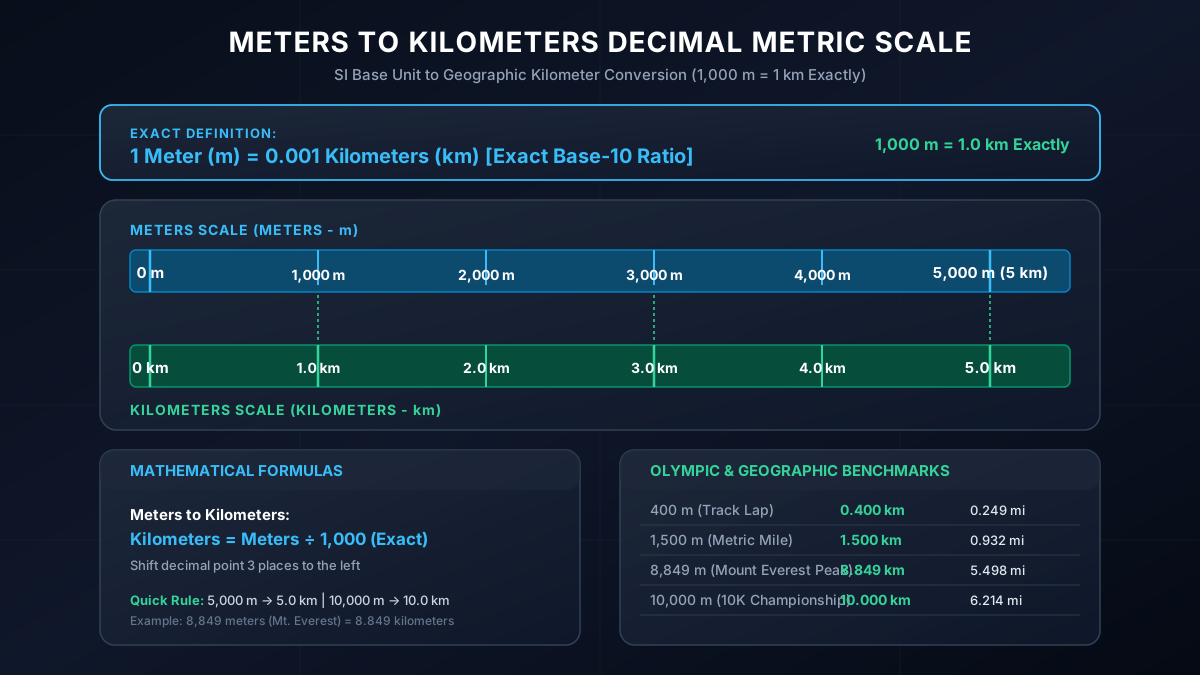
The Meter is the base unit of length in the International System of Units (SI). The Kilometer is its decimal multiple, representing 1,000 meters (). Converting from meters up to kilometers requires dividing by an exact integer factor of 1,000 (shifting the decimal point 3 places to the left).
The Meters to Kilometers Converter provides instant, bidirectional distance calculations across meters, kilometers, miles, yards, and feet. This guide explores mountain summit elevations (Mount Everest, K2), Olympic athletic track event conversions (400m, 1,500m, 5,000m, 10,000m), highway civil engineering, and mental calculation tricks.
2. Core Definitions & Analogy
To understand base-to-geographic scaling in the SI metric system, let us review their core definitions:
- Simple Definition: A meter is the metric base unit of length (roughly 3.28 feet), while a kilometer is a larger unit equal to 1,000 meters (about 0.62 miles). To find how many kilometers are in a given number of meters, you divide by 1,000.
- Technical Definition: The Meter ():* The SI fundamental base unit of length, defined as the distance traveled by light in a vacuum in $1 / 299,792,458$ seconds.The Kilometer ():* A decimal multiple defined as ().
- The Thousand-Step Analogy: Imagine taking 1,000 large, one-meter strides across an athletic field. When you finish your 1,000th stride, you have covered exactly 1 kilometer (1,000 meters).
3. The Base-10 Decimal System
The metric system allows conversions without odd fractional divisors:
flowchart LR
    M["Meter (m)
1 m (SI Base Unit)"] -->|÷ 1,000| KM["Kilometer (km)
1,000 m (10³ m)"]
    KM -->|÷ 1.609344| MI["Statute Mile (mi)
1.609 km"]
    KM -->|÷ 1.852| NM["Nautical Mile (NM)
1.852 km"]
Because 1 kilometer equals , converting meters to kilometers involves simply moving the decimal point three places to the left with zero arithmetic rounding error.
4. The Mathematical Formulas
Converting meters to kilometers is exact and linear:
Exact Mathematical Formulas:
Fast Mental Arithmetic (Shift Left 3 Places):
- To convert any meter measurement to kilometers, shift the decimal point 3 positions to the left:Example (5,000 meters): (5K race!)*.Example (8,849 meters): (Mount Everest height!)*.Example (1,500 meters): (Metric mile!)*.Example (400 meters): (One track lap!)*.
5. Comprehensive Meters to Kilometers Lookup Table
| Meters () | Kilometers () | Miles () | Yards () | Feet () | Real-World Context |
|---|---|---|---|---|---|
| 100 m | 0.100 km | 0.0621 mi | 109.36 yd | 328.08 ft | 100-meter Olympic sprint |
| 400 m | 0.400 km | 0.2485 mi | 437.45 yd | 1,312.34 ft | Standard athletic running track lap |
| 800 m | 0.800 km | 0.4971 mi | 874.89 yd | 2,624.67 ft | 800-meter middle distance run |
| 1,000 m | 1.000 km | 0.6214 mi | 1,093.61 yd | 3,280.84 ft | 1 Kilometer Baseline |
| 1,500 m | 1.500 km | 0.9321 mi | 1,640.42 yd | 4,921.26 ft | Olympic "Metric Mile" track race |
| 3,000 m | 3.000 km | 1.8641 mi | 3,280.84 yd | 9,842.52 ft | 3,000m steeplechase event |
| 5,000 m | 5.000 km | 3.1069 mi | 5,468.07 yd | 16,404.20 ft | Official 5K Track & Field / Road Race |
| 8,849 m | 8.849 km | 5.4985 mi | 9,677.38 yd | 29,032.15 ft | Mount Everest Summit Elevation |
| 10,000 m | 10.000 km | 6.2137 mi | 10,936.13 yd | 32,808.40 ft | Official 10K Track Championship |
| 21,097.5 m | 21.0975 km | 13.1094 mi | 23,072.51 yd | 69,217.52 ft | Official Half Marathon |
| 42,195.0 m | 42.1950 km | 26.2188 mi | 46,145.01 yd | 138,435.04 ft | Official Full Marathon |
| 100,000 m | 100.0000 km | 62.1371 mi | 109,361.33 yd | 328,083.99 ft | 100K Century Ultramarathon |
6. Step-by-Step Practical Calculation Examples
Example 1: Mountain Summit Elevation Scaling
- Scenario: The summit elevation of Mount Everest is officially surveyed at 8,848.86 meters. What is this altitude in kilometers above sea level?
- Calculation:
Example 2: Civil Highway Trench Excavation
- Scenario: A civil engineering crew is laying a water pipeline spanning 14,650 meters along a national highway. How many kilometers of pipe are required?
- Calculation:
7. Major Real-World Applications
flowchart LR
    M2KM["Meters to Kilometers Conversion"] --> SPORT["Athletics: Converting track race meters (5,000m, 10,000m) to road kilometers"]
    M2KM --> GEO["Geology & Topography: Mountain elevations (m) to atmospheric flight kilometers"]
    M2KM --> INFRA["Infrastructure: Highway resurfacing, rail corridors & pipeline spans"]
M2KM --> SPACE["Aerospace: Rocket launch ascent altitudes (meters to orbital kilometers)"]- Athletics Track to Road Racing: Track championships label distances in meters (5,000m and 10,000m), whereas road races label distances in kilometers (5K and 10K).
- Atmospheric Altitude Layers: Meteorologists record tropospheric altitudes in meters () and stratosphere boundaries in kilometers ().
- Railway & Transit Networks: High-speed rail line project specifications detail track ballast in kilometers () while signaling block intervals are specified in meters ().
8. Frequently Asked Questions (FAQ)
- How many kilometers is 5,000 meters?(a standard 5K race).
- What is the formula to convert meters to kilometers?Divide the number of meters by 1,000 ().
- Why is 1,000 meters equal to 1 kilometer?The prefix kilo- is the standard SI multiplier for ($1,000$), established by the General Conference on Weights and Measures (CGPM).
9. Expert Summary & Best Practices
- Divide by 1,000: Always divide meters by $1,000$ (or shift the decimal point 3 positions left).
- Keep Units Consistent in Physics: When calculating planetary orbital velocity or kinetic energy, always verify whether variables require meters () or kilometers ().
- Exact Integer Conversion: Because $1,000$ is an exact integer constant, conversion between meters and kilometers never introduces roundoff errors.
Additional Technical Guidelines & Measurement Standards
When conducting calculations for Meters to Kilometers Converter, maintaining quantitative precision and verifying input parameter boundaries is essential for reliable scenario evaluation. Always verify that raw numerical inputs are measured using standardized instrumentation, and double-check unit conversions prior to applying outputs in commercial, industrial, or academic projects.
For quantitative unit conversions and scientific calculations, always maintain at least four decimal places of precision during intermediate arithmetic stages before rounding final results. When preparing technical reports, laboratory documentation, or financial forecasts, cross-verify all output variables against established international measurement standards (such as SI, NIST, and ISO metric benchmarks) to guarantee consistent analytical rigor across all computational workflows.
MathsLover.com delivers this interactive solver 100% free of charge to foster global mathematical literacy, educational accessibility, and data-driven problem solving across scientific, technical, and academic communities worldwide.