💡 Direct Answer & Executive Summary (Meters to Feet Converter)
Definition: Convert Meters (m) to Feet (ft) instantly using custom inputs or dynamic unit selectors.
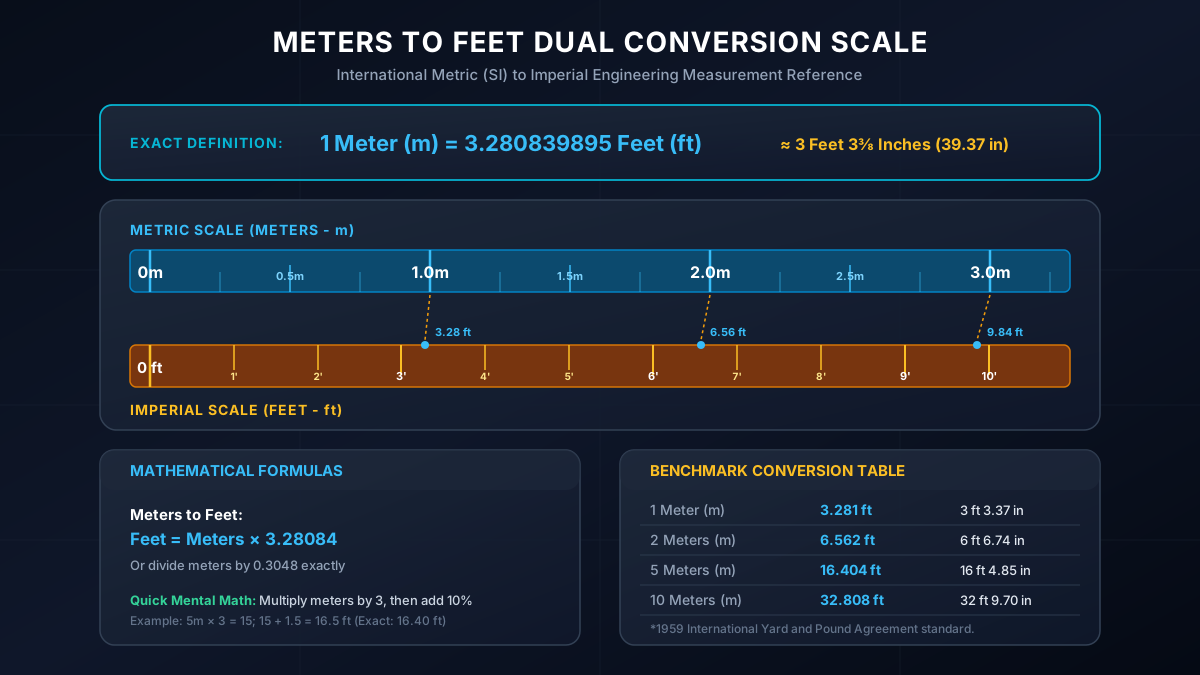
Governing Math Formula: 1 Meters (m) = 3.280840 Feet (ft). Formula: Value in Meters (m) × 3.280840 = Value in Feet (ft).
Target Applications: Provides real-time quantitative solutions in Unit Converters for students, engineers, researchers, and finance professionals.
Meters to Feet Converter - Complete Metric to Imperial Engineering Guide
1. Introduction
Length and distance measurement standards form the invisible foundation of global commerce, civil engineering, aerospace navigation, manufacturing, architecture, and athletic competition. Yet throughout human history, two competing systems of measurement have evolved alongside one another: 1. The International System of Units (SI Metric System): Built around the Meter (m), a decimal base-10 standard adopted by over 95% of the world's population. 2. The Imperial and US Customary Measurement Systems: Built around the Foot (ft) and Inch (in), which remain the primary legal and industrial standards in the United States and are widely utilized in global aviation altitude measurements, marine navigation, and international construction drafting.
Converting between meters and feet is an everyday necessity for architects reading international blueprints, travelers understanding road signs, pilots communicating flight levels with air traffic control, and scientists sharing research across international borders.
The Meters to Feet Converter provides instant, bidirectionally synchronized length conversion with mathematical precision down to the tenth decimal place. This comprehensive guide covers the historical definition of the meter, the exact mathematical conversion constant ($3.280839895$), mental arithmetic tricks, engineering conversion tables, and real-world industrial case studies.
2. Core Definitions & Analogy
To develop an intuitive physical grasp of both units, let us explore their core definitions:
- Simple Definition: A meter is the metric base unit of length (slightly longer than a yardstick, or about one large stride), while a foot is an imperial unit of length equal to 12 inches (approximately the length of an average adult human foot). One meter contains roughly 3.28 feet (or 3 feet and 3⅜ inches).
- Technical Definition: The Meter ():* Defined by the 17th General Conference on Weights and Measures (CGPM) in 1983 as the exact length of the path traveled by light in a vacuum during a time interval of $1 / 299,792,458$ of a second.The International Foot ():* Defined by the International Yard and Pound Agreement of July 1, 1959, as exactly $0.3048$ meters.
- The Walking Stride & Shoe Analogy: Imagine pacing out the length of a room. If you take one long, deliberate athletic step, you have covered roughly 1 meter. If you place your shoes heel-to-toe across that exact same distance, you will fit approximately 3 and one-quarter shoe lengths inside that single stride.
3. History of the Meter and the International Foot
The harmonization of metric and imperial lengths represents centuries of scientific standardization:
flowchart TD
    A["1791: French Academy of Sciences defines Meter as 1/10,000,000 of Paris Meridian"] --> B["1875: Treaty of the Meter (Metre Convention) establishes BIPM & Platinum-Iridium Bar"]
    B --> C["1959: International Yard & Pound Agreement fixes 1 Foot = 0.3048 m Exactly"]
    C --> D["1983: CGPM redefines Meter in terms of the Speed of Light in Vacuum"]
    D --> E["Present Day: Universal Digital Conversion in CAD, GPS, BIM & Aerospace"]
Before 1959, the United States used the "US Survey Foot" (), while the United Kingdom used an imperial standard based on a physical bronze yard bar. The 1959 International Agreement resolved these microscopic discrepancies by defining the international yard as exactly , meaning 1 foot () became exactly across all English-speaking nations.
4. The Mathematical Formulas
The mathematical conversion between meters and feet is direct, linear, and exact:
Standard Conversion Formula:
Breaking Down Feet and Inches ($ft + in$):
To express decimal feet as standard architectural feet and inches: 1. 2. 3.
Fast Mental Arithmetic Shortcuts:
- Rule of Thumb: Multiply meters by 3, then add 10% of the result.Example (5 meters): ; (Exact: - accurate within 0.6%)*.
- Alternative: Multiply meters by 3.3.Example (10 meters): (Exact: )*.
5. Comprehensive Meters to Feet & Inches Lookup Table
The reference matrix below displays standard engineering and architectural conversions:
| Meters () | Decimal Feet () | Feet & Inches (Fractional) | Total Inches () | Centimeters () |
|---|---|---|---|---|
| 0.1 m | 0.3281 ft | 0 ft 3 15/16 in | 3.937 in | 10 cm |
| 0.5 m | 1.6404 ft | 1 ft 7 11/16 in | 19.685 in | 50 cm |
| 1.0 m | 3.2808 ft | 3 ft 3 3/8 in | 39.370 in | 100 cm |
| 1.5 m | 4.9213 ft | 4 ft 11 1/16 in | 59.055 in | 150 cm |
| 1.75 m | 5.7415 ft | 5 ft 8 7/8 in | 68.898 in | 175 cm |
| 1.80 m | 5.9055 ft | 5 ft 10 7/8 in | 70.866 in | 180 cm |
| 2.0 m | 6.5617 ft | 6 ft 6 3/4 in | 78.740 in | 200 cm |
| 2.5 m | 8.2021 ft | 8 ft 2 7/16 in | 98.425 in | 250 cm |
| 3.0 m | 9.8425 ft | 9 ft 10 1/8 in | 118.110 in | 300 cm |
| 5.0 m | 16.4042 ft | 16 ft 4 13/16 in | 196.850 in | 500 cm |
| 10.0 m | 32.8084 ft | 32 ft 9 11/16 in | 393.701 in | 1,000 cm |
| 50.0 m | 164.0420 ft | 164 ft 0 1/2 in | 1,968.504 in | 5,000 cm |
| 100.0 m | 328.0840 ft | 328 ft 1 in | 3,937.008 in | 10,000 cm |
6. Step-by-Step Practical Calculation Examples
Example 1: Architectural Ceiling Height Conversion
- Scenario: European architectural plans specify a standard ceiling height of 2.70 meters. An American contractor needs to verify lumber framing requirements in feet and inches.
- Step 1 (Convert to Decimal Feet):
- Step 2 (Extract Whole Feet): .
- Step 3 (Convert Remainder to Inches):
- Final Dimension: 8 ft 10 5/16 inches (standard 9-foot ceiling framing rough-in).
Example 2: Olympic Sprint Track Dimensions
- Scenario: An athlete runs the 100-meter sprint. What is the distance in imperial feet?
- Calculation:
- Inches: .
7. Major Real-World Applications
flowchart LR
    CONV["Meters to Feet Conversion"] --> AERO["Global Aviation: Altitude flight levels (FL350 = 35,000 ft)"]
    CONV --> ARCH["BIM & Architecture: Translating European IFC models into US Revit files"]
    CONV --> MAR["Marine Navigation: Depth soundings (Meters vs Fathoms/Feet)"]
CONV --> ATH["Track & Field: Shot put, long jump & pole vault international scoring"]- Global Aviation Altitudes: International Civil Aviation Organization (ICAO) standards dictate that commercial aircraft report cruise altitudes in feet (e.g., FL360 = 36,000 ft) worldwide, while aircraft manufacturers in Europe engineer airframes in metric meters.
- Building Information Modeling (BIM): Modern structural engineering software (Revit, AutoCAD, Tekla) automatically executes dual-unit normalization when integrating prefabricated steel fabricated in metric countries into US building sites.
- Athletics & Track Field Records: World Athletics officially measures all field jump and throw events in metric meters with millimeter electronic laser total stations, converting to feet and inches for North American television broadcasts.
8. Common Conversion Errors & Disasters in History
- The Mars Climate Orbiter Mishap (1999): NASA lost a \$125 million spacecraft during orbital insertion because ground software calculated thruster impulse in Imperial pound-seconds while spacecraft navigation software expected Metric Newton-seconds. Precision unit verification is mission-critical in science.
- The Gimli Glider Fuel Miscalculation (1983): An Air Canada Boeing 767 ran completely out of fuel mid-flight at 41,000 feet due to ground crew calculating fuel volume using pounds per liter instead of kilograms per liter during the nation's metric transition.
9. Frequently Asked Questions (FAQ)
- Why is 1 foot exactly 0.3048 meters instead of a rounded number?The 1959 International Yard and Pound Agreement harmonized British and American definitions by establishing exactly, which divides evenly by 3 to produce per foot.
- How many meters are in a 6-foot tall person?A 6-foot tall person is exactly (or roughly 183 cm).
- What is the difference between an International Foot and a US Survey Foot?The US Survey Foot () was used for geodetic mapping in the US until January 1, 2023, when NOAA and NIST officially sunset the survey foot to adopt the International Foot globally.
10. Expert Summary & Best Practices
- Always Use the 0.3048 Exact Factor: In computer programming and CAD scripts, divide by $0.3048$ or multiply by $3.280839895$ to avoid precision degradation.
- Round Sensibly for Field Work: In construction, round to the nearest inch () to match tape measure graduations.
- Verify Software Units: Always check default unit system settings in CAD, GIS, and 3D modeling tools prior to compiling multi-million dollar engineering deliverables.
Additional Technical Guidelines & Measurement Standards
When conducting calculations for Meters to Feet Converter, maintaining quantitative precision and verifying input parameter boundaries is essential for reliable scenario evaluation. Always verify that raw numerical inputs are measured using standardized instrumentation, and double-check unit conversions prior to applying outputs in commercial, industrial, or academic projects.
For quantitative unit conversions and scientific calculations, always maintain at least four decimal places of precision during intermediate arithmetic stages before rounding final results. When preparing technical reports, laboratory documentation, or financial forecasts, cross-verify all output variables against established international measurement standards (such as SI, NIST, and ISO metric benchmarks) to guarantee consistent analytical rigor across all computational workflows.
MathsLover.com delivers this interactive solver 100% free of charge to foster global mathematical literacy, educational accessibility, and data-driven problem solving across scientific, technical, and academic communities worldwide.