💡 Direct Answer & Executive Summary (Meters to Centimeters Converter)
Definition: Convert Meters (m) to Centimeters (cm) instantly using custom inputs or dynamic unit selectors.
Governing Math Formula: 1 Meters (m) = 100.000000 Centimeters (cm). Formula: Value in Meters (m) × 100.000000 = Value in Centimeters (cm).
Target Applications: Provides real-time quantitative solutions in Unit Converters for students, engineers, researchers, and finance professionals.
Meters to Centimeters Converter - SI Unit Scaling Guide
1. Introduction
In physics problem solving, civil architecture, industrial carpentry, textile manufacturing, athletic scoring, and everyday dimensional measurement, converting Meters (m) to Centimeters (cm) is the most common decimal subunit multiplication in the International System of Units (SI).
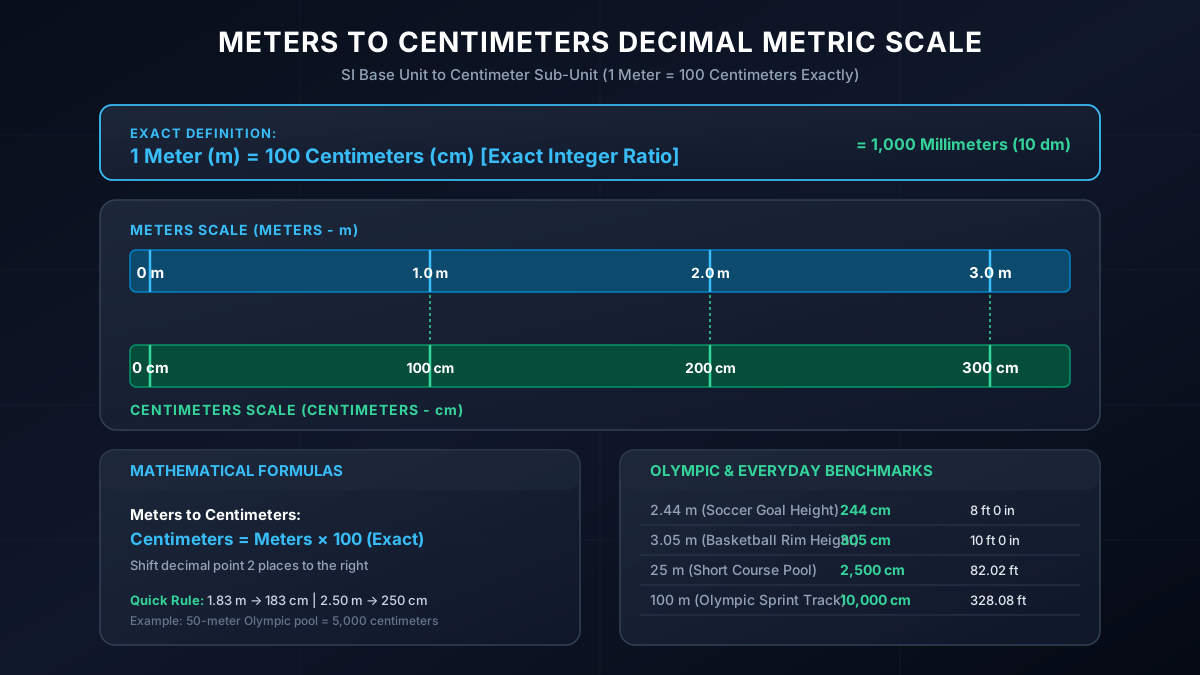
The Meter is the primary base unit of length in SI physics, universally defined based on the speed of light in a vacuum. The Centimeter represents one-hundredth () of a meter (). Converting from meters down to centimeters requires multiplying by an exact integer factor of 100, which is equivalent to shifting the decimal point two places to the right.
The Meters to Centimeters Converter delivers instantaneous, bidirectional calculations across meters, centimeters, millimeters, inches, and feet. This comprehensive guide covers metric decimal scaling, architectural CAD dimensioning, Olympic athletics standards (50m pools, 100m tracks, soccer goals), and real-world industrial case studies.
2. Core Definitions & Analogy
To understand length transformation from the SI meter to centimeter subunits, let us review their core definitions:
- Simple Definition: A meter is the metric base unit of length (about 39.37 inches), while a centimeter is a smaller unit equal to one-hundredth of a meter. There are exactly 100 centimeters in 1 meter.
- Technical Definition: The Meter ():* The SI fundamental base unit of length, defined as the distance traveled by light in a vacuum in $1 / 299,792,458$ seconds.The Centimeter ():* Exactly ().
- The Dollar to Cents Analogy: Think of 1 meter like a 1-dollar bill. Just as contains 100 individual cents, contains 100 individual centimeters. If you have 2.5 meters, you have 250 centimeters.
3. The Base-10 Decimal System
The metric system allows scaling without fractions or odd integer divisors:
flowchart LR
    M["Meter (m)
1 m (SI Base Unit)"] -->|× 10| DM["Decimeter (dm)
10 dm = 1 m"]
    DM -->|× 10| CM["Centimeter (cm)
100 cm = 1 m"]
    CM -->|× 10| MM["Millimeter (mm)
1,000 mm = 1 m"]
Because every metric prefix is a power of ten (), multiplying meters by 100 simply moves the decimal point two places to the right with zero arithmetic rounding error.
4. The Mathematical Formulas
Converting meters to centimeters is direct, linear, and exact:
Exact Mathematical Formulas:
Quick Mental Arithmetic Shortcut (Shift Right 2 Places):
- To convert meters to centimeters, shift the decimal point 2 places to the right:Example (1.85 m): (Human height!)*.Example (2.44 m): (FIFA soccer goal height!)*.Example (0.50 m): (Infant length!)*.Example (50 m): (Olympic swimming pool!)*.
5. Comprehensive Meters to Centimeters Lookup Table
| Meters () | Centimeters () | Millimeters () | Inches () | Feet & Inches ($ft\ in$) | Real-World Context |
|---|---|---|---|---|---|
| 0.01 m | 1 cm | 10 mm | 0.3937 in | 0 ft 0.39 in | Paperclip width |
| 0.05 m | 5 cm | 50 mm | 1.9685 in | 0 ft 1.97 in | Credit card height (5.4 cm) |
| 0.10 m | 10 cm | 100 mm | 3.9370 in | 0 ft 3.94 in | Coffee cup coaster |
| 0.50 m | 50 cm | 500 mm | 19.6850 in | 1 ft 7.69 in | Newborn infant length |
| 1.00 m | 100 cm | 1,000 mm | 39.3701 in | 3 ft 3.37 in | 1 SI Base Meter |
| 1.50 m | 150 cm | 1,500 mm | 59.0551 in | 4 ft 11.06 in | Fabric bolt width |
| 1.75 m | 175 cm | 1,750 mm | 68.8976 in | 5 ft 8.90 in | Average adult stature |
| 1.83 m | 183 cm | 1,830 mm | 72.0472 in | 6 ft 0.05 in | 6-foot adult stature |
| 2.00 m | 200 cm | 2,000 mm | 78.7402 in | 6 ft 6.74 in | Standard door frame |
| 2.44 m | 244 cm | 2,440 mm | 96.0630 in | 8 ft 0.06 in | Regulation soccer goal crossbar height |
| 3.05 m | 305 cm | 3,050 mm | 120.0787 in | 10 ft 0.08 in | Regulation basketball rim height |
| 5.00 m | 500 cm | 5,000 mm | 196.8504 in | 16 ft 4.85 in | Pole vault crossbar height |
| 10.00 m | 1,000 cm | 10,000 mm | 393.7008 in | 32 ft 9.70 in | Olympic 10-meter diving tower |
| 25.00 m | 2,500 cm | 25,000 mm | 984.2520 in | 82 ft 0.25 in | Short course swimming pool |
| 50.00 m | 5,000 cm | 50,000 mm | 1,968.5039 in | 164 ft 0.50 in | Olympic 50M long course pool |
| 100.00 m | 10,000 cm | 100,000 mm | 3,937.0079 in | 328 ft 1.01 in | Olympic 100-meter sprint track |
6. Step-by-Step Practical Calculation Examples
Example 1: Regulation Sports Equipment Setup
- Scenario: International basketball regulations specify the rim height at 3.05 meters above the floor. What is this height in centimeters?
- Calculation:
Example 2: Laboratory Physics Experiment
- Scenario: In an optics laboratory experiment, a laser beam travels a distance of 4.825 meters through an optical bench. What is this distance in centimeters?
- Calculation:
7. Major Real-World Applications
flowchart LR
    MTC["Meters to Centimeters Conversion"] --> SPORT["Sports: Setting soccer crossbars (244 cm) & basketball hoops (305 cm)"]
    MTC --> ARCH["Construction: Translating meter room layouts into centimeter carpentry tolerances"]
    MTC --> LAB["Science Labs: Converting SI meter measurements to centimeter laboratory glassware"]
MTC --> TEXT["Apparel: Converting bulk meter textile bolts to garment pattern centimeters"]- Sports Pitch Regulations: FIFA soccer goal dimensions are legally specified as (), corresponding to .
- Construction Drafting: Architectural blueprints detail overall building spans in meters (e.g. ) while interior cabinet fittings and drywall partitions are dimensioned in centimeters ().
- Clinical Anthropometry: Pediatricians track adolescent child growth in centimeters () while epidemiological databases record adult populations in meters ().
8. Frequently Asked Questions (FAQ)
- How many centimeters are in 2.5 meters?.
- What is the formula to convert meters to centimeters?Multiply the number of meters by 100 ().
- Why is multiplying by 100 exact?Because the metric system is a base-10 positional decimal system where 1 meter is defined as containing exactly 100 centimeters by international SI convention.
9. Expert Summary & Best Practices
- Multiply by 100: Multiply by (or shift the decimal two places right).
- Zero Rounding Degradation: Metric base-10 conversions preserve 100% of the significant digits of the original measurement.
- Keep Units Labeled: Always include explicit unit tags ( or ) in CAD drawings to prevent 100x scale misinterpretations during fabrication.
Additional Technical Guidelines & Measurement Standards
When conducting calculations for Meters to Centimeters Converter, maintaining quantitative precision and verifying input parameter boundaries is essential for reliable scenario evaluation. Always verify that raw numerical inputs are measured using standardized instrumentation, and double-check unit conversions prior to applying outputs in commercial, industrial, or academic projects.
For quantitative unit conversions and scientific calculations, always maintain at least four decimal places of precision during intermediate arithmetic stages before rounding final results. When preparing technical reports, laboratory documentation, or financial forecasts, cross-verify all output variables against established international measurement standards (such as SI, NIST, and ISO metric benchmarks) to guarantee consistent analytical rigor across all computational workflows.
MathsLover.com delivers this interactive solver 100% free of charge to foster global mathematical literacy, educational accessibility, and data-driven problem solving across scientific, technical, and academic communities worldwide.