💡 Direct Answer & Executive Summary (Kilometers to Miles Converter)
Definition: Convert Kilometers (km) to Miles (mi) instantly using custom inputs or dynamic unit selectors.
Governing Math Formula: 1 Kilometers (km) = 0.621371 Miles (mi). Formula: Value in Kilometers (km) × 0.621371 = Value in Miles (mi).
Target Applications: Provides real-time quantitative solutions in Unit Converters for students, engineers, researchers, and finance professionals.
Kilometers to Miles Converter - Complete Distance & Speed Guide
1. Introduction
Whether you are navigating international highway road networks, pacing a 5K or marathon road race, tracking flight telemetry, or planning road trips across borders, converting between Kilometers (km) and Statute Miles (mi) is one of the most widely used geographic and vehicular calculations in the modern world.
Over 90% of the world's nations use the metric system, where highway speeds and geographic distances are posted in Kilometers per Hour (km/h) and Kilometers (km). Meanwhile, the United States and the United Kingdom continue to use Miles per Hour (mph) and Statute Miles (mi) as the statutory highway standard.
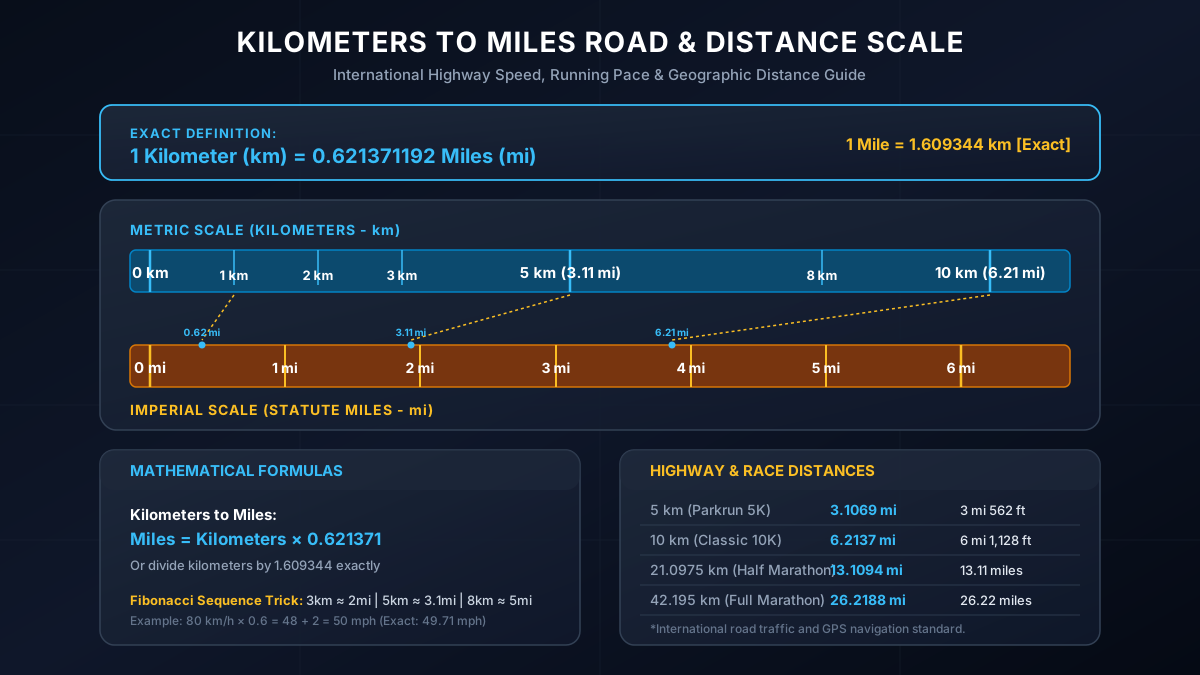
Converting kilometers to miles requires applying the exact international conversion constant established in 1959:
The Kilometers to Miles Converter provides instant, bidirectional speed and distance calculations with mathematical precision. This comprehensive guide covers the legal definition of the statute mile, running race distance standards (5K, 10K, Half Marathon, Marathon), automotive speedometer conversions, Fibonacci mental arithmetic shortcuts, and international road navigation rules.
2. Core Definitions & Analogy
To develop an intuitive physical sense of both units, let us explore their core definitions:
- Simple Definition: A kilometer is a metric unit of geographic distance equal to 1,000 meters (about 10 to 12 minutes of walking), while a mile is an imperial unit of distance equal to 5,280 feet (about 1,609 meters). One kilometer equals roughly 0.62 miles (or just under five-eighths of a mile).
- Technical Definition: The Kilometer ():* A decimal multiple of the SI base unit meter (), defined by the speed of light in vacuum.The International Statute Mile ():* Formally defined under the 1959 International Yard and Pound Agreement as exactly ().
- The Track Lap Analogy: Imagine walking around a standard 400-meter outdoor athletic running track. Walking 2.5 laps covers exactly 1 kilometer (1,000 meters). To walk 1 full mile, you must continue walking for 4 full laps (1,609.34 meters).
3. History of the Kilometer and the Statute Mile
The historical coexistence of the mile and kilometer reflects centuries of transport evolution:
flowchart TD
    A["Roman Empire: Mille Passus ('1,000 paces' = 5,000 Roman feet ≈ 1,480 m)"] --> B["1593: English Parliament under Queen Elizabeth I defines Statute Mile = 5,280 Feet (8 furlongs)"]
    B --> C["1791: French Academy of Sciences introduces Kilometer = 1,000 Meters"]
    C --> D["1959: International Yard & Pound Agreement fixes 1 Mile = 1.609344 km Exactly"]
    D --> E["Present Day: Global dual-dial speedometers & GPS multi-unit navigation"]
The word mile originates from the Latin mille passus, meaning "a thousand paces" (one pace equaled two steps in Roman legionary marches). In 1593, the English Parliament under Queen Elizabeth I formally standardized the statute mile as 8 furlongs (5,280 feet) to align with agricultural surveying. In 1791, the French Revolution introduced the decimal metric system, creating the kilometer as 1,000 meters.
4. The Mathematical Formulas
Converting kilometers to miles involves division by 1.609344 or multiplication by its reciprocal:
Exact Mathematical Formulas:
The Famous Fibonacci Sequence Mental Math Trick:
Because the ratio between consecutive numbers in the Fibonacci sequence ($1, 1, 2, 3, 5, 8, 13, 21, 34, 55, 89...$) converges to the Golden Ratio (), which is remarkably close to $1.609344$, you can convert km to miles by simply taking the previous Fibonacci number:
- 3 km 2 miles (Exact: 1.86 mi)
- 5 km 3 miles (Exact: 3.11 mi)
- 8 km 5 miles (Exact: 4.97 mi)
- 13 km 8 miles (Exact: 8.08 mi)
- 21 km 13 miles (Exact: 13.05 mi - Half Marathon!)
- 34 km 21 miles (Exact: 21.13 mi)
- 55 km 34 miles (Exact: 34.18 mi)
- 89 km 55 miles (Exact: 55.30 mi - US Highway Limit!)
Quick Highway Mental Math Rule:
- Multiply km by 6, then drop the last digit:Example (): (Exact: )*.Example (): (Exact: )*.
5. Comprehensive Kilometers to Miles Lookup Table
The reference table below outlines standard athletic race distances and automotive speed limits:
| Kilometers () | Miles () | Yards () | Feet () | Everyday Context |
|---|---|---|---|---|
| 1 km | 0.6214 mi | 1,093.6 yd | 3,280.8 ft | ~10-minute brisk walk |
| 3 km | 1.8641 mi | 3,280.8 yd | 9,842.5 ft | Track 3000m steeplechase |
| 5 km | 3.1069 mi | 5,468.1 yd | 16,404.2 ft | Standard 5K Charity Race / Parkrun |
| 8 km | 4.9710 mi | 8,748.9 yd | 26,246.7 ft | ~5-mile training run |
| 10 km | 6.2137 mi | 10,936.1 yd | 32,808.4 ft | Standard 10K Road Race |
| 15 km | 9.3206 mi | 16,404.2 yd | 49,212.6 ft | Elite road running race |
| 20 km | 12.4274 mi | 21,872.3 yd | 65,616.8 ft | Olympic race walk distance |
| 21.0975 km | 13.1094 mi | 23,072.5 yd | 69,217.5 ft | Official Half Marathon |
| 42.1950 km | 26.2188 mi | 46,145.0 yd | 138,435.0 ft | Official Full Marathon |
| 50 km | 31.0686 mi | 54,680.7 yd | 164,042.0 ft | Ultramarathon base distance |
| 80 km | 49.7097 mi | 87,489.1 yd | 262,467.2 ft | ~50-mile road trip |
| 100 km | 62.1371 mi | 109,361.3 yd | 328,084.0 ft | 100K Century Ultramarathon / 62 mph |
| 120 km | 74.5645 mi | 131,233.6 yd | 393,700.8 ft | European highway cruise speed (~75 mph) |
| 160.934 km | 100.0000 mi | 176,000.0 yd | 528,000.0 ft | 100-Mile Western States Ultramarathon |
6. Step-by-Step Practical Calculation Examples
Example 1: Running a 5K Race in Miles
- Scenario: A runner signs up for their first 5K road race. How many miles will they run?
- Calculation:
- Fractional Distance: (or ).
Example 2: European Car Speedometer on Highway
- Scenario: An American tourist renting a car in Germany drives at a posted speed limit of 130 km/h on the Autobahn. What is their speed in miles per hour?
- Calculation:
7. Major Real-World Applications
flowchart LR
    KTM["Kilometers to Miles Conversion"] --> AUTO["Automotive: Importing European/Japanese vehicles to US/UK"]
    KTM --> SPORT["Endurance Sports: Running & Cycling training pace calculations"]
    KTM --> TOUR["International Travel: Interpreting GPS navigation, maps & road signs"]
KTM --> SCI["Atmospheric Science: Hurricane track forecasts & weather radar"]- Athletic Race Pacing: Runners use the 0.6214 conversion factor to convert kilometer splits (e.g. ) into mile pace targets ().
- Vehicle Importation & Odometer Compliance: When importing European or Japanese domestic market (JDM) vehicles into North America, digital odometers and instrument clusters must be recoded or calibrated from kilometers to statute miles for Department of Transportation (DOT) compliance.
- Flight Weather & Visibility: Surface meteorological aviation reports (METAR) list runway visual range (RVR) in meters/kilometers internationally, but statute miles in the US.
8. Frequently Asked Questions (FAQ)
- Is a nautical mile the same as a statute mile?No. A Statute Mile is (), based on land surveying. A Nautical Mile is (), based on one minute of latitude on the Earth's circumference.
- Why is a marathon exactly 42.195 km (26.219 miles)?At the 1908 Olympic Games in London, the marathon course was extended from Windsor Castle to the Royal Box at White City Stadium to measure precisely 26 miles and 385 yards (42.195 km), which became the permanent international standard.
- How many miles is 100 km/h?is equal to (or roughly 62 mph).
9. Expert Summary & Best Practices
- Memorize 0.6214 or Divide by 1.609: Multiply by $0.6214$ for fast, accurate calculations.
- Use the Fibonacci Trick on the Go: For instant mental calculations while traveling, use adjacent Fibonacci numbers (, , ).
- Keep Units Straight in Fitness Apps: In Strava, Garmin, and Apple Watch workouts, always check your account profile display preferences to prevent mixing kilometer and mile split times.
Additional Technical Guidelines & Measurement Standards
When conducting calculations for Kilometers to Miles Converter, maintaining quantitative precision and verifying input parameter boundaries is essential for reliable scenario evaluation. Always verify that raw numerical inputs are measured using standardized instrumentation, and double-check unit conversions prior to applying outputs in commercial, industrial, or academic projects.
For quantitative unit conversions and scientific calculations, always maintain at least four decimal places of precision during intermediate arithmetic stages before rounding final results. When preparing technical reports, laboratory documentation, or financial forecasts, cross-verify all output variables against established international measurement standards (such as SI, NIST, and ISO metric benchmarks) to guarantee consistent analytical rigor across all computational workflows.
MathsLover.com delivers this interactive solver 100% free of charge to foster global mathematical literacy, educational accessibility, and data-driven problem solving across scientific, technical, and academic communities worldwide.