💡 Direct Answer & Executive Summary (Kilometers to Meters Converter)
Definition: Convert Kilometers (km) to Meters (m) instantly using custom inputs or dynamic unit selectors.
Governing Math Formula: 1 Kilometers (km) = 1000.000000 Meters (m). Formula: Value in Kilometers (km) × 1000.000000 = Value in Meters (m).
Target Applications: Provides real-time quantitative solutions in Unit Converters for students, engineers, researchers, and finance professionals.
Kilometers to Meters Converter - Complete Metric Scaling Guide
1. Introduction
In athletics, geographic navigation, civil surveying, physics mechanics, and international transportation, converting Kilometers (km) to Meters (m) is the foundational decimal scale calculation that transforms overland distances into fundamental SI base units.
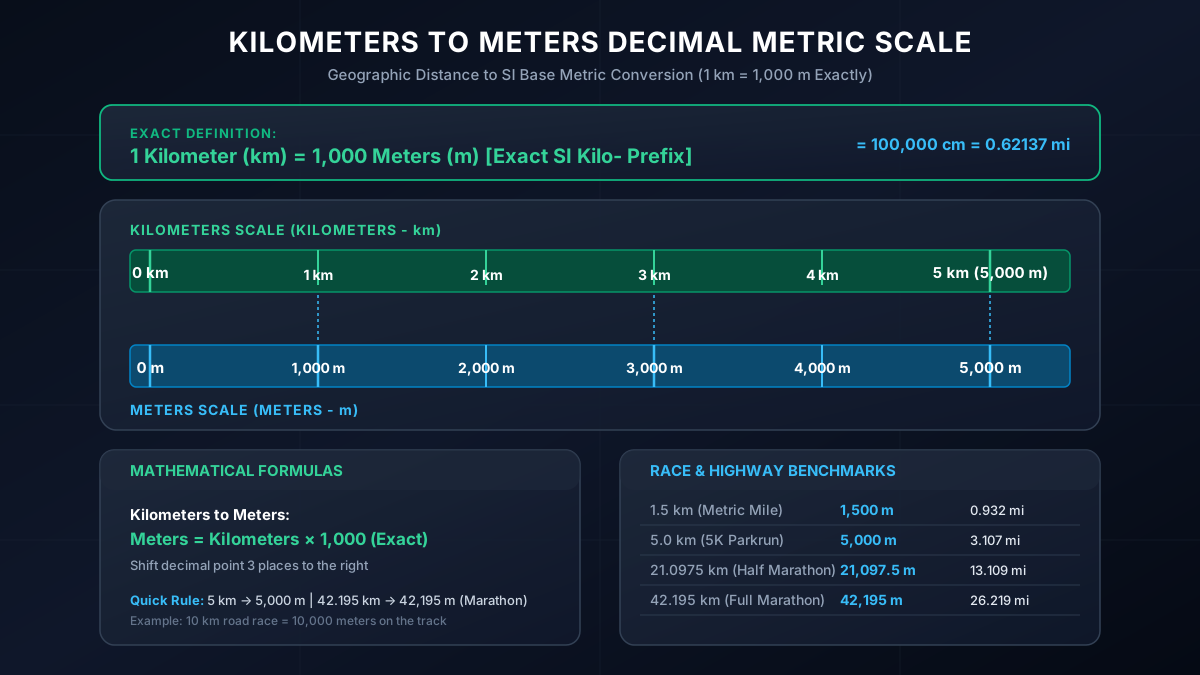
The Meter is the primary base unit of length in the International System of Units (SI). The prefix Kilo- represents an exact factor of $1,000$ (). Therefore, converting kilometers to meters requires multiplying by an exact integer factor of 1,000 (shifting the decimal point 3 places to the right).
The Kilometers to Meters Converter delivers instant, bidirectional calculations across kilometers, meters, centimeters, millimeters, miles, and feet. This comprehensive guide covers running race distances (5K, 10K, Half Marathon, Marathon), SI metric prefixes, physics kinematic calculations, fast mental math rules, and engineering reference tables.
2. Core Definitions & Analogy
To understand geographic-to-base scaling in the SI metric system, let us review their core definitions:
- Simple Definition: A kilometer is a large metric unit of distance equal to 1,000 meters (about a 10 to 12-minute walk), while a meter is the base unit of length (roughly 39.37 inches). There are exactly 1,000 meters in 1 kilometer.
- Technical Definition: The Kilometer ():* Formally defined as ().The Meter ():* Defined as the distance traveled by light in a vacuum in $1 / 299,792,458$ seconds.
- The 400-Meter Running Track Analogy: Imagine standing on a standard 400-meter outdoor Olympic running track. Running 2.5 complete laps equals exactly 1 kilometer (1,000 meters). If you run a 5K road race, you are running the exact equivalent of 12.5 track laps (5,000 meters).
3. The Base-10 Decimal Advantage
The SI metric system eliminates fractional multipliers:
flowchart LR
    KM["Kilometer (km)
1,000 m (10³ m)"] -->|× 1,000| M["Meter (m)
1 m (SI Base Unit)"]
    M -->|× 100| CM["Centimeter (cm)
0.01 m (10⁻² m)"]
    CM -->|× 10| MM["Millimeter (mm)
0.001 m (10⁻³ m)"]
Because 1 kilometer equals , converting km to meters involves simply moving the decimal point three places to the right, guaranteeing zero arithmetic rounding errors.
4. The Mathematical Formulas
Converting kilometers to meters is direct and exact:
Exact Mathematical Formulas:
Fast Mental Arithmetic (Shift Right 3 Places):
- To convert kilometers to meters, shift the decimal point 3 positions to the right (or add 3 zeros to a whole number):Example (5 km): (5K race!)*.Example (10 km): (10K track event!)*.Example (21.0975 km): (Official Half Marathon!)*.Example (42.195 km): (Official Marathon!)*.
5. Comprehensive Kilometers to Meters Lookup Table
| Kilometers () | Meters () | Centimeters () | Miles () | Feet () | Real-World Context |
|---|---|---|---|---|---|
| 0.1 km | 100 m | 10,000 cm | 0.0621 mi | 328.08 ft | 100-meter Olympic premier sprint |
| 0.4 km | 400 m | 40,000 cm | 0.2485 mi | 1,312.34 ft | Standard athletic running track lap |
| 0.8 km | 800 m | 80,000 cm | 0.4971 mi | 2,624.67 ft | 800-meter middle distance run |
| 1.0 km | 1,000 m | 100,000 cm | 0.6214 mi | 3,280.84 ft | 1 Kilometer Baseline |
| 1.5 km | 1,500 m | 150,000 cm | 0.9321 mi | 4,921.26 ft | Olympic "Metric Mile" track race |
| 3.0 km | 3,000 m | 300,000 cm | 1.8641 mi | 9,842.52 ft | 3,000m steeplechase event |
| 5.0 km | 5,000 m | 500,000 cm | 3.1069 mi | 16,404.20 ft | Official 5K Road Race / Parkrun |
| 8.0 km | 8,000 m | 800,000 cm | 4.9710 mi | 26,246.72 ft | ~5-mile road distance |
| 10.0 km | 10,000 m | 1,000,000 cm | 6.2137 mi | 32,808.40 ft | Official 10K Road Championship |
| 21.0975 km | 21,097.5 m | 2,109,750 cm | 13.1094 mi | 69,217.52 ft | Official Half Marathon |
| 42.1950 km | 42,195.0 m | 4,219,500 cm | 26.2188 mi | 138,435.04 ft | Official Full Marathon |
| 50.0 km | 50,000 m | 5,000,000 cm | 31.0686 mi | 164,041.99 ft | Ultramarathon base distance |
| 100.0 km | 100,000 m | 10,000,000 cm | 62.1371 mi | 328,083.99 ft | 100K Century Ultramarathon |
6. Step-by-Step Practical Calculation Examples
Example 1: Physics Kinematic Velocity Calculation
- Scenario: A high-speed electric train travels a distance of 18.5 kilometers in 6 minutes (). Calculate its average velocity in SI standard meters per second ($m/s$).
- Step 1 (Convert km to m):
- Step 2 (Calculate Velocity):
Example 2: Athletic Race Distance Verification
- Scenario: A race director certifies a marathon course measuring 42.195 kilometers. How many meters must the lead timing vehicle travel?
- Calculation:
7. Major Real-World Applications
flowchart LR
    KM2M["Kilometers to Meters Conversion"] --> SPORT["Athletics: Converting 5K, 10K & Marathon road race distances to track meters"]
    KM2M --> PHYS["Physics & Mechanics: Converting km distances into SI base meters for kinematics (v = d/t)"]
    KM2M --> GIS["Civil Engineering: Translating GPS road coordinates to site surveying total stations"]
KM2M --> MAP["Cartography: Scale ratios on topographical maps (1:50,000 -> 1 cm = 500 m = 0.5 km)"]- Athletics Track Equivalencies: Track and field championship events are scheduled by meter designations (1,500m, 5,000m, 10,000m), while road running events are titled in kilometers (5K, 10K).
- Physics Equations: All mechanical physics formulas (, , ) require distance strictly in meters to compute Joules () and Watts ().
- Topographical Map Scales: A standard $1:25,000$ topographic map means on paper equals () on the ground.
8. Frequently Asked Questions (FAQ)
- How many meters are in 1 kilometer?There are exactly 1,000 meters in 1 kilometer.
- What is the fastest way to convert km to meters?Multiply by 1,000 or shift the decimal point three places to the right ().
- Why is the prefix kilo- used?The prefix kilo- originates from the Greek word chilioi (), meaning "one thousand".
9. Expert Summary & Best Practices
- Multiply by 1,000: Always multiply kilometers by $1,000$ for exact SI conversions.
- Normalize in Physics: In scientific mechanics equations, always convert kilometers to meters before computing kinetic energy, acceleration, or work.
- Exact Decimal Conversion: Because is an integer constant, precision is 100% preserved with zero rounding loss.
Additional Technical Guidelines & Measurement Standards
When conducting calculations for Kilometers to Meters Converter, maintaining quantitative precision and verifying input parameter boundaries is essential for reliable scenario evaluation. Always verify that raw numerical inputs are measured using standardized instrumentation, and double-check unit conversions prior to applying outputs in commercial, industrial, or academic projects.
For quantitative unit conversions and scientific calculations, always maintain at least four decimal places of precision during intermediate arithmetic stages before rounding final results. When preparing technical reports, laboratory documentation, or financial forecasts, cross-verify all output variables against established international measurement standards (such as SI, NIST, and ISO metric benchmarks) to guarantee consistent analytical rigor across all computational workflows.
MathsLover.com delivers this interactive solver 100% free of charge to foster global mathematical literacy, educational accessibility, and data-driven problem solving across scientific, technical, and academic communities worldwide.