💡 Direct Answer & Executive Summary (Kilograms to Grams Converter)
Definition: Convert Kilograms (kg) to Grams (g) instantly using custom inputs or dynamic unit selectors.
Governing Math Formula: 1 Kilograms (kg) = 1000.000000 Grams (g). Formula: Value in Kilograms (kg) × 1000.000000 = Value in Grams (g).
Target Applications: Provides real-time quantitative solutions in Unit Converters for students, engineers, researchers, and finance professionals.
Kilograms to Grams Converter - Precision Mass Guide
1. Introduction
In culinary arts, laboratory chemistry, nutritional dietetics, pharmaceutical manufacturing, industrial inventory, and international commerce, converting Metric Kilograms (kg) to Metric Grams (g) is the foundational decimal scale transformation in the International System of Units (SI).
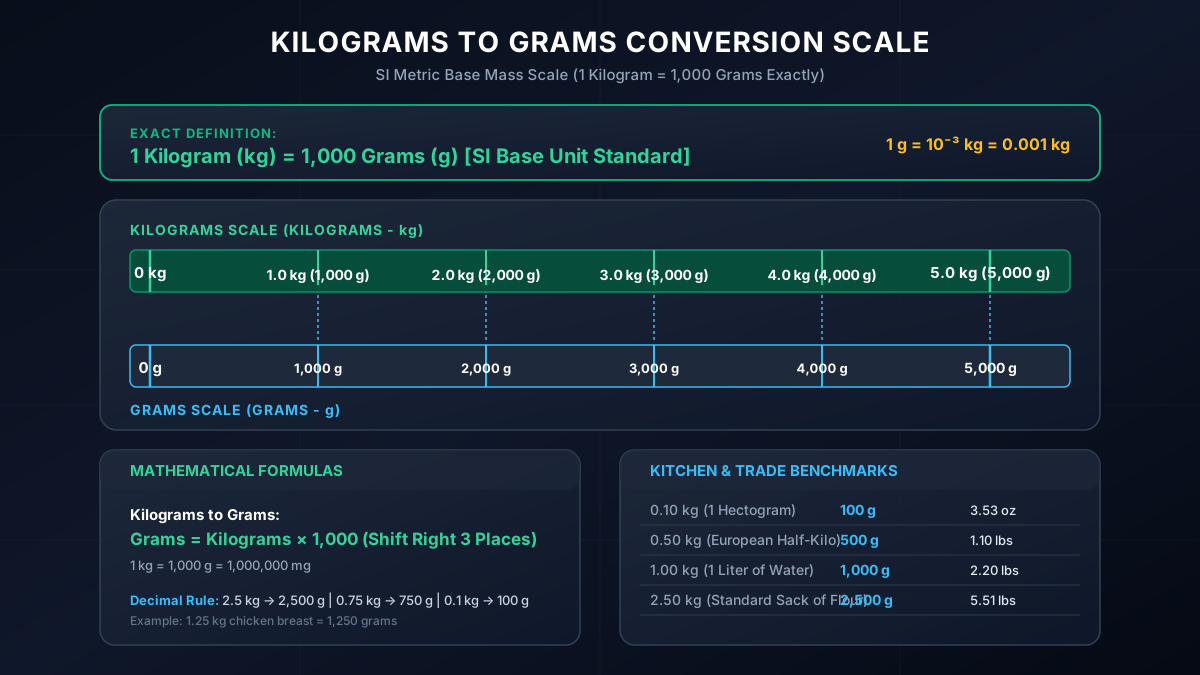
Under the SI decimal prefix framework defined by the International Bureau of Weights and Measures (BIPM), the prefix kilo- represents a multiplication factor of ($1,000$). Therefore, 1 kilogram equals exactly 1,000 Grams, and 1 gram equals exactly 0.001 Kilograms:
The Kilograms to Grams Converter delivers instantaneous, bidirectional precision calculations across kilograms, grams, milligrams (mg), pounds (lbs), and ounces. This comprehensive guide covers grocery benchmarks (, ), 1-liter water mass equivalence, laboratory reagent prep, and the "Shift Right 3 Places" decimal rule.
2. Core Definitions & Analogy
To understand mass expansion from kilograms into grams, let us review their core definitions:
- Simple Definition: A kilogram is the base metric unit of mass (about the weight of a 1-liter bottle of water), while a gram is 1,000 times smaller (about the weight of a paperclip). To convert kilograms to grams, you multiply by 1,000 (shift the decimal point 3 places to the right).
- Technical Definition: The Kilogram ():* The SI base unit of mass, defined since 2019 by fixing the numerical value of the Planck constant ().The Gram ():* Defined as .
- The 1-Liter Water Bottle Analogy: One liter of pure liquid water at has a mass of exactly 1.0 kilogram. If you divide that bottle into 1,000 individual cubic-centimeter droplets, each droplet has a mass of exactly 1.0 gram (1 g).
3. The Mathematical Formulas
Converting kilograms to grams involves multiplying by 1,000:
Exact Mathematical Formulas:
The "Shift Right 3 Places" Decimal Rule:
- Because 1,000 is , simply move the decimal point 3 positions to the right:Example (0.10 kg): (1 Hectogram snack portion!)*.Example (0.50 kg): (European half-kilo!)*.Example (1.25 kg): (Whole chicken!)*.Example (2.50 kg): (Sack of flour!)*.
4. Comprehensive Kilograms to Grams Lookup Table
| Kilograms () | Grams () | Milligrams () | Pounds () | Real-World Context |
|---|---|---|---|---|
| 0.05 kg | 50 g | 50,000 mg | 0.110 lbs | Medium chicken egg |
| 0.10 kg | 100 g | 100,000 mg | 0.220 lbs | 1 Hectogram chocolate bar |
| 0.25 kg | 250 g | 250,000 mg | 0.551 lbs | Standard tub of ricotta cheese |
| 0.4536 kg | 453.59 g | 453,592 mg | 1.000 lb | 1 Standard US Avoirdupois Pound |
| 0.50 kg | 500 g | 500,000 mg | 1.102 lbs | European standard half-kilo pack |
| 0.75 kg | 750 g | 750,000 mg | 1.653 lbs | Standard bottle of olive oil |
| 1.00 kg | 1,000 g | 1,000,000 mg | 2.205 lbs | 1 Liter of Pure Water |
| 1.50 kg | 1,500 g | 1,500,000 mg | 3.307 lbs | Small roasting chicken |
| 2.00 kg | 2,000 g | 2,000,000 mg | 4.409 lbs | 2-Kilogram bag of rice |
| 2.50 kg | 2,500 g | 2,500,000 mg | 5.512 lbs | Standard consumer flour bag |
| 5.00 kg | 5,000 g | 5,000,000 mg | 11.023 lbs | Dumbbell / bag of potatoes |
5. Step-by-Step Practical Calculation Examples
Example 1: Commercial Bakery Sourdough Batch
- Scenario: A bakery production schedule requires 4.5 kg of whole wheat flour. The digital bench scale measures in grams. How many grams of flour are required?
- Calculation:
Example 2: Laboratory Chemical Stock Formulation
- Scenario: A biochemist prepares an aqueous buffer requiring 0.325 kg of anhydrous glucose. What is the mass in grams?
- Calculation:
6. Major Real-World Applications
flowchart LR
    KG2G["Kilograms to Grams Conversion"] --> CULINARY["Culinary & Pastry: Converting bulk warehouse kg to precision recipe grams"]
    KG2G --> PHARMA["Pharma Compounding: Sizing active ingredient bulk kg into unit grams"]
    KG2G --> POSTAL["Postal & Air Cargo: Measuring parcel weight in kilograms for gram rate tiers"]
KG2G --> FITNESS["Sports Nutrition: Tracking daily protein grams from bulk kg bulk purchase tubs"]- Artisan Baking & Cooking: Professional kitchens buy raw ingredients in kilograms (25-kg bags) and measure daily recipes in grams on digital scales.
- Pharmaceutical Manufacturing: Production lines measure bulk active ingredients in kilograms and scale down to grams for master batch records.
- Postal Parcel Fulfillment: Courier services calculate international customs declarations by converting gross package kilograms to item grams.
7. Frequently Asked Questions (FAQ)
- How many grams are in 1 kilogram?There are exactly 1,000 grams in 1 kilogram.
- How many grams is 2.5 kg?.
- What is the formula to convert kg to g?Multiply kilograms by 1,000 ().
8. Expert Summary & Best Practices
- Multiply by 1,000: Always multiply kilograms by $1,000$.
- Shift Decimal 3 Places Right: Move the decimal point 3 places right ().
- Exact SI Prefix Definition: Because kilo- is an exact power of ten (), conversions between kilograms and grams never introduce rounding errors.
Additional Technical Guidelines & Measurement Standards
When conducting calculations for Kilograms to Grams Converter, maintaining quantitative precision and verifying input parameter boundaries is essential for reliable scenario evaluation. Always verify that raw numerical inputs are measured using standardized instrumentation, and double-check unit conversions prior to applying outputs in commercial, industrial, or academic projects.
For quantitative unit conversions and scientific calculations, always maintain at least four decimal places of precision during intermediate arithmetic stages before rounding final results. When preparing technical reports, laboratory documentation, or financial forecasts, cross-verify all output variables against established international measurement standards (such as SI, NIST, and ISO metric benchmarks) to guarantee consistent analytical rigor across all computational workflows.
MathsLover.com delivers this interactive solver 100% free of charge to foster global mathematical literacy, educational accessibility, and data-driven problem solving across scientific, technical, and academic communities worldwide.