💡 Direct Answer & Executive Summary (Inches to Millimeters Converter)
Definition: Convert Inches (in) to Millimeters (mm) instantly using custom inputs or dynamic unit selectors.
Governing Math Formula: 1 Inches (in) = 25.400000 Millimeters (mm). Formula: Value in Inches (in) × 25.400000 = Value in Millimeters (mm).
Target Applications: Provides real-time quantitative solutions in Unit Converters for students, engineers, researchers, and finance professionals.
Inches to Millimeters Converter - Precision Engineering & Tolerance Guide
1. Introduction
In mechanical engineering, aerospace propulsion, precision machining, hardware manufacturing, and electronic packaging, converting Inches (in) to Millimeters (mm) is the fundamental dimensional conversion that bridges American manufacturing standards with international metric production.
The Inch is the basic unit of linear measure in the US Customary and Imperial systems, traditionally divided into binary fractions ($1/2, 1/4, 1/8, 1/16, 1/32, 1/64$) or decimal thousandths ("mils" or "thou", ). The Millimeter is the universal metric engineering standard (), utilized across 95% of international manufacturing drawings and ISO standard specifications.
Under the 1959 International Yard and Pound Agreement:
The Inches to Millimeters Converter delivers instantaneous, bi-directional calculation across decimal and fractional inches, mils, millimeters, and micrometers. This comprehensive guide details fastener thread pitches, CNC G-code conversions, PCB electronics spacing, mental calculation techniques, and precision tolerance reference tables.
2. Core Definitions & Analogy
To develop an intuitive physical sense of fine engineering dimensions, let us review the primary definitions:
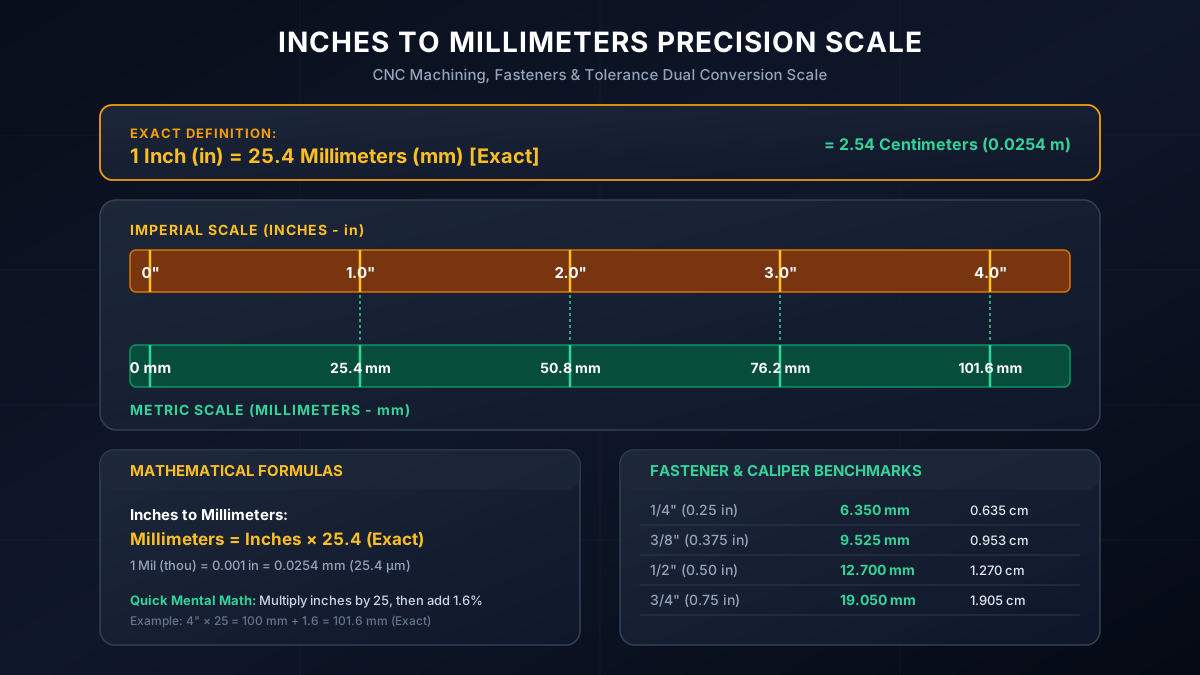
- Simple Definition: An inch is an imperial unit of length (about the width of a thumb), while a millimeter is a metric unit of length (about the thickness of an ID card). One inch contains exactly 25.4 millimeters.
- Technical Definition: The International Inch ():* Defined under international legal treaty since 1959 as exactly ().The Millimeter ():* One-thousandth of the SI base unit meter ().The Microinch ():* One-millionth of an inch ().
- The Ruler Analogy: Look at a standard 12-inch desk ruler that features metric markings on the opposite edge. Each 1-inch block aligns with 2.54 centimeters, which contains 25 full millimeter ticks plus just under half a millimeter.
3. History of the 25.4 mm Exact Standard
The standardization of the 25.4 mm relationship solved major industrial challenges:
flowchart TD
    A["Pre-1959: US Inch = 25.40005 mm vs UK Imperial Inch = 25.399956 mm"] --> B["WWII: Interchangeability challenges with aircraft engine threads & munitions"]
    B --> C["1959: International Agreement permanently fixes 1 Inch = 25.4 mm Exactly"]
    C --> D["Present Day: Global ISO, ANSI, ASME & DIN industrial fastener standards"]
Before 1959, the difference of 0.0001 mm between British and American inches was insignificant for carpentry, but caused critical tolerance failures in precision aerospace bearing assemblies. The 1959 treaty established 25.4 mm exactly, ensuring that parts fabricated in Detroit, London, Tokyo, or Stuttgart interchange seamlessly.
4. The Mathematical Formulas
Converting inches to millimeters is direct, linear, and exact:
Exact Mathematical Formulas:
Converting Fractional Inches to Millimeters:
- Convert fraction to decimal: e.g. .
- Multiply by 25.4:
Quick Mental Arithmetic Shortcut:
- Multiply inches by 25, then add 1.6%:Example (2 inches): (Exact!)*.Example (6 inches): (Exact!)*.
5. Comprehensive Inches to Millimeters Lookup Table
| Fractional Inches | Decimal Inches () | Millimeters () | Micrometers () | Industry Application |
|---|---|---|---|---|
| 1/64 in | 0.0156 in | 0.3969 mm | 396.9 µm | Shims and fine feeler gauges |
| 1/32 in | 0.0312 in | 0.7938 mm | 793.8 µm | Thin sheet gasket material |
| 1/16 in | 0.0625 in | 1.5875 mm | 1,587.5 µm | Standard PCB circuit board thickness (1.6 mm) |
| 1/8 in | 0.1250 in | 3.1750 mm | 3,175.0 µm | 1/8" audio headphone jack / small hardware |
| 3/16 in | 0.1875 in | 4.7625 mm | 4,762.5 µm | Automotive brake hydraulic line diameter |
| 1/4 in | 0.2500 in | 6.3500 mm | 6,350.0 µm | 1/4" guitar cable plug / drive bit socket |
| 5/16 in | 0.3125 in | 7.9375 mm | 7,937.5 µm | 5/16" hardware bolt (~8 mm) |
| 3/8 in | 0.3750 in | 9.5250 mm | 9,525.0 µm | 3/8" socket wrench ratchet drive (~10 mm) |
| 1/2 in | 0.5000 in | 12.7000 mm | 12,700.0 µm | 1/2" copper plumbing pipe / bolt |
| 5/8 in | 0.6250 in | 15.8750 mm | 15,875.0 µm | 5/8" drywall thickness / garden hose diameter |
| 3/4 in | 0.7500 in | 19.0500 mm | 19,050.0 µm | 3/4" plumbing pipe / subflooring plywood |
| 7/8 in | 0.8750 in | 22.2250 mm | 22,225.0 µm | Bicycle handlebar clamp diameter (22.2 mm) |
| 1 in | 1.0000 in | 25.4000 mm | 25,400.0 µm | 1-inch hardware baseline |
| 2 in | 2.0000 in | 50.8000 mm | 50,800.0 µm | 2-inch structural steel tube |
| 4 in | 4.0000 in | 101.6000 mm | 101,600.0 µm | 4-inch PVC sewer drain pipe |
6. Step-by-Step Practical Calculation Examples
Example 1: Selecting Metric Wrench for 9/16" Hex Bolt
- Scenario: A mechanic needs to find the closest metric socket for a 9/16-inch bolt.
- Calculation:
- Recommendation: A 14 mm socket will be slightly too tight (14.0 mm < 14.29 mm), while a 15 mm socket will fit with slight clearance (0.7 mm gap). The ideal tool is an authentic 9/16" socket.
Example 2: Electronic Pin Header Pitch
- Scenario: Standard through-hole electronics pin headers have an imperial pitch of 0.1 inches (100 mils). What is this spacing in millimeters?
- Calculation:
- Result: Standard Arduino and Raspberry Pi breadboards use this exact 2.54 mm grid pitch.
7. Major Real-World Applications
flowchart LR
    ITMM["Inches to Millimeters Conversion"] --> FAST["Fasteners: Machine screws (UNC/UNF threads to ISO metric coarse/fine)"]
    ITMM --> SEMI["Semiconductors: Silicon wafer diameters (8 in = 200mm, 12 in = 300mm)"]
    ITMM --> PIPING["Plumbing & HVAC: Nominal Pipe Size (NPS) to Metric Diameter Nominal (DN)"]
ITMM --> DENT["Dentistry & Surgery: Orthopedic bone screws & dental implants"]- Standard Fastener Interchangeability: Industrial design drawings specify screw thread pitches in Threads Per Inch (TPI) for imperial bolts (e.g. 1/4"-20 UNC) and millimeter pitch for metric bolts (e.g. M6 x 1.0 mm).
- Nominal Pipe Sizing (NPS to DN):* ()* ()* ()
- Silicon Wafer Diameters: Semiconductor foundries (TSMC, Intel, Samsung) classify fabrication lines as 200 mm (8-inch) and 300 mm (12-inch) wafer facilities.
8. Frequently Asked Questions (FAQ)
- Is 1 inch equal to 25 mm or 25.4 mm?1 inch is exactly 25.4 mm. Rounding to 25 mm introduces a significant 1.6% error ( per inch), which causes severe fitment failures in precision tooling.
- What is 1 mil in millimeters?.
- Why are Arduino pin headers spaced at 2.54 mm?Because breadboards and DIP integrated circuits were originally standardized around a 0.1-inch (100-mil) grid ().
9. Expert Summary & Best Practices
- Apply 25.4 Exact: Never round the 25.4 conversion multiplier in computer code, formulas, or spreadsheets.
- Verify Thread Standards: Never force a metric M6 bolt into a 1/4"-20 imperial threaded hole, even though their outer diameters ( vs ) appear similar.
- Convert Binary Fractions Accurately: Always calculate decimal values before applying the 25.4 factor ().
Additional Technical Guidelines & Measurement Standards
When conducting calculations for Inches to Millimeters Converter, maintaining quantitative precision and verifying input parameter boundaries is essential for reliable scenario evaluation. Always verify that raw numerical inputs are measured using standardized instrumentation, and double-check unit conversions prior to applying outputs in commercial, industrial, or academic projects.
For quantitative unit conversions and scientific calculations, always maintain at least four decimal places of precision during intermediate arithmetic stages before rounding final results. When preparing technical reports, laboratory documentation, or financial forecasts, cross-verify all output variables against established international measurement standards (such as SI, NIST, and ISO metric benchmarks) to guarantee consistent analytical rigor across all computational workflows.
MathsLover.com delivers this interactive solver 100% free of charge to foster global mathematical literacy, educational accessibility, and data-driven problem solving across scientific, technical, and academic communities worldwide.