💡 Direct Answer & Executive Summary (Hectares to Acres Converter)
Definition: Convert Hectares (ha) to Acres instantly using custom inputs or dynamic unit selectors.
Governing Math Formula: 1 Hectares (ha) = 2.471054 Acres. Formula: Value in Hectares (ha) × 2.471054 = Value in Acres.
Target Applications: Provides real-time quantitative solutions in Unit Converters for students, engineers, researchers, and finance professionals.
Hectares to Acres Converter - Land Area Guide
1. Introduction
In international agriculture, forestry management, global environmental conservation, geospatial GIS mapping, commercial agribusiness, and cross-border land acquisition, converting Hectares (ha) to International Acres (ac) is the essential area conversion connecting the metric System of Units (SI) with US Customary and British Imperial land measurement systems.
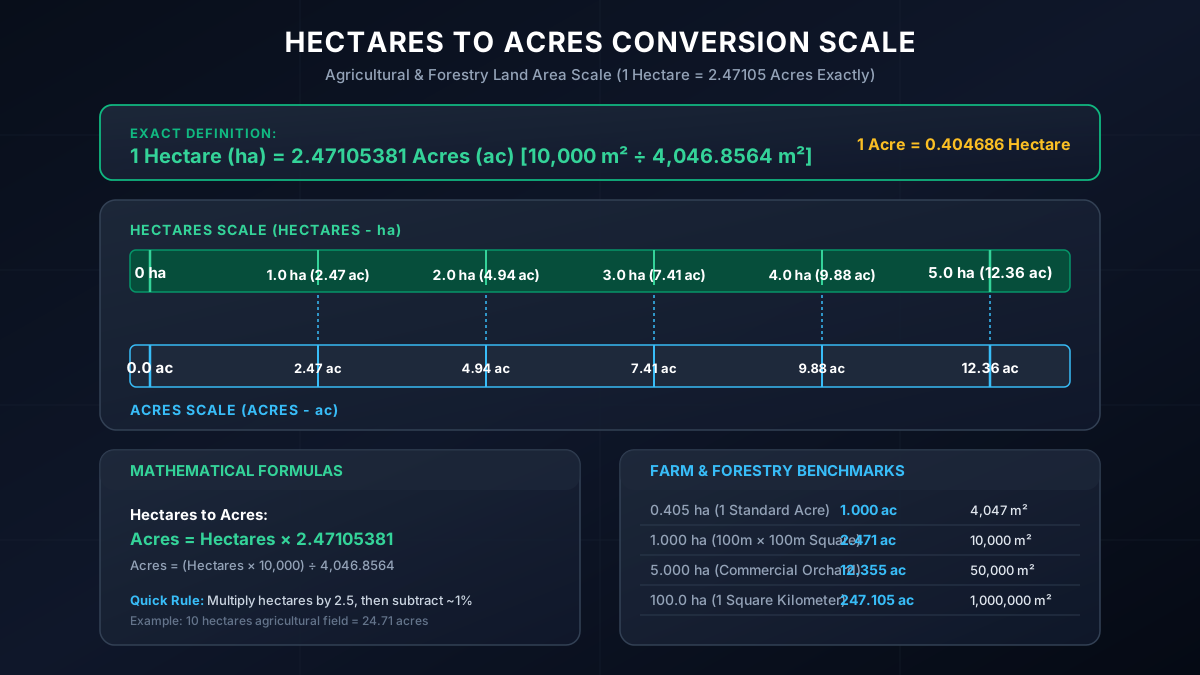
Under the International System of Units (SI), 1 Hectare represents a square measuring 100 meters on each side, which equals exactly 10,000 Square Meters (m²). Because 1 International Acre is legally defined as containing 4,046.8564224 Square Meters, 1 hectare equals approximately 2.47105381 Acres:
The Hectares to Acres Converter provides instantaneous, bidirectional calculations across hectares, acres, square meters, square feet, and square kilometers. This comprehensive guide covers agricultural parcel benchmarks (, , ), forestry tract sizing, and fast mental math shortcuts.
2. Core Definitions & Analogy
To understand land area expansion from hectares into acres, let us review their core definitions:
- Simple Definition: A hectare is a metric unit of land equal to 10,000 square meters (about the size of 2.5 football fields), while an acre is an imperial unit of land. One hectare contains approximately 2.47 acres.
- Technical Definition: The Hectare ():* Exactly .The Acre ():* Exactly .
- The Football Field Grid Analogy: A standard American football field (including end zones) occupies approximately 1.32 acres. One single hectare (2.47 acres) is spacious enough to easily fit nearly two complete regulation football fields side-by-side.
3. The Mathematical Formulas
Converting hectares to acres involves exact decimal multiplication by 2.47105381:
Exact Mathematical Formulas:
Quick Mental Arithmetic (Multiply by 2.5, then minus 1%):
- To estimate in your head, multiply hectares by 2.5, then subtract about 1%:Example (1.0 ha): (Exact 1 hectare!)*.Example (2.0 ha): (5-acre hobby farm!)*.Example (5.0 ha): (Commercial orchard!)*.Example (10.0 ha): (25-acre ranch!)*.
4. Comprehensive Hectares to Acres Lookup Table
| Hectares () | Acres () | Square Meters ($m²$) | Square Feet () | Real-World Context |
|---|---|---|---|---|
| 0.10 ha | 0.247 ac | 1,000 m² | 10,764 sq ft | Large residential building plot |
| 0.405 ha | 1.000 ac | 4,047 m² | 43,560 sq ft | 1 Full American Acre Benchmark |
| 0.50 ha | 1.236 ac | 5,000 m² | 53,820 sq ft | Small equestrian paddock |
| 1.00 ha | 2.471 ac | 10,000 m² | 107,639 sq ft | 1 Hectare (100m × 100m Square) |
| 2.00 ha | 4.942 ac | 20,000 m² | 215,278 sq ft | Vineyard / Hobby farm |
| 5.00 ha | 12.355 ac | 50,000 m² | 538,196 sq ft | Commercial fruit orchard |
| 10.00 ha | 24.711 ac | 100,000 m² | 1,076,391 sq ft | Medium-sized grain or dairy farm |
| 25.00 ha | 61.776 ac | 250,000 m² | 2,690,978 sq ft | Large livestock grazing property |
| 50.00 ha | 123.553 ac | 500,000 m² | 5,381,955 sq ft | Commercial agricultural enterprise |
| 100.00 ha | 247.105 ac | 1,000,000 m² | 10,763,910 sq ft | 1 Square Kilometer (1.00 km²) |
| 259.00 ha | 640.000 ac | 2,589,988 m² | 27,878,400 sq ft | 1 Square Mile (640 Acres / Section) |
5. Step-by-Step Practical Calculation Examples
Example 1: European Vineyard Acquisition
- Scenario: An international agricultural investment fund acquires an estate in Bordeaux, France, comprising 18.5 hectares of vineyards. What is this property size in acres for US investors?
- Calculation:
Example 2: Forestry Carbon Offset Sizing
- Scenario: A rainforest reforestation project restores 250 hectares of tropical tree canopy. How many acres of conservation land does this represent?
- Calculation:
6. Major Real-World Applications
flowchart LR
    HA2AC["Hectares to Acres Conversion"] --> AGRI["Agribusiness: Converting European farm hectares into US commodity acres"]
    HA2AC --> FORESTRY["Forestry: Translating timber canopy hectares into logging tract acres"]
    HA2AC --> CARBON["Carbon Credits: Calculating carbon offset sequestration per acre from ha"]
HA2AC --> GIS["Geospatial GIS: Rendering global land classification hectares into imperial acres"]- International Agribusiness & Crop Reports: Global agricultural agencies (USDA, FAO) standardize international crop acreage reports between metric hectares and US acres.
- Forestry & Conservation Management: Wildfire prevention zones, national parks, and timberland leases measured in hectares are communicated to domestic stakeholders in acres.
- Renewable Energy & Wind Farms: Large-scale utility solar and wind turbine leases convert metric terrain hectares into imperial landowner contracts.
7. Frequently Asked Questions (FAQ)
- How many acres is 1 hectare?There are approximately 2.47105381 acres in 1 hectare ().
- How many acres is 10 hectares?.
- What is the formula to convert hectares to acres?Multiply hectares by 2.47105381 ().
8. Expert Summary & Best Practices
- Multiply by 2.47105: Always multiply hectares by $2.47105381$ for exact conversion.
- Fast Mental Shortcut: Multiply by 2.5, then subtract 1% ().
- Exact Statutory Constant: Derived from the exact international definitions and .
Additional Technical Guidelines & Measurement Standards
When conducting calculations for Hectares to Acres Converter, maintaining quantitative precision and verifying input parameter boundaries is essential for reliable scenario evaluation. Always verify that raw numerical inputs are measured using standardized instrumentation, and double-check unit conversions prior to applying outputs in commercial, industrial, or academic projects.
For quantitative unit conversions and scientific calculations, always maintain at least four decimal places of precision during intermediate arithmetic stages before rounding final results. When preparing technical reports, laboratory documentation, or financial forecasts, cross-verify all output variables against established international measurement standards (such as SI, NIST, and ISO metric benchmarks) to guarantee consistent analytical rigor across all computational workflows.
MathsLover.com delivers this interactive solver 100% free of charge to foster global mathematical literacy, educational accessibility, and data-driven problem solving across scientific, technical, and academic communities worldwide.