💡 Direct Answer & Executive Summary (Gallons to Liters Converter)
Definition: Convert Gallons (gal) to Liters (L) instantly using custom inputs or dynamic unit selectors.
Governing Math Formula: 1 Gallons (gal) = 3.785412 Liters (L). Formula: Value in Gallons (gal) × 3.785412 = Value in Liters (L).
Target Applications: Provides real-time quantitative solutions in Unit Converters for students, engineers, researchers, and finance professionals.
Gallons to Liters Converter - Fluid Volume Guide
1. Introduction
In automotive refueling, cross-border shipping, commercial chemical batching, pool maintenance, and international brewing, converting US Liquid Gallons (gal) to Liters (L) is the critical conversion when adapting American customary volume measurements to standard metric units.
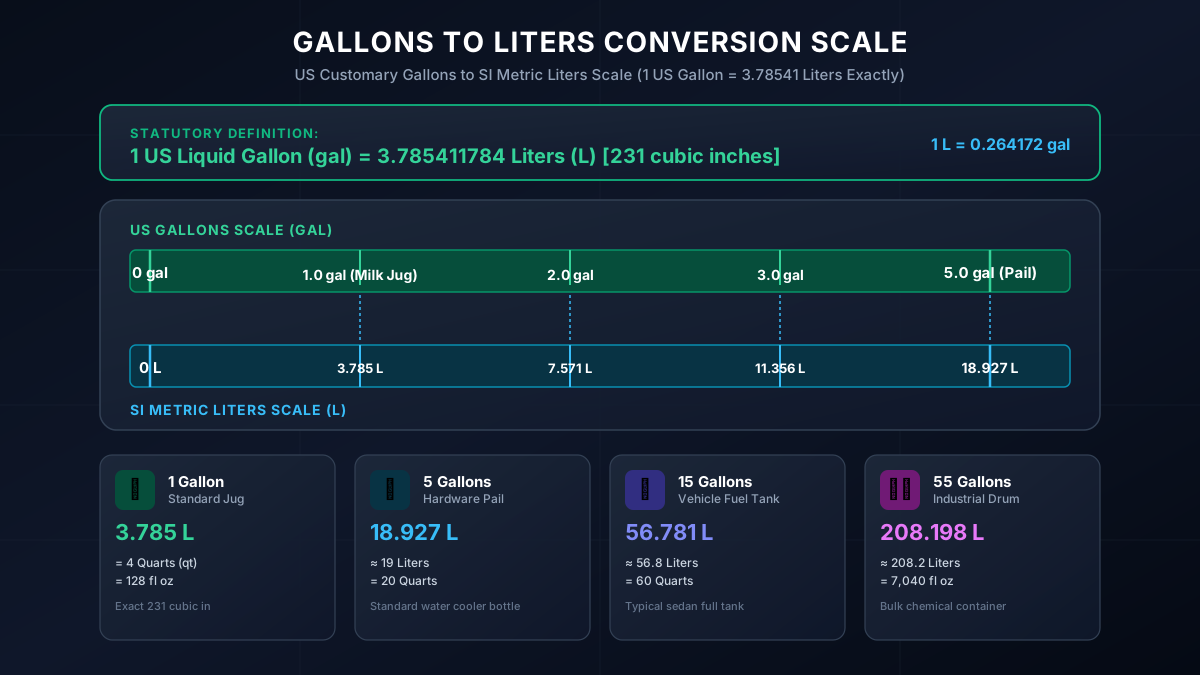
Under international metrological definitions adopted by the US National Institute of Standards and Technology (NIST), 1 US Liquid Gallon is defined as exactly 231 cubic inches, translating into exactly 3.785411784 Liters:
The Gallons to Liters Converter provides instant, bi-directional fluid volume calculations across US liquid gallons, metric liters, imperial UK gallons, quarts, pints, milliliters, and cubic meters. This guide covers everyday volume benchmarks (, , ), tank capacity conversions, and practical mental multiplication shortcuts.
2. Core Definitions & Analogy
To understand fluid capacity conversion between customary gallons and metric liters, let us examine their formal foundations:
- Simple Definition: A US gallon is a large standard container size (such as a family milk jug or paint bucket), while a liter is a smaller metric unit (similar to a standard reusable drink bottle). One gallon equals approximately 3.79 liters.
- Technical Definition:The US Liquid Gallon ():* Exactly .The SI Liter ():* Equal to .The Imperial Gallon (UK):* Defined as (roughly 20% larger than the US gallon).
- The Reusable Bottle Pouring Analogy: Imagine you have an empty 1-gallon milk jug and standard 1-liter reusable water bottles. Pouring 3 full 1-liter bottles plus roughly three-quarters of a 4th bottle into the jug will fill it completely.
3. The Mathematical Formulas
Converting US gallons to liters requires multiplying by the standard NIST conversion factor:
Exact Mathematical Formulas:
Quick Mental Arithmetic (Multiply by 3.8 or 4 minus 5%):
- To estimate quickly without a calculator, multiply gallons by 4, then subtract roughly 5% from the result:Example (5 Gallons): (Actual: 18.93 L, accurate within 0.4%!)*.Example (10 Gallons): (Actual: 37.85 L)*.Example (15 Gallons): (Vehicle gas tank fill)*.
4. Comprehensive Gallons to Liters Lookup Table
| US Gallons () | Liters () | Milliliters () | Fluid Ounces () | Common Practical Context |
|---|---|---|---|---|
| 0.25 gal (1 qt) | 0.946 L | 946.35 mL | 32.0 fl oz | Motor oil bottle / quart carton |
| 0.50 gal (2 qt) | 1.893 L | 1,892.71 mL | 64.0 fl oz | Half-gallon ice cream or milk tub |
| 1.00 gal | 3.785 L | 3,785.41 mL | 128.0 fl oz | Standard 1-Gallon Milk Jug |
| 2.00 gal | 7.571 L | 7,570.82 mL | 256.0 fl oz | Garden watering can |
| 3.00 gal | 11.356 L | 11,356.24 mL | 384.0 fl oz | Small deep fryer / pressure pot |
| 4.00 gal | 15.142 L | 15,141.65 mL | 512.0 fl oz | Backpack herbicide sprayer |
| 5.00 gal | 18.927 L | 18,927.06 mL | 640.0 fl oz | Standard Paint Pail / Office Water Bottle |
| 10.00 gal | 37.854 L | 37,854.12 mL | 1,280.0 fl oz | Home brewing kettle / small aquarium |
| 15.00 gal | 56.781 L | 56,781.18 mL | 1,920.0 fl oz | Typical Compact / Midsize Sedan Fuel Tank |
| 20.00 gal | 75.708 L | 75,708.24 mL | 2,560.0 fl oz | Full-size truck fuel tank / stock tank |
| 30.00 gal | 113.562 L | 113,562.35 mL | 3,840.0 fl oz | Water heater tank / trash can |
| 55.00 gal | 208.198 L | 208,197.65 mL | 7,040.0 fl oz | Standard Industrial Steel Barrel / Drum |
| 100.00 gal | 378.541 L | 378,541.18 mL | 12,800.0 fl oz | Agricultural spray tank |
| 250.00 gal | 946.353 L | 946,352.95 mL | 32,000.0 fl oz | Heating oil tank / intermediate IBC tank |
5. Step-by-Step Practical Calculation Examples
Example 1: Calculating Gas Tank Fill-up in Liters
- Problem: An American driver renting a vehicle abroad wants to calculate the fuel volume needed to fill a 16-gallon tank.
- Formula:
- Calculation:
- Result: Filling the 16-gallon fuel tank requires 60.57 Liters of gasoline.
Example 2: Water Treatment Chemicals for a 500-Gallon Spa
- Problem: A hot tub holds 500 US gallons. Water treatment dosage guidelines require 5 mL of clarifier per 100 liters of water.
- Step 1: Convert gallons to liters:
- Step 2: Calculate dosage:
- Result: The spa requires 1,893 Liters of water and approximately 95 mL of clarifier.
6. Frequently Asked Questions (FAQ)
What is the exact difference between US and UK gallons?
A US liquid gallon is defined as 231 cubic inches (), whereas a UK Imperial gallon is defined as . Thus, 1 UK gallon is approximately 1.20095 US gallons (or 20% larger).
How many liters are in a 5-gallon water cooler jug?
A standard 5-gallon office water bottle holds 18.93 Liters (often rounded to 19 L).
How do I convert dry gallons to liters?
A US Dry Gallon (used historically for grains and produce) is defined as 268.8025 cubic inches, which equals 4.40488 Liters. For liquids, always use the standard US Liquid Gallon ().
Additional Technical Guidelines & Measurement Standards
When conducting calculations for Gallons to Liters Converter, maintaining quantitative precision and verifying input parameter boundaries is essential for reliable scenario evaluation. Always verify that raw numerical inputs are measured using standardized instrumentation, and double-check unit conversions prior to applying outputs in commercial, industrial, or academic projects.
For quantitative unit conversions and scientific calculations, always maintain at least four decimal places of precision during intermediate arithmetic stages before rounding final results. When preparing technical reports, laboratory documentation, or financial forecasts, cross-verify all output variables against established international measurement standards (such as SI, NIST, and ISO metric benchmarks) to guarantee consistent analytical rigor across all computational workflows.
MathsLover.com delivers this interactive solver 100% free of charge to foster global mathematical literacy, educational accessibility, and data-driven problem solving across scientific, technical, and academic communities worldwide.