💡 Direct Answer & Executive Summary (Centimeters to Meters Converter)
Definition: Convert Centimeters (cm) to Meters (m) instantly using custom inputs or dynamic unit selectors.
Governing Math Formula: 1 Centimeters (cm) = 0.010000 Meters (m). Formula: Value in Centimeters (cm) × 0.010000 = Value in Meters (m).
Target Applications: Provides real-time quantitative solutions in Unit Converters for students, engineers, researchers, and finance professionals.
Centimeters to Meters Converter - Decimal Metric Guide
1. Introduction
In physics experiments, architectural floor plans, medical patient records, textile manufacturing, and global trade logistics, converting Centimeters (cm) to Meters (m) is the foundational decimal subunit conversion in the International System of Units (SI).
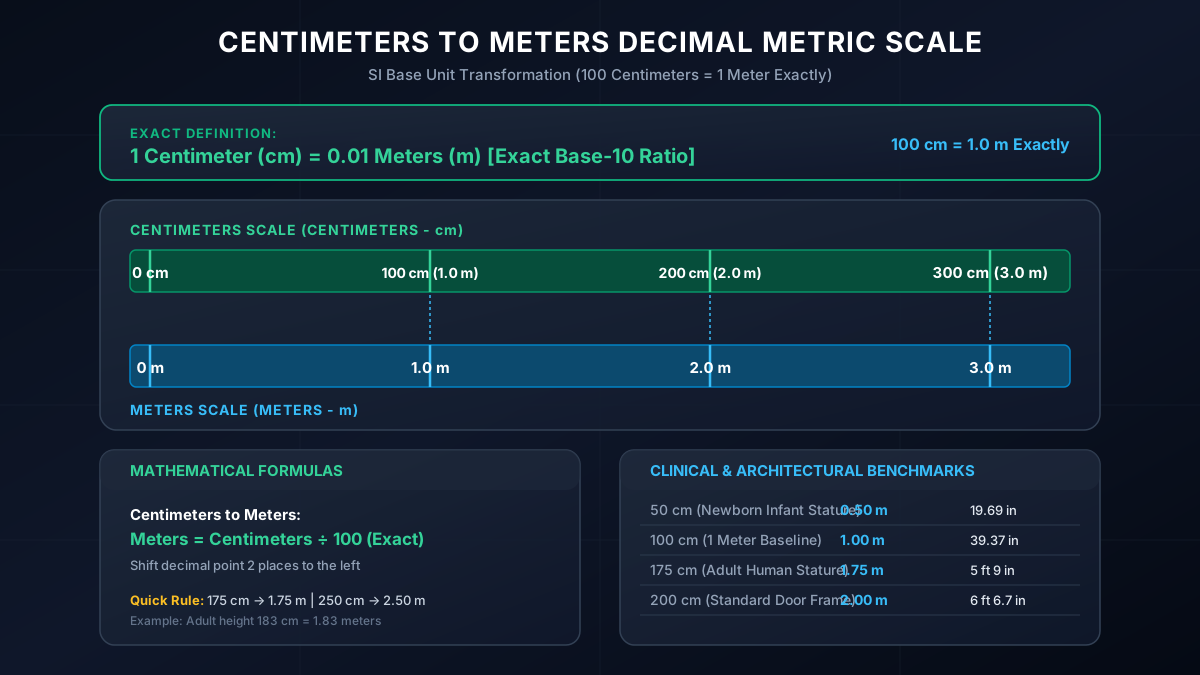
The Meter is the official base unit of length in the SI metric system, defined universally in terms of the fundamental speed of light in a vacuum. The Centimeter represents exactly one-hundredth () of a meter (), making conversion between the two units as simple as shifting the decimal point two places to the left.
The Centimeters to Meters Converter provides instant, bidirectional calculation across centimeters, meters, millimeters, inches, and feet. This guide explores the historical metric base-10 design, human stature clinical records (cm to m for BMI calculations), athletic track measurements, fast mental math rules, and architectural blueprint scaling.
2. Core Definitions & Analogy
To understand decimal length scaling in the metric system, let us review their core definitions:
- Simple Definition: A centimeter is a small metric length unit (about the width of a paperclip), while a meter is the metric base unit (slightly longer than a yardstick). There are exactly 100 centimeters in 1 meter.
- Technical Definition: The Meter ():* The fundamental SI unit of length, defined as the distance traveled by light in a vacuum in $1 / 299,792,458$ seconds.The Centimeter ():* A decimal sub-multiple equal to ().
- The 100-Cent Coin Analogy: Think of centimeters like pennies (cents) and meters like a 1-dollar bill. It takes exactly 100 cents to make 1 dollar, just as it takes exactly 100 centimeters to make 1 meter. If you have 175 cents, you have $1.75; if you have 175 cm, you have 1.75 meters.
3. The Base-10 Decimal Advantage
The beauty of the metric system lies in its base-10 structure:
flowchart LR
    MM["Millimeter (mm)
1/1,000 m (10⁻³ m)"] -->|× 10| CM["Centimeter (cm)
1/100 m (10⁻² m)"]
    CM -->|× 10| DM["Decimeter (dm)
1/10 m (10⁻¹ m)"]
    DM -->|× 10| M["Meter (m)
1 m (SI Base Unit)"]
    M -->|× 1,000| KM["Kilometer (km)
1,000 m (10³ m)"]
Unlike imperial conversions (which require multiplying or dividing by 12, 3, or 5,280), metric conversions require only moving the decimal point, eliminating arithmetic errors and rounding discrepancies.
4. The Mathematical Formulas
Converting centimeters to meters involves division by 100:
Exact Mathematical Formulas:
Fast Mental Arithmetic Shortcut (Shift Left 2 Places):
- To convert any centimeter measurement into meters, simply shift the decimal point 2 places to the left:Example (175 cm): (Standard adult height!)*.Example (250 cm): (Ceiling height!)*.Example (50 cm): (Infant birth length!)*.Example (8 cm):* .
5. Comprehensive Centimeters to Meters Lookup Table
| Centimeters () | Meters () | Millimeters () | Inches () | Feet & Inches ($ft\ in$) | Real-World Context |
|---|---|---|---|---|---|
| 1 cm | 0.01 m | 10 mm | 0.3937 in | 0 ft 0.39 in | Standard paperclip width |
| 5 cm | 0.05 m | 50 mm | 1.9685 in | 0 ft 1.97 in | Credit card height (5.4 cm) |
| 10 cm | 0.10 m | 100 mm | 3.9370 in | 0 ft 3.94 in | Hand palm width / 1 decimeter |
| 25 cm | 0.25 m | 250 mm | 9.8425 in | 0 ft 9.84 in | Dinner plate diameter |
| 50 cm | 0.50 m | 500 mm | 19.6850 in | 1 ft 7.69 in | Newborn infant birth length |
| 75 cm | 0.75 m | 750 mm | 29.5276 in | 2 ft 5.53 in | Standard office desk height |
| 100 cm | 1.00 m | 1,000 mm | 39.3701 in | 3 ft 3.37 in | 1 SI Base Meter |
| 120 cm | 1.20 m | 1,200 mm | 47.2441 in | 3 ft 11.24 in | Dining table width |
| 150 cm | 1.50 m | 1,500 mm | 59.0551 in | 4 ft 11.06 in | Standard fabric bolt width |
| 170 cm | 1.70 m | 1,700 mm | 66.9291 in | 5 ft 6.93 in | Average global adult stature |
| 180 cm | 1.80 m | 1,800 mm | 70.8661 in | 5 ft 10.87 in | Average adult male stature |
| 200 cm | 2.00 m | 2,000 mm | 78.7402 in | 6 ft 6.74 in | Standard residential doorway |
| 244 cm | 2.44 m | 2,440 mm | 96.0630 in | 8 ft 0.06 in | Standard 8-foot building drywall |
| 300 cm | 3.00 m | 3,000 mm | 118.1102 in | 9 ft 10.11 in | High ceiling room height |
| 5,000 cm | 50.00 m | 50,000 mm | 1,968.5039 in | 164 ft 0.50 in | Olympic 50M swimming pool |
6. Step-by-Step Practical Calculation Examples
Example 1: Clinical Body Mass Index (BMI) Calculation
- Scenario: A patient measures 182 cm in height at a medical clinic. To calculate BMI using the formula , the height must be expressed in meters.
- Calculation:
- Application: If the patient weighs , (Healthy weight range).
Example 2: Architectural CAD Plan Scaling
- Scenario: A European architectural drawing details a bedroom wall length of 465 cm. What is this dimension in standard decimal meters for the construction schedule?
- Calculation:
7. Major Real-World Applications
flowchart LR
    CTM["Centimeters to Meters Conversion"] --> MED["Healthcare: Converting patient height (cm) to meters for BMI & BSA equations"]
    CTM --> CAD["Architecture: Translating centimeter field measurements to meter floor plans"]
    CTM --> PHYS["Physics & Engineering: Normalizing laboratory experimental data into SI base meters"]
CTM --> SPORT["Athletics: High jump (245 cm = 2.45 m) & pole vault crossbar heights"]- Medical Clinical Formulas: All standard physiological formulas (Body Mass Index, Mosteller Body Surface Area, DuBois formula) require height expressed strictly in decimal meters.
- Athletics Crossbar Measurements: International track and field officials measure high jump crossbars in centimeters (e.g. world record ) and long jumps in meters ().
- Apparel & Fabric Design: Garment sewing patterns list dimensions in centimeters while commercial textile rolls are sold in linear meters.
8. Frequently Asked Questions (FAQ)
- How many meters is 150 centimeters?(or 1.5 m).
- What is the fastest way to convert cm to meters?Move the decimal point two positions to the left ().
- Why are there 100 centimeters in 1 meter?The prefix centi- is derived from the Latin centum, meaning "one hundred" or "one-hundredth" ().
9. Expert Summary & Best Practices
- Divide by 100: Always divide centimeters by (or multiply by $0.01$).
- Keep Units Consistent in Physics: In scientific mechanics equations (), always convert centimeters into SI base meters first to ensure correct SI derived units (Joules, Newtons, Pascals).
- Decimal Precision: For human stature clinical records, two decimal places () provides millimeter-level precision.
Additional Technical Guidelines & Measurement Standards
When conducting calculations for Centimeters to Meters Converter, maintaining quantitative precision and verifying input parameter boundaries is essential for reliable scenario evaluation. Always verify that raw numerical inputs are measured using standardized instrumentation, and double-check unit conversions prior to applying outputs in commercial, industrial, or academic projects.
For quantitative unit conversions and scientific calculations, always maintain at least four decimal places of precision during intermediate arithmetic stages before rounding final results. When preparing technical reports, laboratory documentation, or financial forecasts, cross-verify all output variables against established international measurement standards (such as SI, NIST, and ISO metric benchmarks) to guarantee consistent analytical rigor across all computational workflows.
MathsLover.com delivers this interactive solver 100% free of charge to foster global mathematical literacy, educational accessibility, and data-driven problem solving across scientific, technical, and academic communities worldwide.