💡 Direct Answer & Executive Summary (Centimeters to Kilometers Converter)
Definition: Convert Centimeters (cm) to Kilometers (km) instantly using custom inputs or dynamic unit selectors.
Governing Math Formula: 1 Centimeters (cm) = 0.000010 Kilometers (km). Formula: Value in Centimeters (cm) × 0.000010 = Value in Kilometers (km).
Target Applications: Provides real-time quantitative solutions in Unit Converters for students, engineers, researchers, and finance professionals.
Centimeters to Kilometers Converter - Metric Scaling Guide
1. Introduction
In cartography map scaling, civil highway construction, athletic course calibration, geophysics tectonic displacement monitoring, and satellite telemetry, converting Centimeters (cm) to Kilometers (km) is an essential base-10 decimal reduction calculation in the International System of Units (SI).
Both units share the metric Meter as their SI base unit (, ). Therefore, there are exactly 100,000 centimeters in 1 kilometer (), and converting centimeters to kilometers involves dividing by 100,000 (shifting the decimal point 5 places to the left).
The Centimeters to Kilometers Converter delivers instantaneous, bidirectional calculations across centimeters, kilometers, meters, millimeters, and miles. This comprehensive guide covers topographic map scales ($1:100,000$ scale where ), road race course distances (), satellite remote sensing, and fast decimal shift rules.
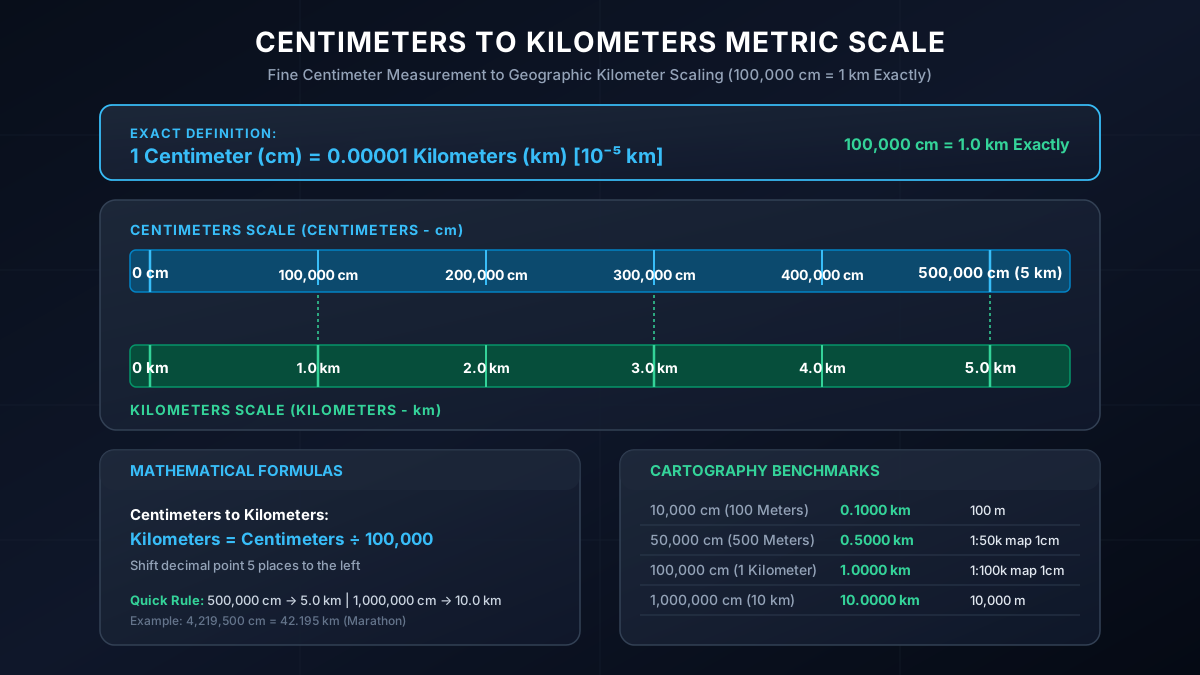
2. Core Definitions & Analogy
To understand dimensional transformation from fine metric centimeters into large geographic kilometers, let us review their core definitions:
- Simple Definition: A centimeter is a small metric unit (about the width of a paperclip), while a kilometer is a large geographic travel unit (1,000 meters). To find how many kilometers are in a given number of centimeters, you divide by 100,000.
- Technical Definition: The Centimeter ():* Defined as ().The Kilometer ():* Defined as ().
- The Topographic Map Scale Analogy: On a $1:100,000$ topographic map, every single 1 centimeter on the map sheet represents 100,000 centimeters on Earth. If you measure a trail line of 5 centimeters on your map, the real-world hiking distance is 500,000 centimeters — exactly 5 kilometers.
3. The Base-10 Decimal System
The metric system simplifies geographic unit reductions:
flowchart LR
    CM["Centimeter (cm)
10⁻² m"] -->|÷ 100| M["Meter (m)
1 m (SI Base Unit)"]
    M -->|÷ 1,000| KM["Kilometer (km)
10³ m (1 km = 100,000 cm)"]
Because 1 kilometer equals exactly , converting centimeters to kilometers involves simply shifting the decimal point 5 places to the left, guaranteeing zero arithmetic rounding errors.
4. The Mathematical Formulas
Converting centimeters to kilometers is direct, linear, and exact:
Exact Mathematical Formulas:
Fast Mental Arithmetic (Shift Left 5 Places):
- To convert centimeters to kilometers, shift the decimal point 5 positions to the left:Example (1,000 cm): (10 meters!)*.Example (50,000 cm): (500 meters / half kilometer!)*.Example (100,000 cm): (1 kilometer exact!)*.Example (500,000 cm): (5K road race!)*.Example (4,219,500 cm): (Official Full Marathon!)*.
5. Comprehensive Centimeters to Kilometers Lookup Table
| Centimeters () | Kilometers () | Meters () | Miles () | Map Scale Context ($1:100k$) | Real-World Context |
|---|---|---|---|---|---|
| 100 cm | 0.0010 km | 1.0 m | 0.0006 mi | 0.001 cm | 1 Meter |
| 1,000 cm | 0.0100 km | 10.0 m | 0.0062 mi | 0.010 cm | 10-meter sprint track |
| 10,000 cm | 0.1000 km | 100.0 m | 0.0621 mi | 0.100 cm | 100m Olympic dash |
| 40,000 cm | 0.4000 km | 400.0 m | 0.2485 mi | 0.400 cm | 1 Standard 400m running track |
| 50,000 cm | 0.5000 km | 500.0 m | 0.3107 mi | 0.500 cm | Half-kilometer |
| 100,000 cm | 1.0000 km | 1,000.0 m | 0.6214 mi | 1.000 cm | 1 Kilometer Benchmark |
| 200,000 cm | 2.0000 km | 2,000.0 m | 1.2427 mi | 2.000 cm | 2 km park loop |
| 500,000 cm | 5.0000 km | 5,000.0 m | 3.1069 mi | 5.000 cm | 5K Road Race distance |
| 1,000,000 cm | 10.0000 km | 10,000.0 m | 6.2137 mi | 10.000 cm | 10K Road Race (1 Million cm) |
| 2,109,750 cm | 21.0975 km | 21,097.5 m | 13.1094 mi | 21.098 cm | Official Half Marathon |
| 4,219,500 cm | 42.1950 km | 42,195.0 m | 26.2188 mi | 42.195 cm | Official Full Marathon |
| 10,000,000 cm | 100.0000 km | 100,000.0 m | 62.1371 mi | 100.000 cm | 100 km Ultramarathon (10 Million cm) |
6. Step-by-Step Practical Calculation Examples
Example 1: Topographic Map Scale Conversion
- Scenario: A hiker measures a trail on a $1:50,000$ scale map. The ruler shows 14.2 cm. How many kilometers long is the trail in real terrain?
- Step 1 (Calculate Ground Centimeters):
- Step 2 (Convert cm to km):
Example 2: Civil Utility Fiber Optic Spool Length
- Scenario: A telecommunications contractor installs 1,850,000 cm of underground fiber optic conduit. What is the total length recorded in kilometers on the regional GIS network?
- Calculation:
7. Major Practical & Scientific Applications
flowchart LR
    C2K["Centimeters to Kilometers Conversion"] --> MAP["Cartography: Translating map scale ruler centimeters to real-world ground kilometers"]
    C2K --> GIS["GIS & Cadastre: Ingesting centimeter aerial photogrammetry into geographic km databases"]
    C2K --> FIBER["Telecommunications: Converting fiber optic conduit centimeter tallies to route kilometers"]
C2K --> ROAD["Civil Surveying: Translating highway station offset centimeters to milepost kilometers"]- Cartography & Orienteering: Translating map-scale ruler measurements into physical ground travel distance.
- Aerial Photogrammetry GIS: Drone orthophotos with ground resolution are tiled across regional datasets spanning hundreds of kilometers.
- Underground Pipeline Surveying: Pipeline inspection gauges (PIGs) record anomaly locations in centimeters from launching stations over long-distance pipeline runs.
8. Frequently Asked Questions (FAQ)
- How many kilometers is 100,000 centimeters?(exact).
- How many kilometers is 500,000 centimeters?(a 5K race).
- What is the formula to convert cm to km?Divide centimeters by 100,000 ().
9. Expert Summary & Best Practices
- Divide by 100,000: Always divide centimeters by $100,000$ (or shift decimal 5 places left).
- Zero Precision Loss: Base-10 metric scaling ensures 100% precision with zero truncation error.
- Scientific Notation: In scientific and astronomical writing, .
Additional Technical Guidelines & Measurement Standards
When conducting calculations for Centimeters to Kilometers Converter, maintaining quantitative precision and verifying input parameter boundaries is essential for reliable scenario evaluation. Always verify that raw numerical inputs are measured using standardized instrumentation, and double-check unit conversions prior to applying outputs in commercial, industrial, or academic projects.
For quantitative unit conversions and scientific calculations, always maintain at least four decimal places of precision during intermediate arithmetic stages before rounding final results. When preparing technical reports, laboratory documentation, or financial forecasts, cross-verify all output variables against established international measurement standards (such as SI, NIST, and ISO metric benchmarks) to guarantee consistent analytical rigor across all computational workflows.
MathsLover.com delivers this interactive solver 100% free of charge to foster global mathematical literacy, educational accessibility, and data-driven problem solving across scientific, technical, and academic communities worldwide.