💡 Direct Answer & Executive Summary (Roof Shingles Bundle Calculator)
Definition: Compute building materials for Roof Shingles Bundle Calculator projects.
Governing Math Formula: Engineering dimensional estimation formula for Roof Shingles Bundle Calculator.
Target Applications: Provides real-time quantitative solutions in Construction for students, engineers, researchers, and finance professionals.
Roof Shingles Bundle Calculator: Complete Roofing Estimating Guide
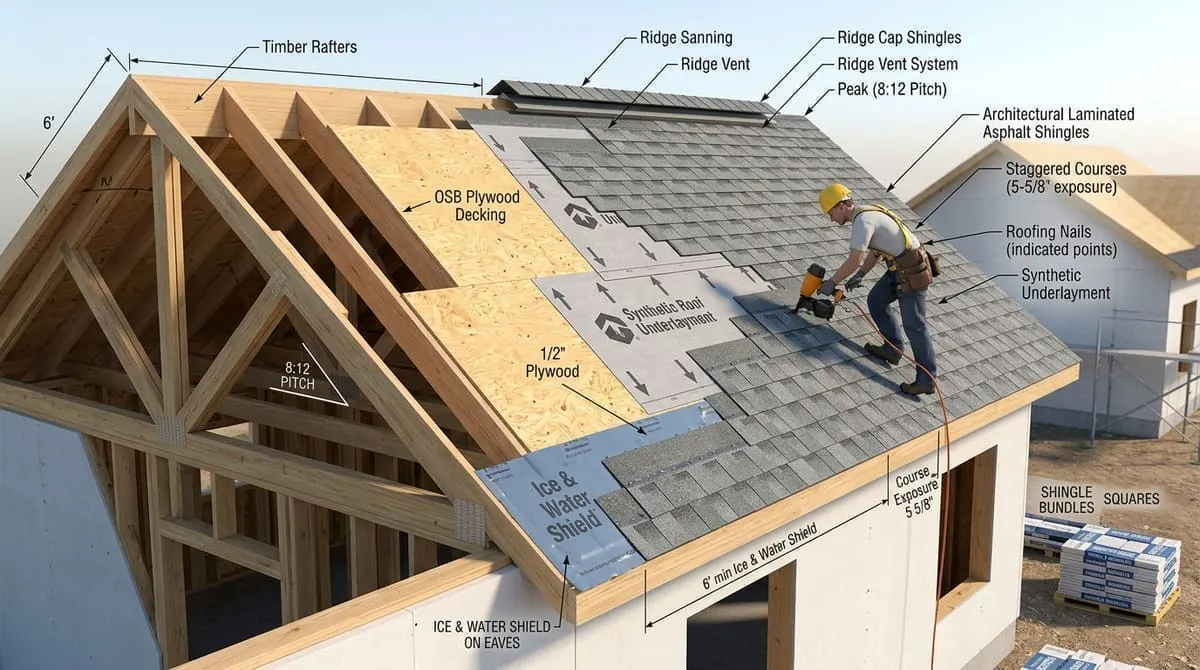
1. Introduction
The roof is a building's first and most critical defense against rain, snow, wind, hail, and solar radiation. Among steep-slope roofing systems in North America and across the globe, asphalt fiberglass shingles are the most widely installed material, protecting over 80% of single-family homes due to their balance of affordability, 30-to-50-year design life, fire resistance, and architectural variety.
However, estimating roofing materials is notoriously tricky. Unlike flat wall surfaces, roofs are sloped 3D planes featuring pitch multipliers, hip and valley cuts, rake edge overhangs, starter strips, and ridge caps. Underestimating shingle quantities leads to mid-project delays and emergency runs for additional bundles—risking color batch discrepancies between manufacturing lots. Overestimating leaves hundreds of pounds of heavy, non-returnable fiberglass bundles sitting in your driveway.
flowchart TD
    FOOTPRINT["📐 Base Footprint Area
Length (ft) × Width (ft)"] --> PITCH["📐 Roof Pitch Multiplier
e.g., 4:12 = 1.054 | 8:12 = 1.202"]
    PITCH --> ACTUAL_AREA["🏠 Actual Sloped Surface Area (sq ft)
Area = Footprint × Pitch Factor"]
    ACTUAL_AREA --> SQUARES["📦 Convert to Roofing Squares
1 Square = 100 sq ft"]
    SQUARES --> WASTE["🛡️ Add Waste Factor (10% to 15%)
Valleys, Hips, Dormers & Starter Cuts"]
    WASTE --> BUNDLES["🛒 Shingle Bundles to Order
3 Bundles per Square (Standard)"]
    BUNDLES --> ACC["🔩 Accessories & Underlayment
Starter Strips, Ridge Caps, Nails & Felt"]
Mastering roof volumetric and geometric estimation enables general contractors, roofing professionals, insurance adjusters, and DIY homeowners to:
- Accurately convert 2D building footprints into true 3D sloped surface areas using trigonometric pitch multipliers.
- Convert square footage into commercial roofing squares ().
- Determine exact retail shingle bundle counts across 3-tab, dimensional/architectural, and luxury heavyweight shingle lines.
- Calculate essential roofing accessories: synthetic underlayment rolls, ice and water shield rolls, starter course strips, ridge cap shingles, and coil roofing nails.
- Factor in roof complexity allowances (10% for simple gable roofs up to 20% for complex multi-valley hip roofs with dormers).
2. Definition & Core Concepts
2.1 The Simple Definition
- Roofing Square: The standard commercial unit of area measurement in the roofing industry, equal to exactly .
- Shingle Bundle: The standard packaging unit for retail asphalt shingles. For standard 3-tab and architectural shingles, 3 bundles cover 1 roofing square ( per bundle).
- Roof Pitch (Slope): The ratio of vertical rise to horizontal run, expressed as inches of vertical rise per 12 inches of horizontal run (e.g., a "6:12 pitch" rises 6 inches for every 12 inches of horizontal span).
- Pitch Multiplier: The geometric hypotenuse factor () used to multiply flat footprint area into true sloped surface area.
2.2 Technical Definition
In structural engineering and building estimation governed by the International Building Code (IBC Chapter 15) and NRCA (National Roofing Contractors Association) guidelines, true roof plane surface area () is calculated using the pitch slope angle () or the pitch multiplier ():
The true sloped surface area () for a horizontal projected area (, including eave and rake overhangs) is:
The net roofing squares () and gross required bundles () with waste contingency () are:
2.3 The Architectural Analogy
Think of a sloped roof like a slide at a playground:
- If you look at the slide from a bird's-eye view directly above (the flat 2D footprint), it looks much shorter than it actually is.
- The steeper the slide is tilted (the roof pitch), the longer the physical surface becomes.
- You must buy enough material to cover the full length of the tilted slide, not just the ground shadow underneath it.
3. Historical Timeline of Roofing Shingle Technology
timeline
    title Milestones in Roof Shingles & Asphalt Roofing
    c. 1840s : Coal-tar saturated felt paper used as early flat-roof membrane in North America
    1901 : Henry M. Reynolds of Grand Rapids, Michigan invents the first individual asphalt-coated shingle
    1903 : Slate & mineral granules embedded into asphalt shingles for UV protection and fire resistance
    1960s : Inorganic fiberglass mat replaces organic cellulose paper core, dramatically boosting fire ratings (Class A)
    1970s : Multi-layer laminated "Architectural / Dimensional" shingles introduced to simulate cedar shake
Modern : Impact-resistant Class 4 shingles and solar-reflective cool roof granules- Coal-Tar Roll Roofing (1840s): Early American builders saturated heavy paper felt in coal-tar pitch to create waterproof roof wraps.
- First Individual Asphalt Shingle (1901): Henry M. Reynolds cut stone-coated roll roofing into individual rectangular strips, creating the world's first asphalt roofing shingles.
- Mineral Surface Granules (1903): Crushed ceramic-coated slate and basalt granules were embedded into the top asphalt coating to shield the bituminous layer from ultraviolet sun breakdown and improve fire resistance.
- Fiberglass Mat Core (1960s): Switching from organic wood-pulp paper to non-combustible woven fiberglass mats gave asphalt shingles a Class A fire rating, reducing residential fire spread.
- Architectural Laminated Shingles (1970s–Present): Manufacturers bonded multiple layers of contoured fiberglass together to create thicker, multi-dimensional shingles that mimic natural slate and wood shake with 30-year to lifetime warranties.
4. Roof Pitch & Slope Multiplier Reference Matrix
Use this master conversion table to calculate true sloped roof area from the flat horizontal footprint:
| Roof Pitch (Rise:Run) | Slope Angle () | Pitch Multiplier () | Multiplier (Decimal) | Slope Category | Walkability |
|---|---|---|---|---|---|
| Flat / Low Slope (1:12) | $1.003$ | Low Slope (Requires membrane) | Very Easy | ||
| 2:12 Pitch | $1.014$ | Low Slope (Double underlayment) | Very Easy | ||
| 3:12 Pitch | $1.031$ | Minimum for standard shingles | Easy | ||
| 4:12 Pitch (Standard) | $1.054$ | Conventional Conventional | Easy to walk | ||
| 5:12 Pitch | $1.083$ | Conventional | Walkable | ||
| 6:12 Pitch (Popular) | $1.118$ | Conventional | Moderately walkable | ||
| 7:12 Pitch | $1.158$ | Moderate Steep | Requires roof brackets | ||
| 8:12 Pitch (Steep) | $1.202$ | Steep Slope | Requires safety harness | ||
| 9:12 Pitch | $1.250$ | Steep Slope | Harness & toe boards | ||
| 10:12 Pitch | $1.302$ | Steep Slope | Harness mandatory | ||
| 12:12 Pitch () | $1.414$ | Extreme Steep | Scaffolding / Roof jacks |
5. Shingle Types & Bundle Coverage Specifications
| Shingle Classification | Bundles per Square () | Coverage per Bundle | Weight per Square | Wind Rating | Expected Lifespan |
|---|---|---|---|---|---|
| Standard 3-Tab Shingles | |||||
| Architectural / Dimensional | |||||
| Luxury / Heavyweight Designer | Lifetime () | ||||
| Starter Strip Shingles | Sold by linear foot | Eaves & rakes | Sealant strip anchors first row | ||
| Hip & Ridge Cap Shingles | Sold by linear foot | High-wind caps | Covers ridges & hips |
6. Complete Hardware & Accessory Estimation Formulas
graph TD
    ROOF_SQ["🏠 Total Gross Roofing Squares (S)"]
    ROOF_SQ --> SHINGLES["📦 Shingles: S × 3 Bundles"]
    ROOF_SQ --> UNDERLAY["📜 Synthetic Underlayment:
S ÷ 10 (1 roll covers ~1,000 sq ft / 10 squares)"]
    ROOF_SQ --> NAILS["🔩 Coil Roofing Nails:
320 nails per square (4 nails/shingle)
480 nails per square in high-wind zones (6 nails/shingle)"]
    ROOF_SQ --> STARTER["📐 Starter Strip:
Total Eave Length + Rake Length (linear ft)"]
    ROOF_SQ --> RIDGE["🏔️ Ridge Cap:
Total Ridge Length + Hip Length (linear ft)"]
6.1 Fasteners (Roofing Nails)
- Standard Application (4 nails per shingle): Approximately 320 nails per square ( coil roofing nails per square).
- High-Wind Application (6 nails per shingle, slopes or hurricane zones): Approximately 480 nails per square ( per square).
6.2 Underlayment & Ice/Water Shield
- Synthetic Underlayment Rolls: A standard commercial roll covers () with overlaps:
- Ice & Water Protective Membrane: Required by code along all eaves (extending at least inside the interior heated wall line) and in all roof valleys. Standard rolls are ( coverage).
7. Step-by-Step Calculation Walkthroughs
flowchart TD
    S1["1. Determine Flat Base Area (with Overhangs):
Flat Area = (House Length + 2 ft) × (House Width + 2 ft)"] --> S2["2. Apply Pitch Multiplier:
Sloped Area = Flat Area × Pitch Factor"]
    S2 --> S3["3. Convert to Squares:
Net Squares = Sloped Area / 100"]
    S3 --> S4["4. Add Waste Allowance (10% to 15%):
Gross Squares = Net Squares × (1 + Waste% / 100)"]
    S4 --> S5["5. Calculate Total Shingle Bundles:
Total Bundles = Gross Squares × 3"]
Example 1: Standard Ranch Home with a 6:12 Pitch Gable Roof
- Building Dimensions: wide long.
- Overhangs: at eaves and at rakes ( total footprint).
- Pitch: 6:12 (Pitch Multiplier = $1.118$).
- Roof Style: Simple 2-sided gable roof (10% waste factor).
- Calculations:1. Flat Footprint with Overhangs: .2. Actual Sloped Surface Area: .3. Net Roofing Squares: .4. With 10% Waste Factor:5. Total Bundles to Order:6. Synthetic Underlayment: .7. Roofing Nails: (Buy one 7,200-count coil nail box).
Example 2: Complex 8:12 Pitch Hip Roof with 2 Valleys
- Footprint with Overhangs: .
- Pitch: 8:12 (Pitch Multiplier = $1.202$).
- Roof Style: Hip roof with valleys (15% waste factor due to angled diagonal cuts).
- Calculations:1. Actual Sloped Surface Area: .2. Net Roofing Squares: .3. With 15% Waste Factor:4. Total Bundles to Order:5. Ice & Water Membrane (Valleys + Eaves): .
8. Waste Factor Selection Matrix
graph TD
    STYLE{"What is your roof configuration?"}
    STYLE --> GABLE["🏠 Simple Gable Roof (2 flat rectangular planes)
Waste Buffer: 10%"]
    STYLE --> HIP["🏛️ Standard Hip Roof (4 triangular & trapezoidal planes)
Waste Buffer: 12% - 15%"]
    STYLE --> COMPLEX["🏰 Complex Multi-Dormer / Multi-Valley Custom Roof
Waste Buffer: 15% - 20%"]| Roof Architecture | Complexity Level | Diagonal Cut Seams | Recommended Waste Factor |
|---|---|---|---|
| Simple Gable (Shed / Cabin) | Low | Zero valleys, 4 rake edges | 8% - 10% |
| L-Shaped Gable | Medium | 1 valley, 2 ridges | 10% - 12% |
| Standard Hip Roof | Medium-High | 4 hip ridges, continuous angled cuts | 12% - 15% |
| Complex Hip with Gables & Dormers | High | Multiple valleys, step flashing, dormers | 15% - 20% |
9. Real-World Case Studies
Case Study 1: The "Flat Footprint" Shortage Disaster
- Scenario: A homeowner measured the ground footprint of their steep home () and ordered 60 bundles () without applying a pitch multiplier.
- Disaster: At a , the pitch multiplier is $1.302$. The actual sloped area was (), requiring 86 bundles with waste. The crew ran out with a third of the roof exposed right before an afternoon thunderstorm.
- Takeaway: Never order shingles based on 2D footprint measurements. Always multiply by the trigonometric pitch factor.
Case Study 2: Reusing Shingles as Starter Strips
- Scenario: An installer trimmed the tabs off standard field shingles to use as starter strips along the eaves instead of buying dedicated starter strip shingles with high-tack thermal sealant.
- Disaster: During the first windstorm, wind caught the bottom edges of the unbonded shingles, ripping off the entire bottom course and voiding the manufacturer's wind warranty.
- Takeaway: Always use factory starter strip shingles with factory-applied adhesive along all eaves and rakes to lock the first course down.
10. Common Installation Mistakes & Best Practices
- High-Nailing: Nailing above the designated double-layer nailing strip prevents the nail from penetrating both laminated layers of an architectural shingle, leading to shingle slide-offs.
- Improper Nail Depth: Under-driven nails poke through the overlapping shingle above, causing leaks; over-driven nails rupture the fiberglass mat, allowing wind to rip shingles off the roof.
- Omitting Drip Edge: Failure to install aluminum drip edge flashing along eaves and rakes allows rainwater to wick backward into the wooden fascia board and roof deck, rotting the plywood edges.
- Covering Ridge Vents with Underlayment: Ridge vents require a clean gap in the roof decking. Leaving underlayment over the ridge slot chokes attic airflow, causing summer heat buildup and winter ice dams.
11. Frequently Asked Questions (FAQ)
How many bundles of shingles are in a square?
There are 3 bundles of shingles in one roofing square for standard 3-tab and architectural/dimensional shingles ( per bundle).
How many square feet does one bundle of shingles cover?
One bundle of standard architectural or 3-tab shingles covers .
What is a roofing square?
A roofing square is a standard industry unit equal to of roof surface area.
What is the formula for calculating roof shingles?
What is a good waste percentage to use for shingles?
- 10% for simple rectangular gable roofs.
- for hip roofs and roofs with valleys or dormers.
- for complex multi-level architectural roofs.
How many nails do I need per shingle bundle?
Each bundle requires approximately 105 to 110 nails for standard 4-nail application (or 160 nails for 6-nail high-wind fastening).
What is the difference between 3-tab and architectural shingles?
- 3-Tab Shingles: Flat, single-layer shingles with distinct cutout slots ( wind rating, lifespan).
- Architectural Shingles: Multi-layered laminated shingles with a textured wood-shake appearance ( wind rating, lifespan).
Can I install shingles over an existing shingle roof?
While some building codes allow up to 2 layers of asphalt shingles, a complete tear-off is strongly recommended to inspect the underlying plywood decking for rot and install proper ice and water shield.
12. Summary Checklist
- ✔ Measure 2D Footprint & Add Overhangs: Length and Width .
- ✔ Identify Pitch & Multiplier: , , .
- ✔ Calculate Actual Sloped Area: Multiply flat area by pitch factor.
- ✔ Convert to Roofing Squares: Divide by .
- ✔ Add 10%–15% Waste Buffer: Account for hips, valleys, and starter cuts.
- ✔ Calculate Bundles & Accessories: Multiply gross squares by 3 for bundles; add underlayment, nails, and ridge caps.
Additional Technical Guidelines & Measurement Standards
When conducting calculations for Roof Shingles Bundle Calculator, maintaining quantitative precision and verifying input parameter boundaries is essential for reliable scenario evaluation. Always verify that raw numerical inputs are measured using standardized instrumentation, and double-check unit conversions prior to applying outputs in commercial, industrial, or academic projects.
For quantitative unit conversions and scientific calculations, always maintain at least four decimal places of precision during intermediate arithmetic stages before rounding final results. When preparing technical reports, laboratory documentation, or financial forecasts, cross-verify all output variables against established international measurement standards (such as SI, NIST, and ISO metric benchmarks) to guarantee consistent analytical rigor across all computational workflows.
MathsLover.com delivers this interactive solver 100% free of charge to foster global mathematical literacy, educational accessibility, and data-driven problem solving across scientific, technical, and academic communities worldwide.