💡 Direct Answer & Executive Summary (Lumber Board Foot Volume Calculator)
Definition: Compute building materials for Lumber Board Foot Volume Calculator projects.
Governing Math Formula: Engineering dimensional estimation formula for Lumber Board Foot Volume Calculator.
Target Applications: Provides real-time quantitative solutions in Construction for students, engineers, researchers, and finance professionals.
Lumber Board Foot Volume Calculator: Complete Hardwood & Softwood Guide
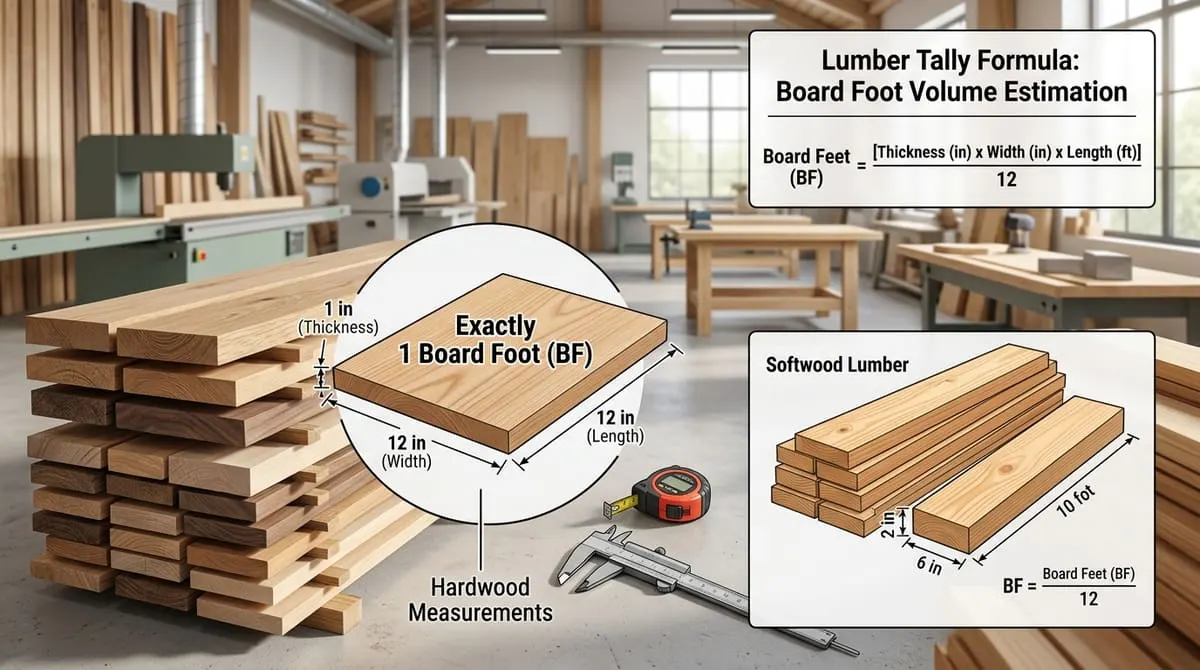
1. Introduction
In the commercial timber, fine woodworking, sawmilling, and architectural carpentry industries, wood is rarely bought and sold by linear feet or square feet alone. Because rough-sawn planks, live-edge slabs, heavy timbers, and dimensional framing stock vary across all three spatial dimensions—thickness, width, and length—the international standard for measuring, pricing, and trading raw lumber is the Board Foot (BF or FBM for Foot Board Measure).
A single board foot is a specialized volumetric unit defined as the volume of a solid piece of wood measuring , equal to exactly ().
However, calculating board footage can be confusing for builders, woodworkers, and remodelers because hardwood lumber and softwood dimensional lumber follow completely different trade conventions. Hardwoods (e.g., Black Walnut, White Oak, Hard Maple, Cherry) are sold in rough-sawn fractional quarter thicknesses (4/4, 5/4, 6/4, 8/4) based on actual lumber volume. Softwoods (e.g., Pine, Douglas Fir, Cedar and ), on the other hand, are sold using nominal pre-surfaced dimensions.
flowchart TD
    DIMS["📐 Board Dimensions
Thickness (in) × Width (in) × Length (ft or in)"] --> FORMULA["🔢 Board Foot Formula
BF = (Thickness'' × Width'' × Length') / 12
or (T'' × W'' × L'') / 144"]
    FORMULA --> BASE_BF["📦 Base Board Footage (BF)
Net Volumetric Footprint"]
    BASE_BF --> WASTE["🛡️ Add Milling & Defect Allowance
+15% for S2S/S4S Surfacing & Kerf Off-Cuts"]
    WASTE --> TOTAL_BF["🛒 Gross Board Feet to Order"]
    TOTAL_BF --> PRICING["💰 Price Calculation
Total Cost = Gross BF × Price per BF ($/BF)"]
Mastering board foot calculations enables furniture makers, cabinetry shops, sawmills, timber framers, and DIY woodworkers to:
- Accurately calculate board footage for individual planks, live-edge slabs, or bulk lumber packs.
- Price hardwood orders using the universal Price per Board Foot ($\$/\text{BF}$) standard.
- Understand hardwood quarter thickness notation (4/4 = $1''$, 5/4 = $1.25''$, 8/4 = $2''$, 12/4 = $3''$).
- Differentiate between rough-sawn timber vs. surfaced lumber (S2S, S4S) and account for planar thickness loss.
- Calculate realistic milling waste factors () for jointer surfacing, planer squaring, table saw kerf, and natural defect trimming (knots, checks, and sapwood).
2. Definition & Core Concepts
2.1 The Simple Definition
- Board Foot (BF): A standard unit of lumber volume equal to a nominal board , , and ().
- Quarter System ($X/4$): The standard hardwood measurement for rough thickness expressed in fractions of an inch, where the denominator is always 4 (e.g., , ).
- Rough-Sawn Lumber: Wood straight from the sawmill blade before being planed flat or dimensioned, typically sold in random widths and lengths.
- Surfaced Lumber (S4S): Lumber that has been planed smooth on all 4 sides (), resulting in dimensions smaller than nominal sizes.
2.2 Technical Definition
Under NHLA (National Hardwood Lumber Association) rules and ASTM D9 standard terminology, a board foot represents a standardized three-dimensional volumetric displacement:
Formula 1: When Length is Measured in Feet ()
Formula 2: When Length is Measured in Inches ()
Where:
- = Nominal or rough thickness in inches.
- = Width in inches.
- = Length in feet ().
Total lumber purchase volume incorporating shop milling waste ():
2.3 The Woodworking Analogy
Think of a board foot like a standard scoop of raw material in baking:
- Whether you spread the scoop thin across a flat sheet pan () or shape it into a thick solid loaf (), the total volume of raw dough is identical.
- In lumber trading, sawmills charge for the total "scoops" (volume of timber fibers), regardless of whether the log is sliced into wide dining tabletop slabs or narrow turning blanks.
3. Historical Timeline of Timber & Lumber Measurement
timeline
    title Milestones in Lumber Measurement & Board Foot Standards
    c. 1650s : American colonial sawmills trade timber by weight and "tally stick" estimates
    1830 : Bangor, Maine emerges as the lumber capital of the world, formalizing the "Board Foot" standard
    1898 : National Hardwood Lumber Association (NHLA) founded in Chicago, standardizing grading & tally rules
    1924 : US Department of Commerce establishes American Lumber Standards (ALS) for softwoods
Modern : Computerized 3D laser log scanning and automated board foot volume optimization- Colonial Tally Sticks (1650s): Early sawmills in New England and Virginia traded logs based on cord weight or rudimentary tally sticks notched by sawyers.
- The Bangor Board Foot (1830): In Bangor, Maine, loggers floating white pine down the Penobscot River standardized the board foot () to create a fair, volumetric currency that accounted for saw kerf and log taper.
- NHLA Inception (1898): As hardwood logging expanded across the Appalachian and Mississippi River basins, the NHLA established standardized grading rules (FAS, #1 Common, #2 Common) based on clear-cutting yields per board foot.
- American Lumber Standards (1924): Secretary of Commerce Herbert Hoover facilitated national standards for construction lumber, distinguishing between rough sawn dimensions and surfaced dry dimensions.
4. Hardwood "Quarter" Sizing & Surfacing Matrix
Hardwood sawmills cut green lumber into quarter-inch thickness increments to allow for natural shrinkage during kiln-drying and subsequent planer surfacing:
| Hardwood Thickness Code | Rough Sawn Thickness | Surfaced 2 Sides (S2S) Finished Thickness | Surfaced 4 Sides (S4S) Finished Thickness | Typical Woodworking Applications |
|---|---|---|---|---|
| 4/4 ("Four-Quarter") | Cabinet doors, drawer fronts, face frames, table aprons | |||
| 5/4 ("Five-Quarter") | Heavy tabletops, stair treads, exterior decking | |||
| 6/4 ("Six-Quarter") | Chair legs, workbench tops, architectural handrails | |||
| 8/4 ("Eight-Quarter") | Dining table tops, bed posts, solid entry doors, mallets | |||
| 10/4 ("Ten-Quarter") | Heavy timber legs, carving blocks, gunstocks | |||
| 12/4 ("Twelve-Quarter") | Structural mantle beams, butcher blocks, turning bowls |
5. Softwood Dimensional Lumber Board Foot Conversion Matrix
For standard construction framing lumber (e.g., ), board footage is calculated using nominal dimensions rather than surfaced actual dimensions:
| Nominal Lumber Size | Actual Surfaced Size | Board Feet per 8-ft Board | Board Feet per 10-ft Board | Board Feet per 12-ft Board | Board Feet per 16-ft Board |
|---|---|---|---|---|---|
6. Practical Real-World Calculation Walkthroughs
Example 1: Building a Solid Walnut Dining Table Top
- Target Table Top Dimensions: .
- Lumber Selection: Rough-sawn 8/4 () Black Walnut at $\$12.50\text{ per Board Foot}$.
- Calculations:1. Calculate Net Board Footage:2. Apply 20% Woodworking Waste Factor (for jointing, grain matching, and trimming ends):3. Calculate Total Material Cost:
Example 2: Hardwood Flooring & Trim Run (White Oak)
- Project: 50 linear feet of stair treads, each .
- Lumber Specifications: Thickness = , Width = , Total Length = .
- Calculations:1. Base Board Footage:2. With 15% Waste:3. At $\$8.00/\text{BF}$, total lumber cost equals $552.00.
Example 3: Construction Timber Pack ( Rafters)
- Order: 24 pieces of Douglas Fir framing lumber, each .
- Calculations:1. Single Board BF: .2. Total Pack Board Footage: .3. At $\$1.10/\text{BF}$, total order cost is $422.40.
7. The Waste & Milling Factor Selection Guide
flowchart TD
    START["🪵 SELECT LUMBER GRADE & MILLING CONDITION"]

    START --> FAS["🏆 FAS Grade Hardwood (Rough Kiln-Dried)
• Operations: Face jointing, thickness planing, edge ripping
• Recommended Waste Buffer: +15% to 20%"]

    FAS --> COM["🌲 #1 & #2 Common Hardwood (Utility Grade)
• Operations: Knot defect culling, color sorting, grain matching
• Recommended Waste Buffer: +25% to 35%"]

    COM --> S4S["📐 Dimensional S4S Lumber (Pre-Surfaced 4 Sides)
• Operations: Minor end-trimming, miter crosscuts & saw kerf
• Recommended Waste Buffer: +10%"]

    S4S --> SLAB["🌳 Live-Edge Natural Tree Slabs
• Operations: Sled flattening, bark removal, epoxy filling
• Recommended Waste Buffer: +30% to 40%"]| Lumber Condition & Grade | Milling Operations Required | Recommended Waste Buffer |
|---|---|---|
| S4S Pre-Surfaced Lumber | Minor end-trimming, miter crosscuts | 10% |
| FAS Hardwood (Rough Sawn) | Face jointing, thickness planing, edge ripping | 15% - 20% |
| Select & Better Grade | Moderate flattening, edge straightening | 20% |
| \#1 Common Hardwood | Knot defect cutting, grain matching, color culling | 25% - 30% |
| Live-Edge Natural Slabs | Sled flattening, bark removal, epoxy filling | 30% - 40% |
8. Common Estimating Mistakes in Lumber Purchasing
- Using Surfaced Thickness to Calculate Hardwood Board Footage: If you buy planed walnut, sawmills charge based on the original 4/4 () rough thickness required to produce that board. Using will underestimate your bill by 25%.
- Forgetting Saw Kerf Loss: Every pass through a table saw consumes of wood into sawdust. When ripping a 6-inch wide board into three narrow strips, you lose nearly of total width.
- Ignoring Natural Wood Cupping & Twisting: Rough-sawn boards are rarely flat. Flattening a cupped board on a jointer can easily reduce its thickness to . If you need a full 2-inch finished thickness, you must purchase 10/4 () rough stock.
- Confusing Square Feet with Board Feet: Square feet measures 2D surface area (). Board feet measures 3D volume. A thick tabletop of contains of lumber.
9. Frequently Asked Questions (FAQ)
How many board feet is a 2x4x8?
A standard board contains:
What is the formula for calculating board feet?
What does 4/4 and 8/4 mean in hardwood lumber?
Hardwood lumber thicknesses are measured in quarters of an inch:
- 4/4 ("four-quarter"): in rough-sawn form (yields surfaced).
- 8/4 ("eight-quarter"): in rough-sawn form (yields surfaced).
How do I calculate board feet for a piece measured in inches?
Divide the total cubic inches by 144:
How many board feet are in a cord of firewood?
A full cord of stacked wood () yields approximately 500 to 600 Board Feet of solid lumber after accounting for bark and air voids.
How much waste should I add for hardwood furniture projects?
Add waste for high-grade FAS lumber, and for \#1 Common lumber with natural knots and grain variations.
10. Summary Checklist
- ✔ Measure Dimensions: Thickness (inches) Width (inches) Length (feet or inches).
- ✔ Apply the 12 or 144 Divisor: Use $/12$ if length is in feet, or $/144$ if length is in inches.
- ✔ Use Rough Quarter Sizing for Hardwoods: 4/4 ($1''$), 5/4 ($1.25''$), 8/4 ($2''$).
- ✔ Add 15%–25% Milling & Kerf Waste: Factor in jointer flattening and table saw cuts.
- ✔ Calculate Total Cost: Multiply gross board footage by Price per Board Foot ($\$/\text{BF}$).
Additional Technical Guidelines & Measurement Standards
When conducting calculations for Lumber Board Foot Volume Calculator, maintaining quantitative precision and verifying input parameter boundaries is essential for reliable scenario evaluation. Always verify that raw numerical inputs are measured using standardized instrumentation, and double-check unit conversions prior to applying outputs in commercial, industrial, or academic projects.
For quantitative unit conversions and scientific calculations, always maintain at least four decimal places of precision during intermediate arithmetic stages before rounding final results. When preparing technical reports, laboratory documentation, or financial forecasts, cross-verify all output variables against established international measurement standards (such as SI, NIST, and ISO metric benchmarks) to guarantee consistent analytical rigor across all computational workflows.
MathsLover.com delivers this interactive solver 100% free of charge to foster global mathematical literacy, educational accessibility, and data-driven problem solving across scientific, technical, and academic communities worldwide.