💡 Direct Answer & Executive Summary (Insulation R-Value Rating Calculator)
Definition: Framing and building estimation tool: Insulation R-Value Rating Calculator.
Governing Math Formula: Total R-Value = Thickness (inches) × R-Value per inch. U-Factor = 1 / Total R-Value.
Target Applications: Provides real-time quantitative solutions in Construction for students, engineers, researchers, and finance professionals.
Insulation R-Value Rating Calculator: Complete Home Thermal Efficiency Guide
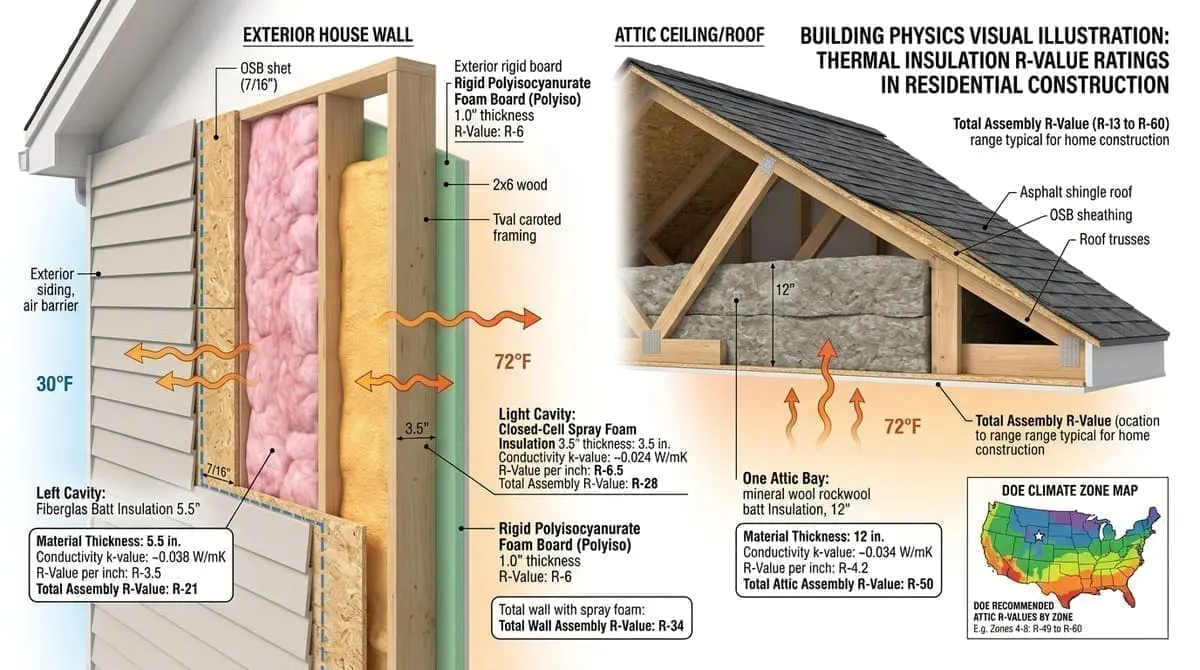
1. Introduction
Heating and cooling account for more than in modern residential and commercial buildings. Building envelope thermal insulation is the single most cost-effective architectural defense against conductive heat transfer, trapping winter furnace heat indoors and blocking scorching summer solar radiation.
The universal metric for rating insulation performance is the R-Value (Thermal Resistance). R-value measures a building material's capacity to resist the conductive flow of heat through its cross-sectional thickness. The higher the R-value, the greater the insulating power, resulting in lower monthly utility bills, reduced HVAC compressor wear, and a more comfortable interior environment without cold drafts or hot spots.
However, understanding R-values requires navigating building science principles. Different insulation materials (fiberglass batts, blown cellulose, open-cell spray foam, closed-cell polyurethane, mineral wool rockwool, and rigid polyisocyanurate foam boards) provide vastly different R-values per inch of thickness ().
Furthermore, total wall assembly performance is heavily reduced by thermal bridging through wooden framing studs and ceiling joists, making the calculation of effective assembly R-values and overall U-Factors () essential for code compliance under the International Energy Conservation Code (IECC).
flowchart TD
    CAVITY["🏠 1. Measure Cavity Depth & Material
Stud Wall Cavity (3.5'' or 5.5'') | Attic Joist Floor (10'' to 16'')"]

    CAVITY --> MATERIAL["🧪 2. Select Insulation Type & R/inch
Fiberglass (3.2–3.8/in) | Rockwool (4.0/in) | Closed Spray Foam (6.5/in)"]

    MATERIAL --> CAVITY_R["📐 3. Compute Cavity R-Value
Cavity R = Thickness (inches) × R-Value per inch"]

    CAVITY_R --> CONTINUOUS["🛡️ 4. Add Continuous Exterior Insulation
Rigid Polyiso / EPS Foam Board Sheathing (+R-5 to R-10)"]

    CONTINUOUS --> TOTAL_R["✨ 5. Calculate Total Assembly R-Value & U-Factor
Total Assembly R-Value = Cavity R + Continuous Sheathing R
U-Factor = 1 ÷ Total R-Value"]
Mastering insulation thermal physics enables architects, energy auditors, general contractors, and homeowners to:
- Calculate exact required insulation thickness for any target thermal rating (R-13, R-15, R-21, R-30, R-38, R-49, R-60).
- Compare the thermal performance and cost per R-value of all major insulation types.
- Convert between Thermal Resistance () and Thermal Transmittance ().
- Comply with the US Department of Energy (DOE) Climate Zone insulation mandates.
- Mitigate thermal bridging loss across and wall stud framing.
2. Definition & Core Concepts
2.1 The Simple Definition
- R-Value (Thermal Resistance): A quantitative measurement of how well a two-dimensional barrier resists the conductive flow of heat (). Higher numbers mean better insulation.
- R-Value per Inch: The thermal resistance rating provided by exactly one inch () of an insulating material.
- U-Factor (Thermal Transmittance): The rate at which heat flows through a building assembly (). Lower numbers mean superior thermal efficiency.
- Continuous Insulation (c.i.): Rigid insulation installed across all structural framing members without thermal bridges (e.g., exterior foam boards).
- Thermal Bridging: The rapid escape of heat through conductive structural framing studs ( wood studs have only ), bypassing cavity insulation.
2.2 Technical Definition & Governing Physics
Under ASTM C518 / C177 standard test methods for steady-state thermal transmission properties, thermal resistance () is defined as the temperature difference ($\Delta T$) across a material divided by the heat flux () per unit area:
Where:
- = Material thickness (in meters or inches).
- = Thermal conductivity of the material ( or ).
Formula 1: Cavity Thermal Resistance ()
Formula 2: Total Composite Assembly R-Value ()
Formula 3: Overall Thermal Transmittance / U-Factor ()
Formula 4: Conductive Heat Loss Rate ()
For a surface area with indoor temperature and outdoor temperature :
2.3 The Winter Coat Analogy
Think of building insulation like dressing for freezing winter weather:
- Cavity Insulation (Fiberglass/Cellulose) is like a thick wool sweater: it traps pockets of still air to hold your body heat.
- Framing Studs (Thermal Bridges) are like an open zipper on your jacket: heat leaks out through the gap even if the wool sweater is thick.
- Continuous Exterior Foam Sheathing is the windproof outer ski parka worn over the sweater, sealing all gaps and preventing any heat escape.
3. Historical Evolution of Building Insulation
timeline
    title Milestones in Building Thermal Insulation Science
    c. 1900 : Early homes use sawdust, newspapers, straw, and air cavities for rudimentary insulation
    1938 : Owens-Corning patents commercial fiberglass wool batt insulation
    1973 : Global OPEC oil crisis triggers first mandatory building energy codes & R-value labeling
    1980s : Polyurethane spray foam & polyisocyanurate rigid foam boards enter market
Modern : Aerogel insulation (R-10/in), vacuum insulated panels (VIPs), and net-zero passive house standards- Natural Organic Insulation (Early 20th Century): Before synthetic materials, builders packed balloon-framed wall cavities with dry wood shavings, corncobs, or crumpled newspapers ().
- Owens-Corning Fiberglass (1938): The invention of fine spun glass fibers trapped millions of micro air pockets, revolutionizing affordable residential insulation ().
- The 1973 Energy Crisis: Skyrocketing heating oil prices led the US Federal Trade Commission (FTC) to establish the "R-Value Rule" (16 CFR Part 460), legally requiring standardized testing and labeling on all building insulation products.
- Modern High-Performance Polymers (2000s–Present): Closed-cell spray foam and polyiso foam boards integrated continuous thermal barriers and built-in vapor retarders into residential building envelopes.
4. Master Insulation Material R-Value Comparison Matrix
| Insulation Material | Physical Form | R-Value per Inch | Moisture Resistance | Air Infiltration Barrier | Fire & Pest Resistance |
|---|---|---|---|---|---|
| Fiberglass Batts | Flexible glass rolls | Poor (loses R when wet) | No (requires air barrier) | Non-combustible | |
| Blown Cellulose | Recycled newsprint | Moderate (borate treated) | Low air permeance | Borate fire-treated | |
| Mineral Wool (Rockwool) | Dense basalt rock batts | High (hydrophobic) | Moderate | Fireproof | |
| Open-Cell Spray Foam | foam | Absorbs moisture | Complete air seal | Class 1 fire rated | |
| Closed-Cell Spray Foam | foam | 100% Vapor barrier | Impermeable structural seal | Structural rigidity | |
| Expanded Polystyrene (EPS) | White beadboard | Moderate | Continuous sheathing | Flammable (needs drywall) | |
| Extruded Polystyrene (XPS) | Pink / Blue rigid board | High (below-grade rated) | Continuous barrier | Flammable (needs drywall) | |
| Polyisocyanurate (Polyiso) | Foil-faced rigid board | High | Radiant barrier included | Thermal barrier required |
5. DOE Climate Zone Recommended R-Values (IECC 2021)
flowchart TD
    ZONE["🗺️ Select Your US DOE Climate Zone"]

    ZONE --> SOUTH["☀️ Zones 1–3 (Southern US / Sunbelt)
• Attic: R-30 to R-38 (9'' to 11'' blown)
• Walls: R-13 to R-15 (2×4 cavity) or R-20 (2×6)
• Floor/Crawlspace: R-13 to R-19"]

    ZONE --> MODERATE["🍂 Zones 4–5 (Mid-Atlantic / Midwest)
• Attic: R-49 to R-60 (14'' to 18'' blown)
• Walls: R-20 (2×6 cavity) or R-13 + R-5 continuous foam
• Basement Walls: R-10 to R-15"]

    ZONE --> NORTH["❄️ Zones 6–8 (Northern US / Canada / Alaska)
• Attic: R-60 (18'' to 22'' blown)
• Walls: R-20 + R-5 foam or R-13 + R-10 continuous foam
• Basement/Slab: R-15 to R-20 continuous"]
6. Practical Real-World Calculation Walkthroughs
Example 1: Upgrading a Exterior Wall Assembly
- Wall Framing: wood studs ( cavity depth) at .
- Insulation Installed: of High-Density Mineral Wool Rockwool () Exterior Polyiso Foam Sheathing ().
- Calculations:1. Cavity Insulation R-Value:2. Total Assembly R-Value:3. Assembly U-Factor:4. Efficiency Gain: Reduces wall conductive heat loss by 93.2% compared to an uninsulated wall ().
Example 2: Attic Ceiling Blown Cellulose Depth ( Target)
- Target Thermal Resistance: for a Zone 5 climate.
- Material Selection: Loose-fill Blown Cellulose ().
- Calculations:1. Minimum Settled Thickness:2. Apply 15% Settling Allowance:
Example 3: Flash-and-Batt Hybrid Wall System ( Studs)
- Wall Cavity: stud cavity.
- Insulation Hybrid: of Closed-Cell Spray Foam () of Fiberglass Batt ().
- Calculations:1. Spray Foam Layer: (also serves as air and vapor barrier).2. Fiberglass Batt Layer: .3. Total Cavity R-Value: in a slim wall!
7. Real-World Case Studies
Case Study 1: The "Compressed Batt" Thermal Failure
- Scenario: A remodeler crammed an fiberglass batt () into a shallow wall cavity, believing more fiberglass meant more insulation.
- Disaster: Compressing fiberglass squashes out the microscopic dead-air pockets where thermal resistance occurs. The batt was reduced to only , wasting $600 in material and bowing out the interior drywall.
- Takeaway: Never compress fiberglass batts into undersized cavities. Match the batt thickness exactly to the framing depth.
Case Study 2: Ice Dams from Attic Heat Bypass
- Scenario: An uninsulated attic hatch and unsealed recessed ceiling light cans in a Minnesota home allowed interior air to leak directly into the cold attic roof space.
- Disaster: The escaping heat melted roof snow, which ran down to the cold roof eaves, refreezing into massive ice dams that backed up under shingles and leaked down interior bedroom walls.
- Takeaway: Air sealing (caulking top plates, sealing can lights, weatherstripping attic hatches) is just as critical as adding R-value insulation.
8. Frequently Asked Questions (FAQ)
What does R-value mean in home insulation?
R-value measures thermal resistance to conductive heat flow. Higher R-values indicate greater insulating power and lower energy bills.
How do I calculate total R-value?
Multiply the insulation thickness in inches by the material's R-value per inch:
How is U-Factor related to R-Value?
The U-Factor is the mathematical reciprocal of the R-value (). Lower U-factors indicate better thermal insulation.
How much insulation do I need in my attic?
- Warm Climates (Zones 1–3): ().
- Cold Climates (Zones 4–8): ().
Which insulation has the highest R-value per inch?
Closed-Cell Polyurethane Spray Foam () and Foil-Faced Polyisocyanurate Board ().
9. Summary Checklist
- ✔ Identify Climate Zone: Check DOE recommendations (R-13 to R-60).
- ✔ Measure Cavity Thickness: $3.5''$ for ; $5.5''$ for .
- ✔ Select Insulation Type: Choose based on R/inch, air barrier, and moisture needs.
- ✔ Compute Cavity R-Value: .
- ✔ Add Continuous Sheathing: Add exterior foam to eliminate thermal bridging.
- ✔ Calculate U-Factor: .
Additional Technical Guidelines & Measurement Standards
When conducting calculations for Insulation R-Value Rating Calculator, maintaining quantitative precision and verifying input parameter boundaries is essential for reliable scenario evaluation. Always verify that raw numerical inputs are measured using standardized instrumentation, and double-check unit conversions prior to applying outputs in commercial, industrial, or academic projects.
For quantitative unit conversions and scientific calculations, always maintain at least four decimal places of precision during intermediate arithmetic stages before rounding final results. When preparing technical reports, laboratory documentation, or financial forecasts, cross-verify all output variables against established international measurement standards (such as SI, NIST, and ISO metric benchmarks) to guarantee consistent analytical rigor across all computational workflows.
MathsLover.com delivers this interactive solver 100% free of charge to foster global mathematical literacy, educational accessibility, and data-driven problem solving across scientific, technical, and academic communities worldwide.