💡 Direct Answer & Executive Summary (Aggregate Gravel Tonnage Solver)
Definition: Framing and building estimation tool: Aggregate Gravel Tonnage Solver.
Governing Math Formula: Gravel Volume = (Area × Depth) / 27 cu ft. Gravel Tonnage = Volume (cu yds) × Bulk Density (approx 1.4 tons/yd³).
Target Applications: Provides real-time quantitative solutions in Construction for students, engineers, researchers, and finance professionals.
Aggregate Gravel Tonnage Solver: Complete Crushed Stone Guide
1. Introduction
Crushed stone aggregate and gravel driveways are the most popular, cost-effective, and permeable access solutions for rural estates, suburban residences, farms, commercial haul roads, and construction site entrances. Compared to asphalt or poured concrete, an engineered aggregate gravel driveway costs less to install, allows storm runoff to percolate naturally into the groundwater table (eliminating standing water puddles), and can be repaired or refreshed in hours using a tractor box blade.
However, estimating bulk gravel is notorious for causing ordering disasters. Quarries, aggregate suppliers, and gravel yards sell rock in two completely different units of trade: Cubic Yards () by volumetric measurement, and Tons () by certified scale weight.
Furthermore, loose aggregate compacts by when vibrated or pressed under traffic wheels, and angular crushed stone weighs significantly more than rounded pea gravel ( vs. ). Underestimating gravel results in a thin muddy track where tires sink into clay subsoil; overestimating results in extra piles of unused stone taking up yard space.
flowchart TD
    DIMS["📐 Driveway Surface Dimensions
Length (ft) × Width (ft) = Total Surface Area (sq ft)"]

    DIMS --> DEPTH["📏 Layer Depth Specification
2'' Top Dressing | 4'' Moderate Renewal | 8'' Full 3-Layer Build"]

    DEPTH --> VOL["📦 Calculate Net Volume in Cubic Yards
Net Cu Yds = (Area × Depth in feet) ÷ 27
= (Area × Depth in inches) ÷ 324"]

    VOL --> WEIGHT["⚖️ Apply Aggregate Bulk Density Factor
Crushed Dense Grade = 1.4 Tons/yd³ (2,800 lbs/yd³)
Net Tonnage = Cubic Yards × 1.4"]

    WEIGHT --> CONTINGENCY["🛡️ Add Compaction & Subgrade Contingency (10% to 15%)
Gross Tonnage = Net Tonnage × 1.10"]

    CONTINGENCY --> TRUCKS["🚚 Dump Truck Logistics & Hauling
Single-Axle: 5–7 Tons | Tri-Axle: 14–16 Tons | End-Dump: 22+ Tons"]
Mastering aggregate gravel mathematics enables homeowners, civil site contractors, landscapers, and farmers to:
- Accurately convert driveway square footage and trench depth into Cubic Yards and Commercial Tons.
- Understand aggregate sizing classifications (#3 Base Stone, #57 Clean Stone, #411 Crusher Run / ABC).
- Account for compaction settlement and subgrade penetration losses ().
- Build the gold-standard 3-layer engineered gravel driveway that prevents washouts, potholes, and rutting.
- Estimate hauling loads and delivery costs across standard tandem and tri-axle dump trucks.
2. Definition & Core Concepts
2.1 The Simple Definition
- Aggregate Gravel: Natural or mechanically crushed rock sorted by particle size used as structural foundation or surface paving.
- Cubic Yard (): A volume of material measuring .
- Tonnage: Weight in US standard short tons ().
- Crusher Run / Dense Grade (#411 / ABC): A blend of crushed stone ranging from down to fine stone dust that compacts into a rock-solid, cement-like surface.
- Clean Stone (#57): Uniformly sized angular crushed stones washed free of fines, creating voids for high-capacity water drainage.
2.2 Technical Definition & Governing Formulas
Under ASTM C29 / C136 standard test methods for aggregate bulk density, crushed limestone, granite, and dolomite aggregate typically possess a dry loose-to-compacted bulk density () ranging between:
Formula 1: Net Volume in Cubic Yards ()
Formula 2: Net Weight in Commercial Tons ()
Formula 3: Incorporating Compaction & Spreading Contingency ()
Number of 15-Ton Tri-Axle Dump Truck Loads:
2.3 The Masonry Analogy
Think of an engineered gravel driveway like a layered three-tiered wedding cake made of stone:
- Layer 1 (Bottom Foundation): Big, heavy baseball-sized stones (#3 / #4) that lock together and keep the cake from sinking into the soft mud below.
- Layer 2 (Middle Cushion): Golf-ball-sized clean angular stones (#57) that bridge the gaps and allow rainwater to drain away freely.
- Layer 3 (Top Icing): Crusher run (#411) with fine stone dust that fills all the surface crevices and binds under tire pressure into a smooth, driving crust.
3. Historical Evolution of Road Aggregates
timeline
    title Milestones in Aggregate Engineering & Road Foundations
    c. 312 BCE : Roman engineers build the Appian Way using multi-layer compacted aggregate & stone
    1816 : Scottish engineer John Loudon McAdam invents angular crushed stone interlock (Macadam roads)
    1920s : Mechanized mechanical jaw crushers & vibrating screen sorting revolutionize quarry sizing
    1970s : Non-woven geotextile synthetic fabrics introduced to prevent aggregate subgrade sinking
Modern : Recycled Concrete Aggregate (RCA) and laser-guided grading with drone volumetric mapping- Roman Tiered Stratification (312 BCE): Roman military engineers pioneered the 4-layer roadbed (statumen, rudus, nucleus, pavimentum), creating drainage layers that lasted millennia.
- The McAdam Principle (1816): John McAdam proved that roads did not need massive stone slabs; instead, smaller angular crushed stones packed tightly together under cartwheel traffic formed an impenetrable, self-draining crust.
- Standardized Sieve Sizes (1920s): The American Society for Testing and Materials (ASTM) formalized numerical aggregate gradations (#1 through #89) based on standard wire mesh sieves.
- Geotextile Separation Membranes (1970s): High-strength polypropylene geotextiles revolutionized civil engineering by preventing heavy road gravel from sinking into underlying soft subgrade soils.
4. Master Aggregate Sizing & Density Chart
| Aggregate Size & Name | Typical Particle Diameter | Bulk Density | Best Construction Use Cases | Drainage Capacity |
|---|---|---|---|---|
| #3 / #4 Ballast Stone | Deep base layer, muddy stabilization, culvert exits | Exceptional | ||
| #57 Crushed Stone | Middle driveway layer, French drains, concrete mix | High | ||
| #411 Crusher Run / ABC | Top driving surface, maximum compaction & binding | Moderate | ||
| #8 / #89 Pea Gravel | Decorative walkways, patios (too loose for steep drives) | High | ||
| Recycled Concrete (RCA) | Budget driveway base, eco-friendly road building | Good | ||
| Decomposed Granite (DG) | Rustic garden paths, natural compacted driveways | Moderate |
5. Step-by-Step Mathematical Formulations
flowchart TD
    S1["1. Measure Driveway Area (A):
Area = Length (ft) × Width (ft)"]

    S1 --> S2["2. Choose Gravel Depth in Inches (D):
2'' (top dress), 4'' (resurfacing), 8'' (new build)"]

    S2 --> S3["3. Compute Net Volume in Cubic Yards (V):
V = (Area × Depth) ÷ 324"]

    S3 --> S4["4. Multiply by Density Factor (1.4 Tons/yd³):
Net Tonnage = V × 1.4"]

    S4 --> S5["5. Add 10% to 15% Compaction & Rutting Allowance:
Gross Tonnage = Net Tonnage × 1.10"]

    S5 --> S6["6. Determine Dump Truck Delivery Loads:
Trucks = Ceiling(Gross Tonnage ÷ 15 tons)"]
5.1 The Master 324-Divisor Rule
Because and , the conversion divisor is :
6. Practical Real-World Calculation Walkthroughs
Example 1: Resurfacing a Country Driveway ()
- Driveway Dimensions: .
- Project: 3-inch top layer renewal of #411 Crusher Run.
- Calculations:1. Volume in Cubic Yards:2. Net Weight in Tons:3. With 10% Compaction Factor:4. Dump Truck Order: or 1 full tandem load.
Example 2: Brand New 3-Layer Engineered Driveway ()
- Surface Area: .
- Target Total Depth: ().
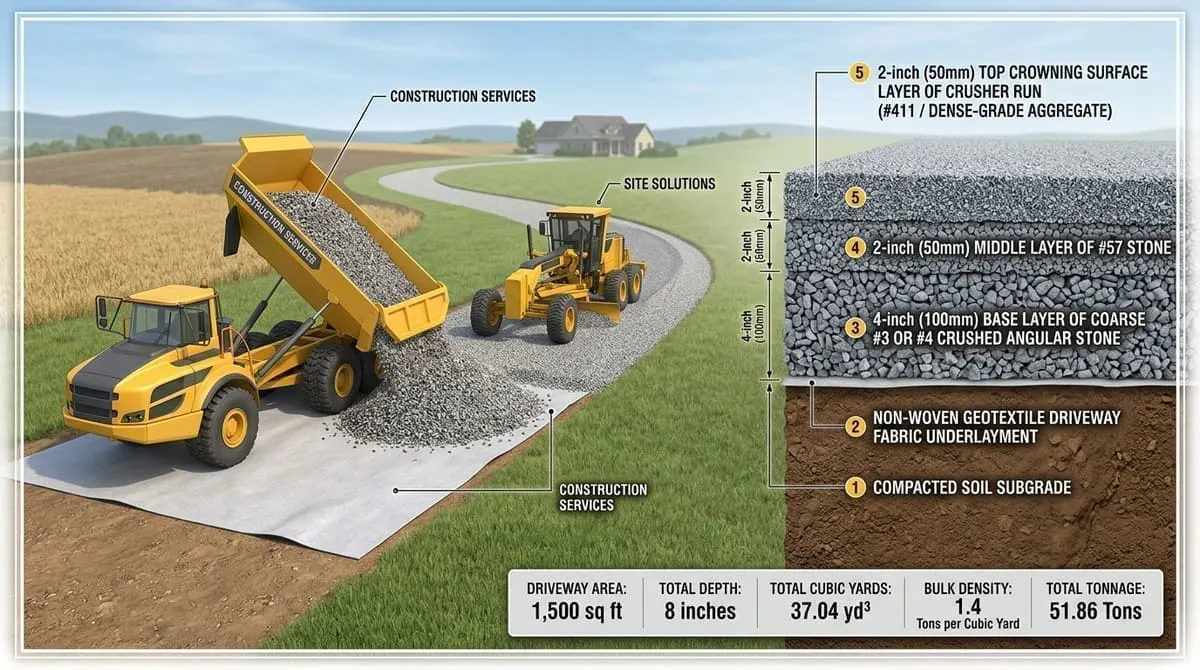
- Calculations:1. Layer 1: 4-inch #3 Heavy Base Stone2. Layer 2: 2-inch #57 Intermediate Drainage Stone3. Layer 3: 2-inch #411 Crusher Run Surface4. Total Project Aggregate: .
Example 3: Two-Car Parking Pad ()
- Surface Area: at .
- Calculations:1. Volume: .2. Net Tonnage: .3. With 10% Compaction: (1 full tri-axle truckload).
7. The 3-Layer Engineered Driveway Blueprint
flowchart TD
    SUB["🚜 1. Compacted Earth Subgrade
Excavate topsoil, grade 2% drainage crown & compact"]

    SUB --> FABRIC["🛡️ 2. Heavy Non-Woven Geotextile Fabric
Separates aggregate from subgrade mud & stops gravel sinking"]

    FABRIC --> BASE["🪨 3. Base Layer: 4'' to 6'' of #3 or #4 Heavy Stone
1.5'' to 2.5'' angular rock creates solid structural bridge"]

    BASE --> MID["💎 4. Middle Layer: 2'' to 3'' of #57 Crushed Stone
1/2'' to 1'' clean aggregate interlocks with base & drains water"]

    MID --> TOP["✨ 5. Surface Layer: 2'' of #411 Crusher Run / Dense Grade
3/4'' stone with dust compacts into durable driving crust"]| Driveway Layer | Ideal Material | Thickness | Primary Function |
|---|---|---|---|
| Geotextile Underlay | Non-Woven Polypropylene | — | Prevents mud migration & stone sinking |
| Bottom Base | #3 or #4 Ballast () | Structural load bridging over soil | |
| Middle Course | #57 Clean Crushed Stone ($3/4''$) | Interlocking transition & water drainage | |
| Top Surface | #411 Crusher Run / ABC / Dense Grade | Smooth, compact driving surface |
8. Real-World Case Studies
Case Study 1: The Disappearing Gravel Driveway
- Scenario: A rural homeowner poured of #57 gravel directly onto soft clay topsoil without installing geotextile fabric.
- Disaster: During the first wet spring, truck tires pumped the wet clay upward through the rocks. Within 6 months, over 80% of the expensive stone had sunk into the mud, leaving deep ruts and standing water.
- Takeaway: Never pour gravel over soft clay without a non-woven geotextile driveway fabric underlayment. The $300 fabric saves thousands in lost gravel.
Case Study 2: The "Flat Driveway" Pothole Epidemic
- Scenario: A property owner graded a 200-foot driveway perfectly flat with no center crown.
- Disaster: Rainwater pooled in the center of the driveway. Every passing car tire splashed water, accelerating aggregate displacement and eroding deep potholes across the road.
- Takeaway: Always grade gravel driveways with a center crown of of width ( slope) so storm runoff immediately flows off into side drainage ditches.
9. Common Mistakes & Quality Control
- Using Rounded Pea Gravel on Driveways: Pea gravel is smooth and round like ball bearings. Cars will spin their tires and sink. Always use angular crushed stone that interlocks under pressure.
- Forgetting the Crown: A flat gravel road is guaranteed to develop potholes. Create a distinct center ridge sloping outward to both edges.
- Ordering in Cubic Yards When the Quarry Sells in Tons: Always verify whether your supplier charges per cubic yard or per certified ton. Use our multiplier to avoid short orders.
- Neglecting Edge Retaining: Without a timber border, trench edge, or grass shoulder, driving over edges causes gravel to spread into lawn turf.
10. Frequently Asked Questions (FAQ)
How many tons of gravel do I need for my driveway?
Multiply surface area (sq ft) by depth (inches), divide by 324 to find cubic yards, then multiply by 1.4:
How many square feet will 1 ton of gravel cover?
At a , 1 ton of crushed stone covers approximately . At a , 1 ton covers .
How many cubic yards are in a ton of gravel?
One ton () of typical crushed stone aggregate equals approximately ().
What is the best gravel for a driveway surface?
#411 Crusher Run (also called ABC or Dense Grade Aggregate). It contains a mixture of angular stone and fine stone dust that compacts into a tight, hard crust.
How thick should a gravel driveway be?
- Resurfacing existing base: .
- New driveway construction: total depth installed in distinct layers.
11. Summary Checklist
- ✔ Calculate Square Footage: Length (ft) Width (ft).
- ✔ Determine Depth: $2''$ for topping, $4''$ for renewal, $8''$ for new build.
- ✔ Apply 324 Divisor: Find exact volume in cubic yards.
- ✔ Multiply by 1.4 Bulk Density: Convert cubic yards to commercial tons.
- ✔ Add 10%–15% Buffer: Factor in compaction and wheel rutting.
- ✔ Install Geotextile Fabric: Prevent stone from sinking into clay subgrade.
- ✔ Grade a 2% Center Crown: Ensure water sheds into side ditches.
Additional Technical Guidelines & Measurement Standards
When conducting calculations for Aggregate Gravel Tonnage Solver, maintaining quantitative precision and verifying input parameter boundaries is essential for reliable scenario evaluation. Always verify that raw numerical inputs are measured using standardized instrumentation, and double-check unit conversions prior to applying outputs in commercial, industrial, or academic projects.
For quantitative unit conversions and scientific calculations, always maintain at least four decimal places of precision during intermediate arithmetic stages before rounding final results. When preparing technical reports, laboratory documentation, or financial forecasts, cross-verify all output variables against established international measurement standards (such as SI, NIST, and ISO metric benchmarks) to guarantee consistent analytical rigor across all computational workflows.
MathsLover.com delivers this interactive solver 100% free of charge to foster global mathematical literacy, educational accessibility, and data-driven problem solving across scientific, technical, and academic communities worldwide.