💡 Direct Answer & Executive Summary (Decking Boards Lineal Feet Calculator)
Definition: Framing and building estimation tool: Decking Boards Lineal Feet Calculator.
Governing Math Formula: Lineal Feet = (Deck Area in sq ft × 12) / Effective Board Width (in). Board Count = Lineal Feet / Board Length.
Target Applications: Provides real-time quantitative solutions in Construction for students, engineers, researchers, and finance professionals.
Decking Boards Lineal Feet Calculator: Complete Deck Framing & Fasteners Guide
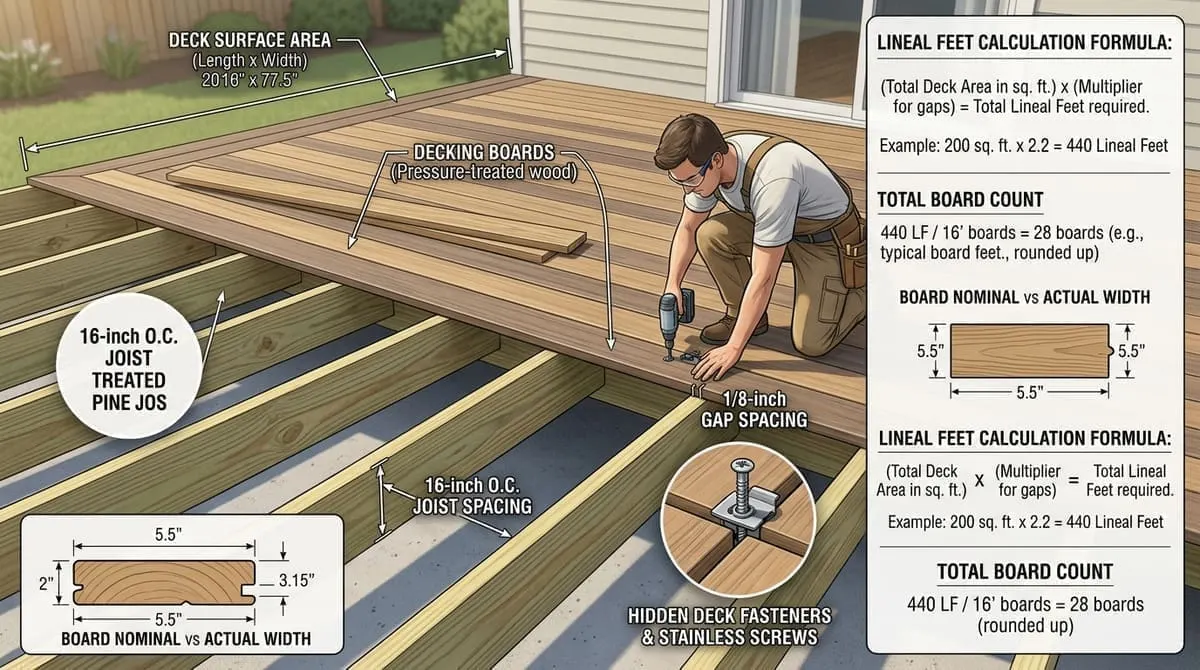
1. Introduction
Building an outdoor deck is one of the most rewarding and value-adding home improvement projects, transforming backyards into functional outdoor living spaces. However, calculating the exact quantity of decking lumber and fasteners is notoriously tricky. Unlike flooring sold in square feet, composite and wooden decking boards are sold in commercial lengths of Lineal Feet (LF) (e.g., boards).
A common homeowner mistake is ordering decking boards based purely on square footage ( of deck does NOT equal of boards). Because a standard board () is less than half a foot wide, a deck actually requires more than of boards!
Furthermore, factors such as expansion gap spacing (), board orientation (straight vs. diagonal herringbone), framing joist overhangs, picture-frame border trims, and screw fastener counts (typically ) must all be accounted for to prevent multiple trips to the lumberyard and unsightly mid-span board splices.
flowchart TD
    DIMS["📐 Deck Footprint Dimensions
Length (ft) × Width (ft) = Total Deck Surface Area (sq ft)"]

    DIMS --> WIDTH["📏 Select Board Nominal Size & Gap
5.5'' (5/4×6) or 3.5'' (5/4×4) + 1/8'' (0.125'') expansion gap"]

    WIDTH --> LINEAL["📏 Calculate Base Lineal Feet (LF)
Effective Width = Board Width + Gap Spacing
Net LF = (Deck Area × 12) ÷ Effective Width"]

    LINEAL --> CONTINGENCY["🛡️ Add Pattern & Trimming Waste Allowance
Straight Lay: +10% | Diagonal Lay: +15% to 20%"]

    CONTINGENCY --> BOARDS["🪵 Calculate Board Stock Quantities
12-ft Boards | 16-ft Boards | 20-ft Boards"]

    BOARDS --> SCREWS["🔩 Calculate Fasteners & Joist Screws
~3.5 Deck Screws / Hidden Clips per Lineal Foot"]
Mastering decking mathematics enables carpenters, general contractors, and DIY builders to:
- Accurately calculate total required Lineal Feet (LF) from any deck square footage.
- Compare standard lumber sizes: vs. vs. .
- Properly integrate expansion gap spacing () for composite and kiln-dried wood.
- Determine the optimal board length () to eliminate butt-joint seams.
- Calculate required boxes of hidden deck clips, stainless steel composite screws, or color-matched plug fasteners.
2. Definition & Core Concepts
2.1 The Simple Definition
- Lineal Foot (LF): A one-dimensional measure of length along the board, regardless of width or thickness ().
- Nominal vs. Actual Board Width: A nominal decking board is actually wide; a board is wide.
- Effective Width: The physical board width plus the mandatory expansion gap ().
- Joist Spacing On-Center (O.C.): The distance between structural joists ( for wood decking; for composite or diagonal decking).
2.2 Technical Definition & Governing Formulas
To cover a rectangular deck of area (in square feet) using decking boards of actual width (in inches) with an installation expansion gap (in inches):
Formula 1: Effective Board Coverage Width ()
Formula 2: Net Lineal Feet Required ()
Formula 3: Gross Lineal Feet with Waste Allowance ()
Formula 4: Number of Commercial Length Boards ()
Formula 5: Fastener & Deck Screw Estimation ()
For standard framing with joists spaced ( between joists) using 2 screws per joist crossing:
2.3 The Flooring Analogy
Think of installing deck boards like laying railway tracks across structural ties:
- The joists are the railroad ties supporting the load from underneath.
- If your rails are wide and you leave a thermal expansion gap between them, every row of track advances you across the deck by exactly .
- Counting how many track rows you need multiplied by the length of the track gives you the total lineal footage of lumber to buy.
3. Historical Timeline of Deck Construction
timeline
    title Evolution of Residential Outdoor Decks & Fasteners
    c. 1950s : Post-WWII suburban housing boom popularizes California redwood & cedar backyard decks
    1970s : Chromated Copper Arsenate (CCA) pressure-treated Southern Yellow Pine dominates market
    1990s : Trex invents composite decking (recycled wood fiber & polyethylene plastic polymer)
    2004 : EPA mandates phase-out of arsenic CCA wood, replacing with copper azole (CA-B) & ACQ
Modern : Capped polymer PVC decking, hidden grooved clip fasteners, and aluminum substructures- Western Red Cedar & Redwood Era (1950s): Early mid-century modern architects integrated seamless indoor-outdoor living using naturally rot-resistant heartwood lumber.
- The Pressure-Treated Revolution (1970s): Chemical pressure treating allowed economical yellow pine to resist fungal decay and subterranean termites for 25+ years.
- Composite Decking Invention (1990s): The synthesis of reclaimed wood flour and recycled plastic grocery bags created splinter-free, low-maintenance decking that does not require annual staining.
- Hidden Fasteners & Capped PVC (2000s–Present): Hidden groove fasteners eliminated surface screw holes, and protective polymer capstocks solved stain, mold, and UV fading problems.
4. Master Decking Material Comparison Matrix
| Decking Material Type | Actual Board Dimensions | Recommended Joist Spacing | Thermal Expansion Gap | Fastener Method | Lifespan |
|---|---|---|---|---|---|
| Pressure-Treated Pine | Butt tight if wet ($1/8''$ gap forms after drying) | Ceramic-coated $3''$ screws | |||
| Western Red Cedar | Stainless steel #305 screws | ||||
| Ipe / Cumaru Hardwood | Pre-drilled hidden clips / plugs | ||||
| Capped Composite (Trex/TimberTech) | Grooved edge hidden clips | ||||
| Cellular PVC (Azek) | Cortex plugs / hidden clips |
5. Step-by-Step Mathematical Formulations
flowchart TD
    S1["1. Determine Deck Square Footage (A):
Area = Length (ft) × Width (ft)"]

    S1 --> S2["2. Calculate Effective Board Width (W_eff):
Actual Width (5.5'') + Gap (0.125'')
= 5.625 inches"]

    S2 --> S3["3. Compute Net Lineal Feet (LF_net):
LF_net = (Area in sq ft × 12) ÷ 5.625''"]

    S3 --> S4["4. Apply Waste & Trimming Contingency:
Gross LF = LF_net × 1.10 (straight lay)
or × 1.15 (diagonal lay)"]

    S4 --> S5["5. Calculate Board Quantities:
16-ft Boards = Ceiling(Gross LF ÷ 16)"]

    S5 --> S6["6. Calculate Deck Fasteners:
Fasteners / Clips = Gross LF × 3.5"]
5.1 The Lineal Foot Multiplier Rule
For standard decking boards with a gap:
6. Practical Real-World Calculation Walkthroughs
Example 1: Standard Suburban Deck ()
- Deck Dimensions: .
- Material Selection: Capped Composite ( actual width) with gap.
- Calculations:1. Effective Width: .2. Net Lineal Feet:3. With 10% Trimming Waste:4. Board Quantities (Ordering boards):5. Fasteners Required:
Example 2: Large Raised Deck with Picture-Frame Border ()
- Surface Area: straight lay double picture-frame perimeter breaker board.
- Calculations:1. Main Field Lineal Feet: .2. Border Boards: .3. Total Net Lineal Feet: .4. With 12% Waste Allowance: .5. Board Purchase: (to eliminate all butt splices across the 16-ft span).
Example 3: Narrow Deck with Boards ()
- Decking Size: ( actual width) with gap ().
- Calculations:1. Net Lineal Feet: .2. Gross with 10% Waste: .3. Board Purchase: .
7. Fastener Selection & Screwing Guide
flowchart TD
    SUB["🌲 Select Decking Substrate & Board Type"]

    SUB --> WOOD["🪵 Pressure-Treated Pine or Cedar
• Fastener: #9 or #10 × 3'' Ceramic-Coated or Stainless Deck Screws
• Pattern: 2 screws per joist crossing (3/4'' from board edge)"]

    SUB --> COMP["✨ Grooved-Edge Composite Decking
• Fastener: Universal Hidden Deck Clips with Stainless Torx Screws
• Pattern: 1 clip per joist bay slide into side groove"]

    SUB --> PVC["🛡️ Solid PVC & Hardwood (Ipe / Cumaru)
• Fastener: Cortex Concealed Screw & Matching Wood Plug System
• Pattern: Pre-drill counter-bore, drive screw, tap in matching plug"]| Fastener Type | Best For | Corrosion Resistance | Fasteners per 100 sq ft |
|---|---|---|---|
| Ceramic-Coated Screws | Pressure-treated wood | Good (1,000 hr salt spray) | |
| Grade 305 Stainless Steel | Cedar, Redwood, inland decks | High (Rust-proof) | |
| Grade 316 Marine Stainless | Coastal saltwater environments | Maximum (Salt-resistant) | |
| Hidden Grooved Clips | Trex, TimberTech, Fiberon | Hidden / Stainless | |
| Cortex Color-Matched Plugs | Solid edge boards, stair treads | Invisible finish |
8. Real-World Case Studies
Case Study 1: The "Butt Joint Stumble" on a 16-ft Deck
- Scenario: A DIY builder bought boards for a wide deck to save on delivery fees, forcing a staggered butt-joint splice on every single row.
- Disaster: Because the cut ends absorbed rainwater, the butt joints swelled, curled upward, and rotted out the underlying joist tops within 4 years, creating tripping hazards.
- Takeaway: Always order full-span boards () or install a perpendicular center "breaker transition board" to eliminate random, unsightly butt joints.
Case Study 2: The Bouncy Composite Deck (Joist Spacing Error)
- Scenario: A homeowner replaced old wood decking with modern composite decking laid at a diagonal over existing joists.
- Disaster: When decking is laid diagonally across joists, the effective span between joists increases to . The composite boards sagged and flexed under foot, feeling like a trampoline.
- Takeaway: Composite decking installed diagonally strictly requires joist framing.
9. Frequently Asked Questions (FAQ)
How many lineal feet of decking do I need for a 12x12 deck?
A is . Using standard boards with a gap:
What is the difference between lineal feet and square feet?
- Square Feet (sq ft): 2D surface area ().
- Lineal Feet (LF): 1D total length of all physical boards placed end-to-end. One square foot of deck requires of standard decking.
How many deck screws do I need per board?
Drive 2 screws at every joist intersection. For joists spaced , this equals approximately 3.5 screws per lineal foot of board ( of deck).
What is the standard gap between deck boards?
- Kiln-Dried Wood & Composite: Leave a gap for drainage and thermal expansion.
- Wet Pressure-Treated Wood: Install butt tight with zero gap; as the wet wood dries out over 6 weeks, it will naturally shrink and open up a gap.
What size boards should I buy to minimize waste?
Match board lengths to your deck width. For a deck, buy boards. For a deck, buy boards to eliminate butt-joint splices.
10. Summary Checklist
- ✔ Calculate Deck Area: .
- ✔ Determine Effective Width: Board width expansion gap ().
- ✔ Compute Lineal Feet: .
- ✔ Add 10%–15% Waste Buffer: Account for end trims, miter cuts, and pattern geometry.
- ✔ Calculate Board Count: Divide gross LF by board length ($12', 16', 20'$).
- ✔ Order Fasteners: Multiply gross LF by 3.5 to determine screw/clip counts.
Additional Technical Guidelines & Measurement Standards
When conducting calculations for Decking Boards Lineal Feet Calculator, maintaining quantitative precision and verifying input parameter boundaries is essential for reliable scenario evaluation. Always verify that raw numerical inputs are measured using standardized instrumentation, and double-check unit conversions prior to applying outputs in commercial, industrial, or academic projects.
For quantitative unit conversions and scientific calculations, always maintain at least four decimal places of precision during intermediate arithmetic stages before rounding final results. When preparing technical reports, laboratory documentation, or financial forecasts, cross-verify all output variables against established international measurement standards (such as SI, NIST, and ISO metric benchmarks) to guarantee consistent analytical rigor across all computational workflows.
MathsLover.com delivers this interactive solver 100% free of charge to foster global mathematical literacy, educational accessibility, and data-driven problem solving across scientific, technical, and academic communities worldwide.