💡 Direct Answer & Executive Summary (Asphalt Driveway Tonnage Estimator)
Definition: Framing and building estimation tool: Asphalt Driveway Tonnage Estimator.
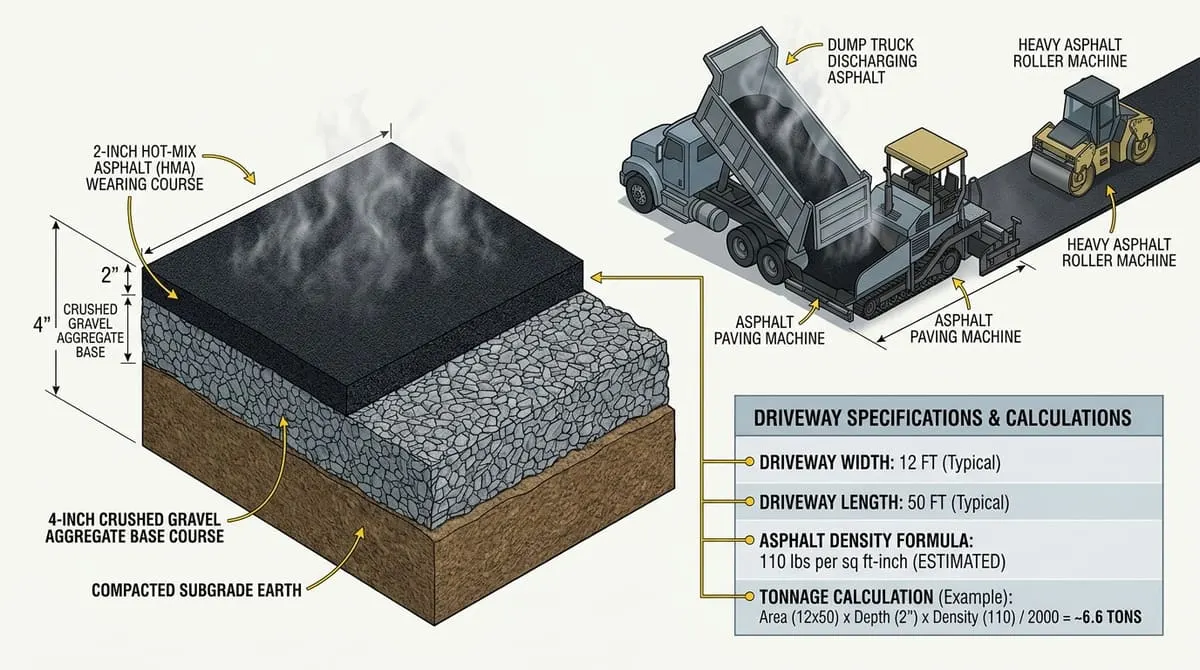
Governing Math Formula: Asphalt Weight = Area (sq ft) × Thickness (in) × 110 lbs/sq ft-inch ÷ 2000 lbs/ton.
Target Applications: Provides real-time quantitative solutions in Construction for students, engineers, researchers, and finance professionals.
Asphalt Driveway Tonnage Estimator: Complete Paving & Blacktop Guide
1. Introduction
Asphalt pavement—specifically Hot-Mix Asphalt (HMA) or bituminous blacktop—is the world's most widely utilized road and driveway surfacing material, paving more than 90% of highways, suburban streets, parking lots, and residential driveways across North America. Engineered from a blend of high-grade mineral aggregate (crushed stone, sand, and gravel) bound together with viscous petroleum asphalt cement binder, an asphalt driveway provides a flexible, seamless, water-resistant, and dark solar-absorbing surface that naturally melts winter snow and resists severe freeze-thaw cycles.
However, estimating asphalt material is fundamentally different from ordering ready-mix concrete. Asphalt is manufactured in high-temperature batch asphalt plants at temperatures between and is sold strictly by the Ton (, not by the cubic yard. Because loose hot asphalt compacts by under heavy vibrating steel-drum rollers, underestimating tonnage results in an uncompacted, thin pavement mat that cracks within 2 years. Overestimating tonnage results in asphalt cooling below its critical compaction temperature () in the dump truck, turning tons of expensive mix into solid, unusable rock.
flowchart TD
    DIMS["📐 Driveway Surface Dimensions
Length (ft) × Width (ft) = Total Surface Area (sq ft)"]

    DIMS --> THICK["📏 Specify Compacted Layer Thickness
2.0'' (Standard Overlay/Top) | 3.0'' (Full Depth) | 4.0'' (Heavy Duty)"]

    THICK --> NET_TONS["⚖️ Calculate Net Weight in Pounds & Tons
Net Weight = Area (sq ft) × Thickness (in) × 110 lbs/sq ft-inch
Net Tons = Net Weight ÷ 2,000 lbs/ton"]

    NET_TONS --> WASTE["🛡️ Add Compaction & Subgrade Contingency (10%)
Gross Tons = Net Tons × 1.10"]

    WASTE --> TRUCKS["🚚 Dump Truck Logistics & Hauling
Standard Tri-Axle Dump Truck Capacity: 14 to 16 Tons"]
Mastering asphalt tonnage mathematics enables paving contractors, civil engineers, landscapers, and property owners to:
- Accurately calculate the exact hot-mix asphalt weight in commercial tons ().
- Apply the industry standard asphalt density coefficient of ().
- Convert between volumetric cubic yards and commercial asphalt tonnage.
- Calculate required base materials (crushed stone aggregate base course) and tack coat emulsion gallons.
- Size dump truck logistics (number of 15-ton tri-axle or 20-ton quint-axle truckloads needed).
2. Definition & Core Concepts
2.1 The Simple Definition
- Hot-Mix Asphalt (HMA): A high-temperature mixture of 95% crushed mineral aggregate and 5% liquid asphalt cement binder, laid hot () and compacted before cooling.
- Tonnage: The commercial unit of weight used to sell asphalt ().
- Compacted Thickness: The final finished depth of the asphalt layer after being pressed by a multi-ton vibrating roller (asphalt loses approximately of thickness per inch of loose laydown during rolling).
- Aggregate Base Course (ABC / Crush and Run): A 4-to-6-inch layer of crushed gravel and stone dust placed directly over compacted earth subgrade to provide structural support for the flexible asphalt layer.
2.2 Technical Definition
Under AASHTO (American Association of State Highway and Transportation Officials) and NAPA (National Asphalt Pavement Association) standards, compacted hot-mix dense-graded asphalt has an in-place unit density () ranging between .
Expressed per square foot of surface area per inch of depth:
For a driveway of surface area (in square feet) and compacted thickness (in inches):
Applying the standard subbase undulation and waste buffer (, standardly 10%):
Number of standard 15-ton tri-axle dump trucks:
2.3 The Civil Engineering Analogy
Think of paving an asphalt driveway like spreading and baking a giant chocolate-chip granola bar:
- The crushed stones and sand are the oats and nuts that provide structural strength.
- The hot liquid asphalt binder is the melted honey that coats every pebble and binds them together when hot.
- The heavy roller machine presses the mixture tightly together into a dense, interlocking cake. If you don't roll it while it's hot, the granola bar crumbles into loose gravel.
3. Historical Timeline of Asphalt Paving
timeline
    title Milestones in Bituminous Asphalt Paving History
    600 BCE : Ancient Babylonians use natural asphalt pitch to waterproof stone roads & palace walls
    1820 : Scottish engineer John McAdam pioneers "Macadam" crushed stone road compaction
    1870 : Belgian chemist Edward de Smedt patents modern sheet asphalt pavement in Newark, New Jersey
    1876 : First major municipal asphalt paving on Pennsylvania Avenue in Washington, D.C.
    1956 : US Federal-Aid Highway Act initiates nationwide Interstate Highway System using HMA
Modern : Warm-Mix Asphalt (WMA), 100% Recycled Asphalt Pavement (RAP), and porous asphalt- Natural Pitch Waterproofing (600 BCE): Babylonian king Nabopolassar paved processional roadways with stone slabs bedded in natural asphalt seepage from the Euphrates river basin.
- Macadam Roads (1820): John Loudon McAdam discovered that single-sized angular crushed stones compacted under traffic interlocked into a stable, load-bearing roadway.
- Edward de Smedt Patent (1870): Belgian chemist Edward de Smedt developed the first modern hot petroleum asphalt mixture in Newark, New Jersey, combining sand and heavy petroleum residues.
- Federal Highway Boom (1956–Present): The construction of the US Interstate Highway System drove rapid advances in computerized asphalt batch plants, continuous pavers, and polymer-modified asphalt binders.
4. Driveway Thickness & Application Guidelines
| Paving Application | Recommended Compacted Thickness | Base Course Layer | Expected Vehicle Traffic | Design Life |
|---|---|---|---|---|
| Resurfacing / Cap Overlay | Existing sound asphalt | Passenger cars, light SUVs | ||
| Standard Residential Driveway | crushed stone | Daily cars, light delivery trucks | ||
| Heavy-Duty Residential / RV | crushed stone | Motorhomes, heavy work trucks, boats | ||
| Commercial Parking Lot | Semi-trucks, garbage trucks, delivery vans |
5. Step-by-Step Mathematical Formulations
flowchart TD
    S1["1. Determine Driveway Square Footage (A):
Area = Length (ft) × Width (ft)"]

    S1 --> S2["2. Select Compacted Depth (T):
Typically 2.0'' (overlay) or 3.0'' (new driveway)"]

    S2 --> S3["3. Calculate Net Weight in Pounds:
Weight = Area (sq ft) × Depth (in) × 110 lbs"]

    S3 --> S4["4. Convert to Net Tons:
Net Tons = Weight (lbs) ÷ 2,000 lbs/ton"]

    S4 --> S5["5. Apply 10% Waste & Compaction Buffer:
Gross Tons = Net Tons × 1.10"]

    S5 --> S6["6. Determine Dump Truck Delivery Count:
Trucks = Ceiling(Gross Tons ÷ 15 tons)"]
5.1 The Standard 110-lb Rule Formula
5.2 Volumetric Cubic Yard Conversion
Since :
6. Practical Real-World Calculation Walkthroughs
Example 1: Standard Suburban Two-Car Driveway ()
- Driveway Dimensions: .
- Paving Depth: compacted wearing course.
- Calculations:1. Base Weight in Pounds:2. Net Tonnage:3. With 10% Waste Buffer (subgrade undulation & edge compaction roll):4. Dump Truck Delivery: Exactly .
Example 2: Long Country Farm Driveway ()
- Driveway Dimensions: .
- Paving Depth: heavy-duty binder course.
- Calculations:1. Net Weight: .2. Net Tonnage: .3. With 10% Contingency Factor:4. Dump Truck Hauling Logistics:
Example 3: Commercial Parking Pad for Heavy Equipment ()
- Surface Area: .
- Paving Depth: (2-inch binder course $+ 2$-inch top wearing course).
- Calculations:1. Net Tonnage: .2. With 10% Waste Factor: .3. Delivery: .
7. Subgrade & Base Course Preparation Guide
flowchart TD
    SUB["🚜 1. Earth Subgrade Compaction
Excavate organic topsoil, grade for 1-2% drainage slope & compact with roller"]

    SUB --> GRAVEL["🪨 2. Crushed Stone Base Course (ABC / Crush & Run)
Install 4'' to 6'' of aggregate, dampen with water & compact to 98% density"]

    GRAVEL --> TACK["🧪 3. Tack Coat Emulsion (If Overlaying)
Apply asphalt emulsion adhesive (0.05 to 0.10 gal/sq yd)"]

    TACK --> PAVE["🔥 4. Hot-Mix Asphalt Laydown & Roll
Pave at 290°F+ and compact immediately with vibratory steel roller"]| Layer | Material Type | Minimum Thickness | Compaction Requirement | Function |
|---|---|---|---|---|
| Subgrade Soil | Virgin soil / Clay / Sand | Excavated depth | Foundation supporting all loads | |
| Aggregate Base | Crushed Stone (#21A / ABC) | Distributes weight, prevents frost heave | ||
| Tack Coat | Liquid Bitumen Emulsion (SS-1h) | Thin film | Fully broken | Bonds asphalt layers together |
| Asphalt Layer | Hot-Mix Asphalt (HMA Type 9.5mm) | Smooth, waterproof riding surface |
8. Real-World Case Studies
Case Study 1: The "Cold Asphalt" Rolling Calamity
- Scenario: A paving contractor scheduled two 15-ton loads of hot-mix asphalt for an 8:00 AM pour in late November ( air temperature). Traffic delayed the roller machine by 45 minutes.
- Disaster: By the time the roller began compacting the second load, the asphalt temperature had dropped below . The asphalt mix became too stiff to compact to the required 93% density, leaving a rough, porous, gravelly surface that raveled and disintegrated during the first winter rain.
- Takeaway: Never pave when ambient temperatures are below . Always compact hot-mix asphalt while it is between .
Case Study 2: Paving Over Soft Mud Without Base Stone
- Scenario: A homeowner saved $1,500 by skipping the 4-inch crushed gravel aggregate base course and paving $2.5\text{ inches}$ of asphalt directly over clay soil.
- Disaster: During the spring thaw, the wet clay subgrade softened. The weight of a standard SUV punched rutted wheel tracks deep into the asphalt, collecting standing water and cracking the pavement.
- Takeaway: An asphalt driveway is only as strong as the crushed stone base underneath it. Never skimp on the 4-to-6-inch aggregate base.
9. Common Mistakes & Quality Control
- Forgetting the 10% Compaction and Subgrade Waste Factor: Excavated gravel bases are never perfectly flat. Running short of asphalt by half a ton leaves an unfinished driveway and creates an unsightly cold joint seam when a second batch arrives hours later.
- Inadequate Slope for Water Drainage: Asphalt driveways require a minimum slope () away from the home foundation to prevent water pooling and ice formation.
- Parking Heavy Vehicles Too Soon: Fresh asphalt takes 30 to 90 days to fully cure and oxidize. Parking heavy trailers, RVs, or turning car tires while stationary during the first hot summer week will leave permanent gouges.
- Neglecting Edge Compaction: The outer edges of an asphalt driveway must be compacted at a with hand tampers or roller bevels to prevent edge crumbling under wheel loads.
10. Frequently Asked Questions (FAQ)
How do I calculate asphalt tonnage for my driveway?
Multiply surface area in square feet by thickness in inches, multiply by 110, and divide by 2,000:
How many square feet does 1 ton of asphalt cover?
At a standard compacted thickness, 1 ton of asphalt covers approximately . At , 1 ton covers .
How many tons of asphalt are in a dump truck?
A standard tri-axle dump truck holds 14 to 16 tons of hot-mix asphalt. Larger quint-axle or semi-dump trailers carry 20 to 24 tons.
How thick should a residential asphalt driveway be?
Residential driveways should have a minimum of of compacted asphalt over a crushed stone aggregate base.
How long does a new asphalt driveway need to cure before parking?
- Drive on: You can drive passenger cars on it after .
- Full Cure: The bitumen takes to fully harden.
When should I sealcoat my new asphalt driveway?
Wait 6 to 12 months after paving before applying the first coat of asphalt sealcoat to allow oils in the asphalt to oxidize and evaporate.
11. Summary Checklist
- ✔ Measure Length and Width: Calculate total square footage ().
- ✔ Select Layer Depth: $2.0''$ for overlay; $3.0''$ for new construction.
- ✔ Calculate Net Tons: .
- ✔ Add 10% Waste Factor: Buffer for compaction roll and gravel subbase undulation.
- ✔ Size Dump Trucks: Order 1 tri-axle truck per 15 gross tons.
- ✔ Ensure Subgrade Strength: 4 to 6 inches of compacted crushed aggregate base (ABC).
Additional Technical Guidelines & Measurement Standards
When conducting calculations for Asphalt Driveway Tonnage Estimator, maintaining quantitative precision and verifying input parameter boundaries is essential for reliable scenario evaluation. Always verify that raw numerical inputs are measured using standardized instrumentation, and double-check unit conversions prior to applying outputs in commercial, industrial, or academic projects.
For quantitative unit conversions and scientific calculations, always maintain at least four decimal places of precision during intermediate arithmetic stages before rounding final results. When preparing technical reports, laboratory documentation, or financial forecasts, cross-verify all output variables against established international measurement standards (such as SI, NIST, and ISO metric benchmarks) to guarantee consistent analytical rigor across all computational workflows.
MathsLover.com delivers this interactive solver 100% free of charge to foster global mathematical literacy, educational accessibility, and data-driven problem solving across scientific, technical, and academic communities worldwide.