💡 Direct Answer & Executive Summary (Solution Dilution M1V1=M2V2 Solver)
Definition: Chemical stoichiometry calculation: Solution Dilution M1V1=M2V2 Solver.
Governing Math Formula: M1 × V1 = M2 × V2, Dilution Factor DF = M1 / M2 = V2 / V1, Added Solvent Volume = V2 - V1. Solves the required stock solution volume (V1) to prepare diluted working solutions.
Target Applications: Provides real-time quantitative solutions in Chemistry for students, engineers, researchers, and finance professionals.
Solution Dilution ()
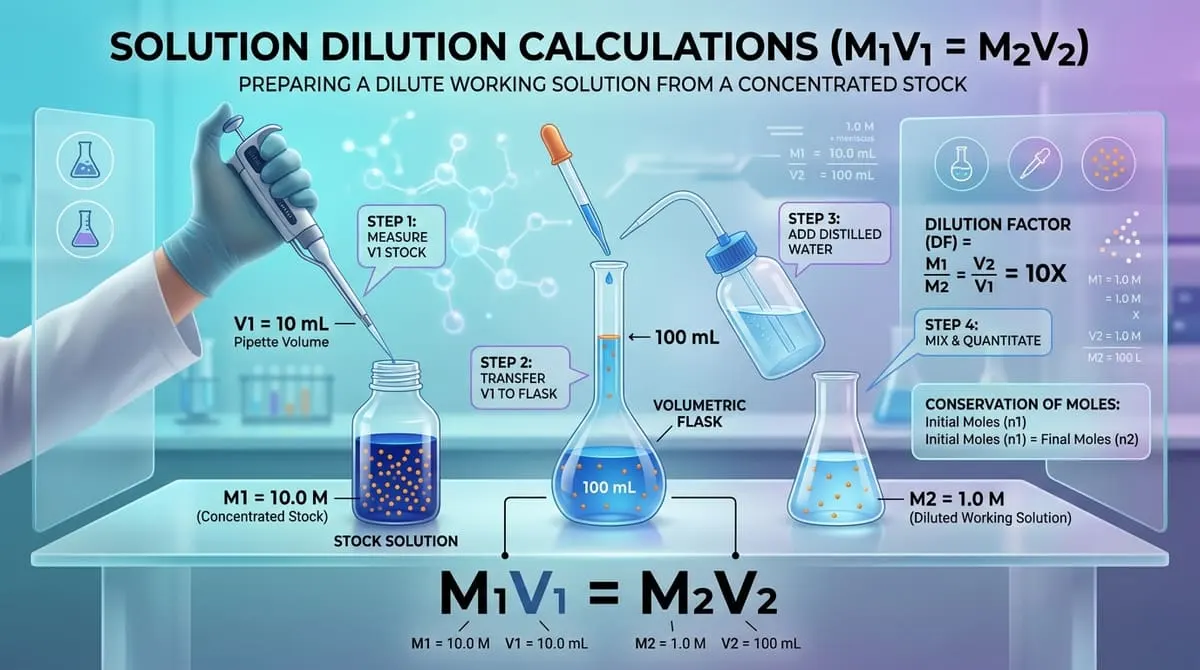
1. Introduction & Conceptual Overview
How do molecular biologists dilute concentrated electrophoresis running buffer down to a working solution? How do pharmacologists prepare precise micro-molar drug serial dilution gradients for cell culture assays? How do acid-base chemists safely prepare dilute hydrochloric acid () from dangerous concentrated fuming stock ()?
All of these daily laboratory tasks rely on the golden rule of wet chemistry: the Solution Dilution Equation ( or ).
The principle of dilution rests upon a fundamental physical law: The Law of Conservation of Mass. When solvent (such as deionized water) is added to a sample of concentrated stock solution, the total number of solute molecules (moles, ) remains strictly unchanged. Only the liquid volume expands, causing the concentration per unit volume to decrease.
flowchart TD
    subgraph S1["🧪 1. Concentrated Stock Solution"]
        M1["Stock Concentration: M₁ = 10.0 M"]
        V1["Stock Aliquot Pipetted: V₁ = 10.0 mL"]
        N1["Dissolved Solute Moles: n₁ = M₁ × V₁ = 0.10 mol"]
    end

    subgraph ADD["💧 2. Dilution & Solvent Addition"]
        SOLV["Add 90.0 mL Deionized Water Solvent
(Total Solute Moles Conserved: n₁ = n₂ = 0.10 mol)"]
    end

    subgraph S2["🧬 3. Final Diluted Working Solution"]
        M2["Target Working Concentration: M₂ = 1.0 M"]
        V2["Final Homogeneous Volume: V₂ = 100.0 mL"]
        DF["Dilution Factor: DF = M₁/M₂ = 10× (1:10 Dilution)"]
    end

    S1 --> ADD
ADD --> S2Fundamental Dilution Invariance:
Dilution only changes volume; it never changes the total quantity of dissolved solute particles.
2. Chemical Definition & Mathematical Derivation
2.1 The Conservation of Moles Principle
Recall the definition of molarity:
- Before Dilution (Stock Solution):
- After Dilution (Working Solution):
- Because adding pure solvent adds zero moles of solute ():
Where:
- (or ) = Initial concentration of concentrated stock solution
- = Volume of stock solution to pipette or aliquot
- (or ) = Desired final concentration of diluted working solution
- = Total final volume of diluted solution after adding solvent
3. The Dilution Factor () & Added Solvent Volume
3.1 Dilution Factor ()
The Dilution Factor () expresses the ratio of stock concentration to working concentration, or final volume to stock volume:
For example, diluting a stock to is a dilution ().
3.2 Calculating Added Solvent Volume ()
The volume of diluent (water or buffer) required is simply the difference between final volume and stock volume:
4. Mathematical Formulas & Algebraic Solvers
flowchart TD
    ROOT["🎯 Master Dilution Equation: M₁ · V₁ = M₂ · V₂"]

    ROOT --> B1["🔵 Solve for Stock Volume to Pipette (V₁)"]
    ROOT --> B2["🟢 Solve for Final Diluted Concentration (M₂)"]
    ROOT --> B3["🟠 Solve for Stock Concentration (M₁)"]
    ROOT --> B4["🟣 Solve for Maximum Final Volume (V₂)"]

    B1 --> F1["V₁ = (M₂ · V₂) / M₁"]
    B2 --> F2["M₂ = (M₁ · V₁) / V₂"]
    B3 --> F3["M₁ = (M₂ · V₂) / V₁"]
    B4 --> F4["V₂ = (M₁ · V₁) / M₂"]
5. Serial Dilutions in Biological & Pharmaceutical Assays
When preparing solutions that span multiple orders of magnitude (e.g., down to for antibiotic minimum inhibitory concentration assays or ELISA standard curves), preparing them in a single step would require impractically tiny pipette volumes (). Scientists use Serial Dilutions:
flowchart LR
    subgraph T1["Tube 1 (Stock)"]
        A1["1.0 M (1000 µL)"]
    end
    subgraph T2["Tube 2 (1:10)"]
        A2["0.10 M (100 µL into 900 µL)"]
    end
    subgraph T3["Tube 3 (1:100)"]
        A3["0.010 M (100 µL into 900 µL)"]
    end
    subgraph T4["Tube 4 (1:1000)"]
        A4["0.0010 M (100 µL into 900 µL)"]
    end

    T1 -->|"Transfer 100 µL"| T2
    T2 -->|"Transfer 100 µL"| T3
T3 -->|"Transfer 100 µL"| T4Where is the number of serial transfer steps.
6. Real-World Practical Examples & Calculations
Example 1: Diluting Concentrated Hydrochloric Acid ()
- Goal: Prepare of solution for standard wet lab titrations.
- Given Data:- Stock Concentration:- Target Concentration:- Target Final Volume:
- Step 1: Solve for Required Stock Volume ():
- Step 2: Calculate Solvent to Add:
- Critical Lab Safety Rule ("Do As You Oughta, Add Acid To Wata"): Never pour water directly into concentrated acid (causes boiling and acid splashing). Always add of water to the flask first, slowly add the of concentrated , and then make up to the mark.
Example 2: Preparing Buffer from Stock
- Goal: Prepare of .
- Calculation:
- Action: Measure of stock and add of distilled water.
7. Common Student Mistakes & How to Avoid Them
| Common Mistake | Why It Happens | Solution |
|---|---|---|
| Adding of solvent to of stock | Confusing final solution volume () with solvent volume added (). | is the total final volume. Solvent to add is . |
| Mismatched Volume Units | Using in and in Liters without converting. | Ensure both volumes use the exact same unit ( or ). |
| Attempting to "Dilute Up" | Setting target . | You cannot dilute a solution to make it more concentrated; concentration requires evaporation or adding solid solute. |
8. Frequently Asked Questions (FAQ)
Q1: What is the main formula for solution dilutions?
A: The governing equation is (or ), representing the conservation of dissolved solute moles before and after adding solvent.
Q2: Does the dilution equation work with non-molar concentration units?
A: Yes! The formula works with any concentration unit (, , , , or ), provided the same units are used for both and .
Q3: What is a $1:10$ dilution vs a dilution?
A: A $1:10$ dilution means for a total of ().
Q4: Why is volumetric glassware required for dilutions?
A: When concentrated solutions mix with solvent, non-ideal volumetric contraction or expansion can occur due to intermolecular hydrogen bonding (e.g., mixing ethanol with water yields , not ). Always dilute up to the calibration mark in a volumetric flask.
9. Key Takeaways & Summary
- Conservation of Moles: because solute molecules are neither created nor destroyed during dilution.
- Stock Volume Equation: .
- Solvent Requirement: Solvent to add is .
- Dilution Factor (): .
- Universal Applications: Essential for molecular biology buffer preparation, clinical medicine dosing, pharmacology serial dilutions, and analytical spectroscopy calibration curves.
Additional Technical Guidelines & Measurement Standards
When conducting calculations for Solution Dilution M1V1=M2V2 Solver, maintaining quantitative precision and verifying input parameter boundaries is essential for reliable scenario evaluation. Always verify that raw numerical inputs are measured using standardized instrumentation, and double-check unit conversions prior to applying outputs in commercial, industrial, or academic projects.
For quantitative unit conversions and scientific calculations, always maintain at least four decimal places of precision during intermediate arithmetic stages before rounding final results. When preparing technical reports, laboratory documentation, or financial forecasts, cross-verify all output variables against established international measurement standards (such as SI, NIST, and ISO metric benchmarks) to guarantee consistent analytical rigor across all computational workflows.
MathsLover.com delivers this interactive solver 100% free of charge to foster global mathematical literacy, educational accessibility, and data-driven problem solving across scientific, technical, and academic communities worldwide.