💡 Direct Answer & Executive Summary (Molarity Solution Concentration Calculator)
Definition: Chemical stoichiometry calculation: Molarity Solution Concentration Calculator.
Governing Math Formula: Molarity M = moles of solute / liters of solution (M = n / V). Also derived from mass and molar mass: M = mass / (molar mass × volume).
Target Applications: Provides real-time quantitative solutions in Chemistry for students, engineers, researchers, and finance professionals.
Molarity & Solution Concentration (): Comprehensive Concept & Calculation Guide
1. Introduction & Conceptual Foundation
In quantitative chemistry, pharmaceutical compounding, molecular biology, and chemical engineering, Molarity () is the universal standard for measuring chemical concentration in liquid solutions.
When conducting chemical reactions in an aqueous medium—such as neutralizing an acid with a base, synthesizing an active pharmaceutical ingredient (API), or running an enzyme-linked immunosorbent assay (ELISA)—chemical species react molecule-for-molecule and ion-for-ion in accordance with balanced stoichiometric coefficients, not gram-for-gram.
Because individual molecules have vastly different atomic masses (for example, one mole of hydrogen gas weighs , whereas one mole of glucose weighs ), measuring solutions solely by bulk weight or percentage does not reveal how many reactive particles are actually present.
Molarity bridges the microscopic world of atoms and the macroscopic world of laboratory beakers by defining exactly how many moles of chemical solute are dissolved in one liter of total solution volume.
flowchart TD
    SUBSTANCE["🧪 Chemical Solute (Mass in Grams m)"] --> MOLAR_MASS["⚖️ Divide by Molar Mass (Mw in g/mol)"]
    MOLAR_MASS --> MOLES["🔢 Moles of Solute (n = m / Mw)"]
    MOLES --> DISSOLVE["💧 Dissolve in Solvent & Dilute to Final Volume (V in Liters)"]
    DISSOLVE --> MOLARITY["🔬 Molar Concentration (M = n / V in mol/L)"]
    MOLARITY --> REACTION["⚗️ Stoichiometrically Controlled Chemical Reaction"]
2. What is Molarity? Core Chemical Definitions
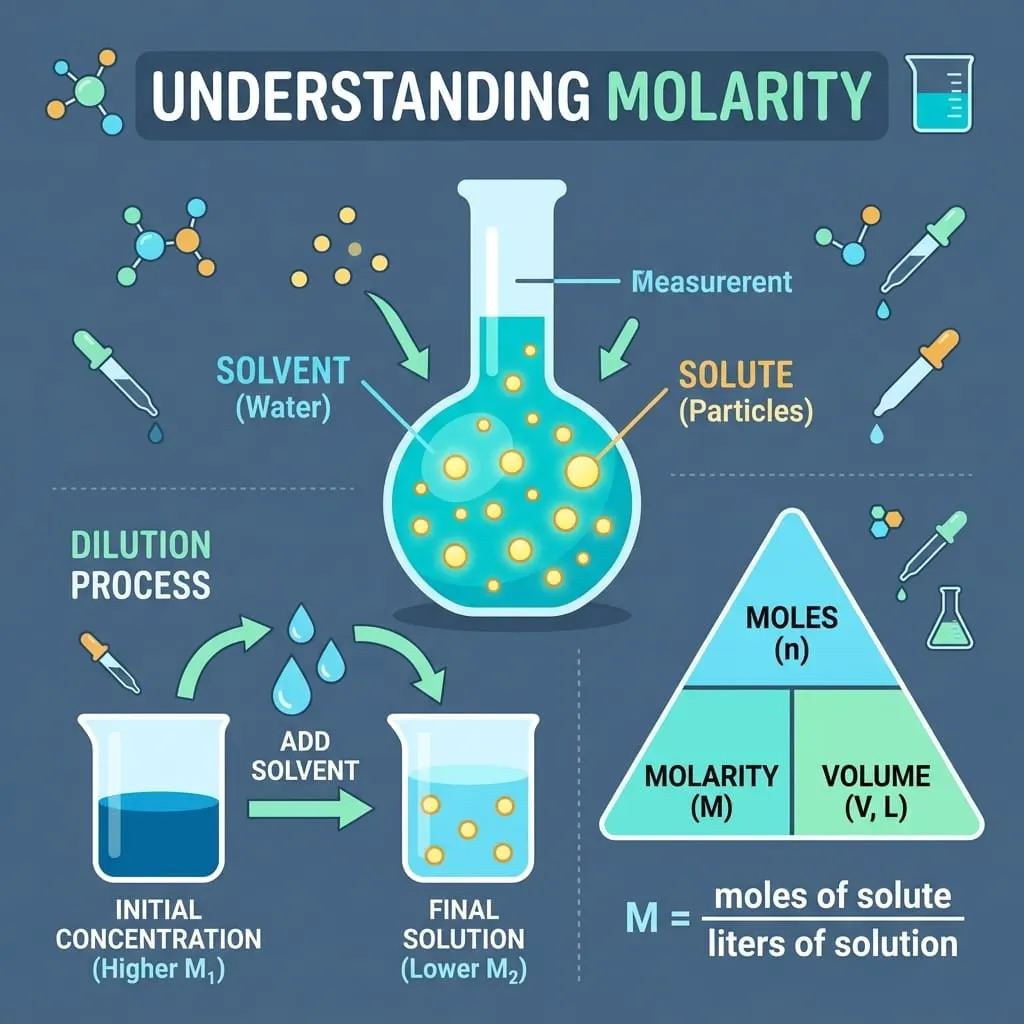
To fully understand molarity, we must first establish the physical anatomy of a chemical solution:
2.1 The Components of a Solution
- Solute: The chemical substance that is dissolved into the mixture. It can be a solid (e.g., sodium chloride , sucrose ), a liquid (e.g., pure ethanol , glacial acetic acid), or a gas (e.g., hydrogen chloride , carbon dioxide ).
- Solvent: The dissolving medium that surrounds and solvates the solute particles. Water () is the most common solvent and is referred to as the "universal solvent," producing aqueous solutions (). Non-aqueous solvents include methanol, acetone, DMSO, and dichloromethane.
- Solution: The resulting single-phase, homogeneous physical mixture where solute particles are uniformly dispersed at the molecular or ionic level down to .
graph LR
    SOLUTE["🧂 Solute (e.g. NaCl Salt)"] --> MIX["➕ Homogeneous Dissolution"]
    SOLVENT["💧 Solvent (e.g. H₂O Water)"] --> MIX
    MIX --> SOLUTION["🧪 Solution (e.g. Saline Aqueous Phase)
Uniform particle dispersion throughout volume V"]
2.2 Formal Mathematical Definition of Molarity ()
Molarity (also designated as molar concentration, symbol or ) is defined as the number of moles of solute dissolved per liter of total solution volume:
Where:
- : Molarity in moles per liter (, , or simply pronounced "Molar").
- : Amount of substance in moles (). One mole equals Avogadro's constant: particles.
- : Total volume of the final liquid solution in Liters ().
graph TD
    TRIANGLE["📐 Molarity Calculation Triangle"]
    N_TOP["🔺 Solute Moles (n = M × V)"]
    M_LEFT["◀️ Molarity (M = n / V)"]
    V_RIGHT["▶️ Volume (V = n / M)"]
    N_TOP --> M_LEFT
    N_TOP --> V_RIGHT
3. The Calculation Concepts: Step-by-Step Mathematical Derivations
In actual laboratory practice, chemicals are rarely measured directly in moles. Instead, solid reagents are weighed on analytical balances in grams (), and liquid volumes are measured in milliliters () or liters ().
Here are the fundamental formulas connecting mass, moles, volume, and molarity:
3.1 From Mass to Molarity ()
Because the number of moles equals mass in grams divided by molecular molar mass (), substituting into the molarity definition gives:
Where:
- = Mass of pure chemical weighed in grams ().
- = Molecular weight / molar mass of the compound in grams per mole ().
- = Total final volume in Liters ().
3.2 Finding the Required Solute Mass to Prepare a Target Solution
When formulating a solution of specific concentration and volume , rearrange the equation to solve for the required mass :
Example: To prepare () of ():
4. The Universal Dilution Law ()
In biochemical and chemical research, concentrated reagents are stored as Stock Solutions (e.g., , TAE buffer). Preparing a diluted working solution involves adding pure solvent.
Because only pure solvent (water) is added during dilution, the total number of solute moles remains strictly constant:
sequenceDiagram
    participant Stock as 🧪 Concentrated Stock (M₁, V₁)
    participant Solvent as 💧 Pure Solvent (Water)
    participant Final as 🥛 Diluted Target Solution (M₂, V₂)
    Note over Stock: Moles n₁ = M₁ × V₁
    Stock->>Final: Aliquot Volume V₁ transferred
    Solvent->>Final: Add (V₂ - V₁) Solvent
    Note over Final: Moles n₂ = M₂ × V₂ (n₁ = n₂)
Where:
- : Initial concentration of stock solution.
- : Volume of stock solution needed.
- : Desired final concentration of working solution.
- : Desired final total volume of working solution.
5. Correct Laboratory Preparation Protocol
Preparing a molar solution requires a precise standard operating procedure (SOP) to ensure volumetric accuracy:
flowchart LR
    STEP1["⚖️ Step 1: Weigh Solute
Measure exact mass (m) on analytical balance"] --> STEP2["🧪 Step 2: Dissolve in Beaker
Dissolve in ~60-70% target volume of solvent"]
    STEP2 --> STEP3["🍶 Step 3: Transfer to Volumetric Flask
Quantitatively rinse beaker into volumetric flask"]
    STEP3 --> STEP4["💧 Step 4: Dilute to Meniscus Mark
Add solvent until bottom of curved meniscus touches calibration line"]
    STEP4 --> STEP5["🔄 Step 5: Invert & Homogenize
Stopper flask and invert 10-15 times for complete mixing"]Why never add solute directly to the final volume of water?
If you add of to exactly of water, the dissolved ions displace volume, producing a final volume greater than (e.g., ). This lowers the true concentration to . Always dissolve the solute first and dilute up to the final graduation line.
6. Molarity vs. Other Solution Concentration Metrics
Depending on temperature conditions, pressure, and application, chemists use different concentration units:
| Metric | Symbol | Mathematical Formula | Temperature Sensitive? | Typical Real-World Applications |
|---|---|---|---|---|
| Molarity | Yes (Liquid expands/contracts with $\Delta T$) | General bench chemistry, titrations, spectrophotometry | ||
| Molality | No (Mass is invariant with temperature) | Freezing point depression, boiling point elevation | ||
| Normality | Yes | Acid-base neutralizations ( equivalents), redox titrations | ||
| Mass Concentration | Yes | Commercial biological media, protein formulations | ||
| Weight Percent | No | Bulk industrial acids (, ) | ||
| Parts Per Million | No | Environmental water testing, heavy metal trace analysis |
7. Master Formula Summary Table
| Desired Unknown Quantity | Given Known Parameters | Exact Working Formula |
|---|---|---|
| Molarity () | Solute Moles (), Solution Volume () | |
| Molarity () | Solute Mass (), Molar Mass (), Volume () | |
| Required Mass () | Target Molarity (), Target Volume (), Molar Mass () | |
| Solution Volume () | Solute Moles (), Target Molarity () | |
| Dilution Stock Volume () | Stock Molarity (), Target Molarity (), Target Volume () | |
| Millimolar () | Molar Concentration () | |
| Micromolar () | Molar Concentration () |
8. Detailed Real-World Calculation Examples
Example 1: Calculating Molarity from Weighed Solid
- Problem: A chemist dissolves of pure anhydrous sodium chloride (, ) in deionized water to make a total solution volume of . What is the molarity of the solution?
- Step 1: Convert Volume to Liters:
- Step 2: Calculate Moles of :
- Step 3: Calculate Molarity:
Example 2: Preparing a Standard Buffer Solution from Reagents
- Problem: How many grams of potassium dihydrogen phosphate (, ) are needed to prepare of a () phosphate buffer?
- Step 1: Calculate Total Moles Required:
- Step 2: Calculate Mass in Grams:
Example 3: Serial Dilution in Molecular Biology
- Problem: You have a concentrated stock solution. You need to prepare of () physiological saline. What volume of stock solution and water must be combined?
- Step 1: Apply Dilution Formula ():
- Step 2: Calculate Volume of Solvent (Water) Needed:
9. Chemical & Clinical Case Studies
Case Study 1: Intravenous Normal Saline Osmotic Balance
- Clinical Setting: In hospital emergency departments, intravenous fluids must match the natural osmolarity of human blood plasma () to prevent red blood cell lysis (bursting) or crenation (shriveling).
- Physiological Saline Formula: Standard contains per of sterile water.
- Stoichiometric Derivation:
- Osmolarity Calculation: Because dissociates completely into two ions ( and ):This is isotonic with blood plasma, providing safe fluid resuscitation without damaging erythrocyte cell membranes.
Case Study 2: Industrial Wastewater Neutralization
- Engineering Setting: A manufacturing facility discharges of acidic wastewater containing (sulfuric acid). Environmental regulations require neutralization to using sodium hydroxide (, ).
- Reaction Stoichiometry:
- Moles of Acid per Hour:
- Moles of Base Required:
- Mass of Solid Needed per Hour:
10. Common Calculation Pitfalls & Safety Rules
Pitfall 1: Unit Mismatch (mL vs. L)
The volume parameter in must always be in Liters. If you divide moles by milliliters without converting, your calculated molarity will be off by a factor of .
Pitfall 2: Hydrate Salt Molecular Weights
When weighing crystal reagents like copper sulfate pentahydrate (), you must include the weight of the five bound water molecules () in your molar mass calculation rather than anhydrous ().
Safety Rule: "Add Acid to Water" (AAW)
When preparing dilute solutions of strong concentrated acids (such as or ), the hydration reaction is violently exothermic. Always add acid slowly down the side of the container into water with continuous stirring. Never pour water into concentrated acid.
11. Frequently Asked Questions (FAQ)
Q1: Why does molarity vary with temperature while molality does not?
A: Molarity is defined per liter of solution volume (). Because liquids expand when heated (increasing ) and contract when cooled (decreasing ), the molar concentration decreases slightly at higher temperatures even though the number of solute molecules remains unchanged. Molality () is defined per kilogram of solvent mass, which is completely invariant to temperature and pressure changes.
Q2: What is the relationship between Molarity and Normality?
A: Normality () equals Molarity () multiplied by the number of active reactive equivalents per mole (): For hydrochloric acid (), because it provides . For sulfuric acid (), because each mole donates .
Q3: What is the molarity of pure liquid water?
A: At , of water has a mass of . With molar mass :
Q4: How do I convert Mass Percent () to Molarity?
A: Use the solution's density ($\rho$ in or ):
12. Summary & Key Takeaways
- Molarity Definition: , expressing concentration as moles of solute per liter of total solution.
- Stoichiometric Utility: Enables precise chemical reaction control based on discrete particle counts ().
- Dilution Invariance: Solute moles are preserved during dilution: .
- Preparation Accuracy: Always dissolve solute in partial solvent first, then bring the solution up to the exact volumetric calibration line.
Additional Technical Guidelines & Measurement Standards
When conducting calculations for Molarity Solution Concentration Calculator, maintaining quantitative precision and verifying input parameter boundaries is essential for reliable scenario evaluation. Always verify that raw numerical inputs are measured using standardized instrumentation, and double-check unit conversions prior to applying outputs in commercial, industrial, or academic projects.
For quantitative unit conversions and scientific calculations, always maintain at least four decimal places of precision during intermediate arithmetic stages before rounding final results. When preparing technical reports, laboratory documentation, or financial forecasts, cross-verify all output variables against established international measurement standards (such as SI, NIST, and ISO metric benchmarks) to guarantee consistent analytical rigor across all computational workflows.
MathsLover.com delivers this interactive solver 100% free of charge to foster global mathematical literacy, educational accessibility, and data-driven problem solving across scientific, technical, and academic communities worldwide.