💡 Direct Answer & Executive Summary (Cell Culture Doubling Time Calculator)
Definition: Calculate cell culture doubling time (Td), specific exponential growth rate (µ), population generation count, and proliferation kinetics for in vitro mammalian, insect, and bacterial cultures.
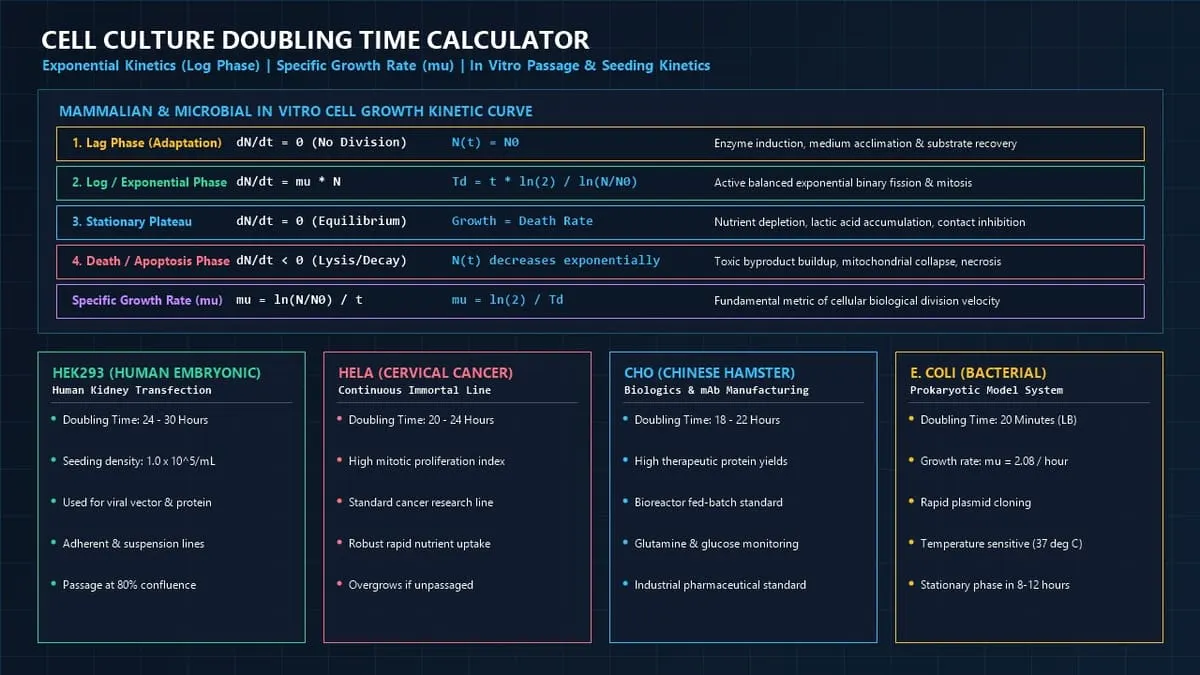
Governing Math Formula: Doubling Time (Td) = t × ln(2) ÷ ln(Nt ÷ N0). Specific Growth Rate (µ) = ln(Nt ÷ N0) ÷ t = ln(2) ÷ Td. Total Cell Generations (n) = log₂(Nt ÷ N0) = 3.322 × log₁₀(Nt ÷ N0).
Target Applications: Provides real-time quantitative solutions in Biology for students, engineers, researchers, and finance professionals.
Cell Culture Doubling Time Calculator: In Vitro Exponential Kinetics & Proliferation Guide
1. Introduction
In cell biology, tissue engineering, biopharmaceutical manufacturing (such as monoclonal antibody production in CHO cells), oncology drug discovery, and regenerative medicine, quantitatively monitoring in vitro cellular proliferation kinetics is a fundamental laboratory requirement.
Whether cultivating adherent human embryonic kidney cells (HEK293), immortalized cancer cell lines (HeLa), therapeutic Chinese hamster ovary cells (CHO), induced pluripotent stem cells (iPSCs), or rapid microbial cultures (E. coli), maintaining rigorous control over population expansion rates ensures experimental reproducibility and biological integrity.
graph LR
    SEED_IN["🌱 Initial Seeded Count (N₀)
e.g. 1.0 × 10⁵ cells"] --> KINETIC_ENG["🔬 Exponential Proliferation Engine
N(t) = N₀ · e^(µ·t)
T_d = t · ln(2) ÷ ln(N_t ÷ N₀)
n = log₂(N_t ÷ N₀)"]
    HARVEST_IN["🧫 Final Harvested Count (N_t)
e.g. 8.0 × 10⁵ cells"] --> KINETIC_ENG
    TIME_IN["⏱️ Elapsed Culture Time (t)
e.g. 48.0 Hours"] --> KINETIC_ENG
    KINETIC_ENG --> TD_OUT["⏱️ Doubling Time (T_d): 16.00 Hours"]
    KINETIC_ENG --> MU_OUT["📈 Specific Growth Rate (µ): 0.0433 / hour"]
    KINETIC_ENG --> GEN_OUT["🧬 Population Generations: 3.00 Doublings"]
    KINETIC_ENG --> DENSITY_OUT["📊 Harvest Density: 8.0 × 10⁴ cells/mL"]
Mastering doubling time calculations enables bioprocess engineers, cell culture technicians, and academic researchers to:
- Detect early cellular senescence, phenotypic drift, or subtle mycoplasma contamination.
- Schedule optimized passage intervals before cells achieve high contact inhibition or nutrient depletion.
- Standardize cell seeding densities across multi-well assay plates (-well, -well, -well, -well).
- Calculate population doubling levels (PDL) for primary human cells to avoid Hayflick replicative senescence limits.
- Optimize bioreactor fed-batch volumetric productivity in biopharmaceutical manufacturing.
2. Definitions & Mathematical Formulations
2.1 The Four Classic Phases of In Vitro Cell Growth
In batch cultivation systems, cells exhibit a characteristic 4-phase sigmoidal growth curve:
graph TD
    GROWTH_CURVE["🧫 Batch In Vitro Growth Curve"]
    GROWTH_CURVE --> LAG["1. Lag Phase
Adaptation, enzyme synthesis, zero net division (dN/dt = 0)"]
    GROWTH_CURVE --> LOG["2. Log / Exponential Phase
Maximal balanced division at constant growth rate µ (dN/dt = µ·N)"]
    GROWTH_CURVE --> STAT["3. Stationary Plateau
Nutrient depletion & contact inhibition; division equals death rate"]
    GROWTH_CURVE --> DEATH["4. Death / Apoptosis Phase
Toxic metabolite accumulation (lactate, ammonia); exponential lysis"]Doubling time and specific growth rate equations are mathematically valid only during the Log (Exponential) Growth Phase, where cell division occurs under unconstrained, substrate-saturating conditions.
2.2 Formal Mathematical Formulations
1. Fundamental Exponential Growth Equation
During balanced exponential proliferation, the rate of population increase is directly proportional to the instantaneous population size:
Integrating from initial time (with initial cell count ) to time (with harvest cell count ):
Where:
- = Initial cell number seeded at .
- = Final cell number harvested at time .
- = Total elapsed cultivation time (typically in hours).
- = Specific growth rate ().
2. Specific Growth Rate ()
Rearranging the logarithmic form yields the specific growth rate:
3. Doubling Time ( or )
Doubling time represents the precise duration required for the population to double ():
Substituting gives the universal doubling time formula:
4. Total Number of Population Generations ()
The number of population doublings () that occurred during the cultivation period:
5. Population Doubling Level (PDL) for Passage Tracking
For tracking primary cell longevity across serial subcultures (passages):
flowchart TD
    START["Input Initial Count N0, Final Count Nt & Time t (hours)"] --> VALIDATE{"Validate: Nt > N0 > 0 and t > 0?"}
    VALIDATE -->|No| ERR["Return Error: Insufficient proliferation data"]
    VALIDATE -->|Yes| RATIO["Compute Fold Expansion: R = Nt / N0"]
    RATIO --> CALC_MU["Compute Specific Growth Rate:
µ = ln(R) / t (hr⁻¹)"]
    CALC_MU --> CALC_TD["Compute Doubling Time:
Td = (t × ln(2)) / ln(R) (Hours)"]
    CALC_TD --> CALC_GEN["Compute Generations:
n = log2(R) = t / Td"]
    CALC_GEN --> CALC_DENSITY["Compute Harvest Density:
Density = Nt / Culture Volume (mL)"]
    CALC_DENSITY --> BENCHMARK["Compare against Benchmark Cell Lines (HEK293, HeLa, CHO)"]
    BENCHMARK --> DISPLAY["Render Doubling Time Dashboard & Proliferation Metrics"]
3. Master Cell Line Kinetic Reference Benchmarks
| Cell Line | Species & Tissue Origin | Typical Doubling Time () | Specific Growth Rate () | Standard Seeding Density | Primary Research / Industrial Application |
|---|---|---|---|---|---|
| HEK293 | Human Embryonic Kidney | Adenoviral/Lentiviral packaging, protein transient expression | |||
| HeLa | Human Cervical Carcinoma | Oncology drug screening, basic cellular physiology | |||
| CHO-K1 | Chinese Hamster Ovary | Therapeutic Monoclonal Antibody (mAb) biomanufacturing | |||
| Jurkat | Human T-Lymphocyte (Suspension) | Immunology, T-cell receptor (TCR) signaling assays | |||
| NIH-3T3 | Mouse Embryonic Fibroblast | Contact inhibition studies, cell transformation assays | |||
| hMSC | Human Mesenchymal Stem Cell | Regenerative medicine, tissue scaffold seeding (Hayflick limit: ~PDL 30) | |||
| S. cerevisiae | Budding Yeast (Eukaryotic) | Recombinant genetics, fermentation bioengineering | |||
| E. coli (K-12) | Bacterium (Prokaryotic, LB 37°C) | Molecular cloning, plasmid amplification |
4. Laboratory Counting Methods & Protocols
Accurate doubling time estimation depends on precise quantification of initial () and harvested () viable cell populations:
graph TD
    COUNT_METHODS["🔬 Laboratory Cell Enumeration Modalities"]
    COUNT_METHODS --> HEMATO["🧫 Manual Hemocytometer (Neubauer Chamber)
Trypan Blue viability exclusion (Viable Cells = Clear, Dead = Blue)
Total = (Avg Count in 4 corners) × Dilution × 10⁴ / mL"]
    COUNT_METHODS --> AUTO["⚡ Automated Image-Based Counters (Countess / Vi-CELL)
Dual-channel fluorescence (AO/PI) or brightfield imaging"]
    COUNT_METHODS --> FLOW["📊 Flow Cytometry / Coulter Counter
Impedance-based volumetric counting with forward/side scatter gating"]
    COUNT_METHODS --> SPEC["📈 Spectrophotometric Turbidimetry (Microbial OD₆₀₀)
Beer-Lambert scattering approximation during early log phase"]
5. Step-by-Step Practical Laboratory Walkthrough
Problem: Bioprocess Characterization of a CHO Cell Subculture
A bioprocess technician seeds a T-75 flask containing of complete CD CHO medium with (). After of incubation at with on an orbital shaker (125 RPM), the flask is harvested and counted via automated hemocytometer, yielding .
Step-by-Step Mathematical Evaluation:
- Calculate Population Expansion Ratio ():
- Calculate Specific Growth Rate ():
- Calculate Cell Culture Doubling Time ():
- Calculate Number of Generations ():(Verification: expansion).
- Calculate Final Cell Density:
- Quality Control Verdict: Doubling time of 24.0 hours aligns with standard healthy CHO growth kinetics, indicating optimal media buffering, no nutrient depletion, and ready passaging state.
6. Critical Factors Influencing In Vitro Proliferation Rates
- Serum Batch & Growth Factor Concentration: Fetal Bovine Serum (FBS) lot-to-lot variance can alter mammalian doubling times by up to 30%.
- Dissolved Oxygen () and pH Control: As cells proliferate, lactic acid accumulation acidifies the medium (), inhibiting phosphofructokinase and slowing mitosis.
- Contact Inhibition & Cell-Cell Junctions: Adherent non-transformed cells arrest in the cell cycle phase upon reaching 100% confluence.
- Mycoplasma Contamination: Cryptic mycoplasma infection degrades arginine and alters host DNA synthesis, silently doubling or tripling normal doubling times without visible turbidity.
7. Frequently Asked Questions (FAQ)
What is the formula for calculating doubling time?
Where is elapsed time, is the starting cell count, and is the final cell count.
What is the difference between doubling time () and specific growth rate ()?
Specific growth rate () is the continuous instantaneous rate of population growth per hour (), while doubling time () is the actual duration in hours required for the population to double ().
Why must doubling time be measured during the exponential phase?
During the lag phase, cells are adapting rather than dividing. During the stationary and death phases, growth rates decline due to nutrient starvation and toxic byproduct accumulation. Only the exponential phase reflects unconstrained intrinsic mitotic capacity.
What is Population Doubling Level (PDL)?
PDL represents the total cumulative number of times a two-fold population expansion has occurred since the primary tissue was originally isolated from the donor organism.
8. Summary Checklist
- ✔ Enter Initial Seeding Count (): Record viable starting cells.
- ✔ Enter Final Harvest Count (): Quantify total viable cells at harvest.
- ✔ Specify Incubation Hours (): Enter elapsed time in hours.
- ✔ Review Doubling Time (): Compare against cell line benchmark ranges.
- ✔ Inspect Specific Growth Rate (): Record kinetic parameter for bioprocess scaling.
Additional Technical Guidelines & Measurement Standards
When conducting calculations for Cell Culture Doubling Time Calculator, maintaining quantitative precision and verifying input parameter boundaries is essential for reliable scenario evaluation. Always verify that raw numerical inputs are measured using standardized instrumentation, and double-check unit conversions prior to applying outputs in commercial, industrial, or academic projects.
For quantitative unit conversions and scientific calculations, always maintain at least four decimal places of precision during intermediate arithmetic stages before rounding final results. When preparing technical reports, laboratory documentation, or financial forecasts, cross-verify all output variables against established international measurement standards (such as SI, NIST, and ISO metric benchmarks) to guarantee consistent analytical rigor across all computational workflows.
MathsLover.com delivers this interactive solver 100% free of charge to foster global mathematical literacy, educational accessibility, and data-driven problem solving across scientific, technical, and academic communities worldwide.