💡 Direct Answer & Executive Summary (ABO Blood Group Punnett Cross Solver)
Definition: Calculate offspring ABO blood group probabilities, Rhesus (Rh D) factor inheritance, Punnett square genotype distributions, transfusion compatibility, and HDFN alloimmunization risks.
Governing Math Formula: Multiple Alleles: IA and IB are codominant; i is recessive. Rh(D) is autosomal dominant (D > d). Cross IAi × IBi yields 25% AB, 25% A, 25% B, 25% O. Rh- Mother (dd) × Rh+ Father (Dd) confers 50% HDFN risk.
Target Applications: Provides real-time quantitative solutions in Biology for students, engineers, researchers, and finance professionals.
ABO Blood Group Punnett Cross Solver: Multiple Alleles, Codominance & Rh Factor Guide
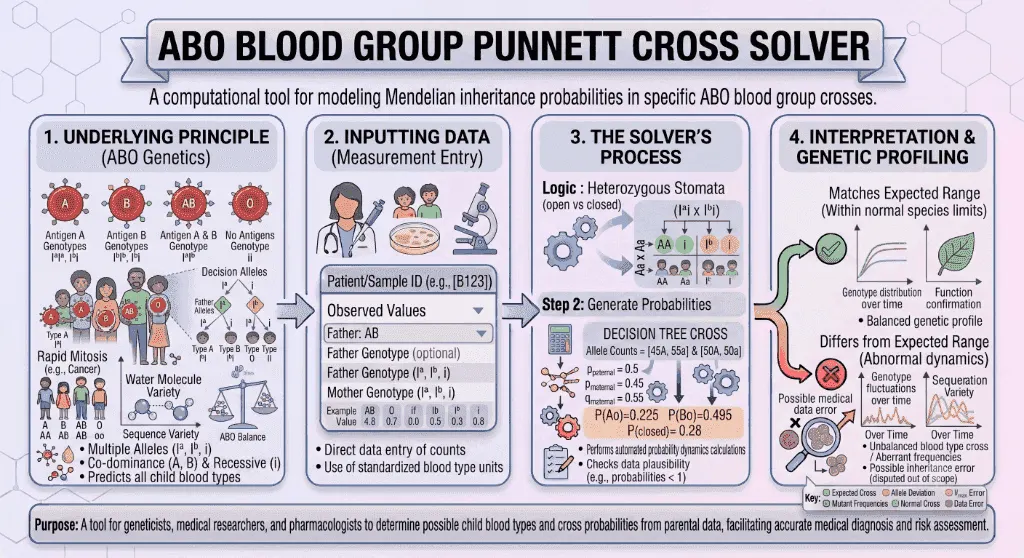
1. Introduction
In human genetics, transfusion medicine, forensic biology, and obstetrics, the ABO Blood Group System and the Rhesus (Rh D) System represent the most clinically critical cell-surface antigen complexes in human physiology. Correct identification of blood group inheritance is essential for safe blood transfusions, organ transplantation, resolving disputed parentage, and preventing life-threatening fetal hemolytic disease.
Discovered by Austrian physician Karl Landsteiner in 1900, the ABO system is the classic textbook example of Multiple Allelism and Codominance in human genetics. Unlike simple Mendelian traits controlled by only two alleles, the ABO locus on chromosome features three major alleles: , , and .
The and alleles are codominant to each other—both expressing their respective carbohydrate antigens simultaneously on red blood cells (erythrocytes) in heterozygous individuals (Type AB)—while both and are completely dominant over the null recessive allele (Type O).
Simultaneously, the Rhesus (Rh) D antigen on chromosome follows classical dominant/recessive inheritance (). In obstetrics, when an carries an fathered by an male, fetomaternal hemorrhage can trigger maternal anti-D alloimmunization, causing Hemolytic Disease of the Fetus and Newborn (HDFN / Erythroblastosis Fetalis) in subsequent pregnancies unless prevented by prophylactic RhoGAM.
How do parental genotypes combine across Punnett crosses to yield offspring blood groups? Why is Type the universal red blood cell donor while Type is the universal plasma donor?
This comprehensive guide details the molecular genetics, Punnett square derivations, transfusion compatibility matrices, and clinical case studies governing ABO and Rh blood group crosses.
flowchart LR
    GENETICS["🧬 ABO & Rh(D) Gene Loci
Chromosome 9q34 (IA, IB, i)
Chromosome 1p36 (RHD+, RHD-)"] --> PUNNETT["🧮 Punnett Cross Solver
Joint ABO & Rh Offspring Probabilities
Genotypes (IAIA, IAi, IBIB, IBi, IAIB, ii)"]
    PUNNETT --> COMPAT["🩸 Immunohematology Matrix
RBC & Plasma Transfusion Matching
Universal Donor (O-) & Recipient (AB+)"]
    COMPAT --> OBSTETRICS["🤰 Clinical Protection
Forensic Paternity Exclusion & RhoGAM HDFN Prevention"]
2. Definitions
2.1 Simple Everyday Definition
An ABO Blood Group Punnett Cross Solver is a genetic calculator that predicts all possible blood types (A, B, AB, or O, positive or negative) a child can inherit based on their biological parents' blood groups and Rhesus factors.
2.2 Formal Technical Definition
The ABO Blood Group Genetic Model describes the inheritance of the human ABO gene locus (chromosome ), which exhibits Multiple Allelism with three primary alleles ():
- Codominance (): Both alleles express functional glycosyltransferases simultaneously in the heterozygous genotype (Blood Group AB).
- Complete Dominance over : and are completely dominant over the allele ( and ; and ).
- Homozygous Recessive (): The null genotype produces no functional transferase, leaving the precursor antigen unmodified (Blood Group O).
- Rhesus (Rh D) System: Governed by the RHD locus on chromosome , where the allele (Rh-positive) is autosomal dominant over the deletion/null allele (Rh-negative).
2.3 Vivid Real-World Analogies
The Dual-Antenna Radio Broadcast (Codominance):
Imagine an antenna tower. Allele broadcasts an AM radio frequency (A antigen), while allele broadcasts an FM radio frequency (B antigen). If you have , the tower broadcasts both AM and FM simultaneously without interference. The allele is a silent dead channel. Only if both transmitters are silent () is no broadcast made (Type O).
The Security Guard and Foreign Passports (Landsteiner's Rule):
Your immune system's antibodies are security guards that inspect red blood cells. If your cells carry the "A passport" (Type A), the guard attacks anyone holding a "B passport" (anti-B antibody). Type AB holds both passports, so security attacks neither (Universal Recipient). Type O holds no passports, so security attacks anyone presenting A or B passports, but Type O cells can slip into any patient unseen (Universal Donor).
3. History & Scientific Milestones
The discovery of human blood groups transformed surgery, military trauma resuscitation, and medical genetics.
flowchart TD
    K1["📅 1900–1901: Karl Landsteiner
Discovers ABO blood groups via serological agglutination (Awarded 1930 Nobel Prize)"] --> K2["📅 1910: Emil von Dungern & Ludwik Hirszfeld
Prove that ABO blood groups follow Mendelian inheritance laws in families"]
    K2 --> K3["📅 1924: Felix Bernstein
Mathematically proves the 3-allele single-locus model (IA, IB, i) via population statistics"]
    K3 --> K4["📅 1940: Landsteiner & Alexander Wiener
Discover the Rhesus (Rh D) antigen system in rhesus macaque & human erythrocytes"]
    K4 --> K5["📅 1968: Ronald Finn & Vincent Freda
Introduce RhoGAM (anti-D immunoglobulin), virtually eradicating fatal infant HDFN"]- Karl Landsteiner (1900–1901): Mixed serum and red blood cells from colleagues at the University of Vienna, discovering hemagglutination patterns that defined the , , and (originally "C") blood groups, winning the 1930 Nobel Prize in Physiology or Medicine.
- Emil von Dungern & Ludwik Hirszfeld (1910): Demonstrated through family pedigrees that blood types are inherited strictly according to Mendelian genetics, introducing the notation (Isohemagglutinin).
- Felix Bernstein (1924): Proved mathematically that ABO inheritance is controlled by a single genetic locus with three multiple alleles (), disproving earlier two-locus linkage theories.
- Karl Landsteiner & Alexander S. Wiener (1940): Identified the Rhesus (Rh) factor, explaining mysterious hemolytic transfusion reactions and fetal hydrops in mothers carrying second pregnancies.
- Vincent Freda, John Gorman, and William Pollack (1968): Developed , an injectable passive antibody that cleared fetal cells from maternal blood, preventing alloimmunization.
4. Core Concepts & Biochemical Mechanisms
graph TD
    ABO_MECH["🩸 Biochemical Architecture of ABO & Rh Antigens"]

    ABO_MECH --> H_SUBST["1. Precursor H Antigen (FUT1 Gene)
• Fucose added to oligosaccharide chain (Fuc-α1,2-Gal)
• Essential foundation for both A and B transferases
• Homozygous recessive (hh) causes rare Bombay Phenotype"]

    ABO_MECH --> GLYCOSYL["2. Glycosyltransferase Enzymes (ABO Gene)
• IA: Adds N-acetylgalactosamine (GalNAc) → Antigen A
• IB: Adds D-galactose (Gal) → Antigen B
• i: Frameshift deletion (ΔG261) → Inactive enzyme (Antigen O/H)"]

    ABO_MECH --> ISOHEMAG["3. Landsteiner's Law of Isoantibodies
• Type A: Anti-B IgM in plasma
• Type B: Anti-A IgM in plasma
• Type AB: Neither antibody (Universal RBC Recipient)
• Type O: Both Anti-A and Anti-B IgM/IgG (Universal RBC Donor)"]
4.1 The Molecular Genetics of Glycosyltransferases
The ABO gene on chromosome spans exons. The differences between the alleles stem from single nucleotide polymorphisms:
- Allele: Encodes , attaching to the antigen terminal galactose.
- Allele: Differs by amino acid substitutions (), shifting specificity to attach .
- Allele: Contains a critical single-guanine deletion at position (), causing a frameshift that introduces a premature stop codon, producing an inactive truncated protein.
4.2 Landsteiner's Rule and Natural Isohemagglutinins
Individuals naturally produce IgM antibodies (isohemagglutinins) against the ABO carbohydrate antigens missing from their own erythrocytes:
- Environmental gut bacteria (e.g., E. coli) possess cell-wall lipopolysaccharides mimicking A and B antigens.
- Infants begin producing anti-A and anti-B antibodies around of age following intestinal bacterial colonization.
- Transfusing mismatched blood (e.g., Type A blood into a Type B patient) triggers immediate acute hemolytic transfusion reaction (AHTR) with complement activation, intravascular lysis, and acute renal failure.
4.3 The Rhesus (Rh D) System & HDFN Pathophysiology
- The RHD gene encodes a integral membrane protein (the D antigen).
- : Genotypes or express the D antigen.
- : Genotype (complete deletion of the RHD gene in 85% of Caucasian individuals).
- Unlike ABO, anti-D antibodies are not naturally occurring; they develop only after blood exposure (e.g., childbirth, miscarriage, trauma).
- Anti-D antibodies are IgG, which actively cross the placenta via Fc receptors. In an mother sensitized during a prior pregnancy, anti-D IgG destroys fetal erythrocytes in subsequent pregnancies, causing severe fetal anemia, erythroblastosis fetalis, and hydrops fetalis.
5. Formulas & Mathematical Derivations
5.1 The ABO Punnett Cross Matrix
Let maternal alleles be and paternal alleles be , where .
The probability of any offspring genotype across the equal quadrants is:
5.2 ABO Phenotypic Probability Calculations
5.3 Combined ABO and Rhesus Joint Probabilities
Assuming independent assortment between chromosome (ABO) and chromosome (RHD):
Where:
5.4 Variable Reference Table
| Blood Type | Genotypes | RBC Surface Antigens | Plasma Antibodies | Can Receive RBCs From | Can Donate RBCs To |
|---|---|---|---|---|---|
| Type A | A Antigen | Anti-B | |||
| Type B | B Antigen | Anti-A | |||
| Type AB | A and B Antigens | None | All (A, B, AB, O) | ||
| Type O | $i i$ | None (H only) | Anti-A and Anti-B | All (A, B, AB, O) | |
| $DD, Dd$ | D Antigen | None | only | ||
| No D Antigen | Anti-D (if sensitized) | only |
6. Step-by-Step Computational Walkthrough
Let us calculate the offspring blood group distribution for the following couple:
- Mother: Blood Group A Heterozygous (),
- Father: Blood Group B Heterozygous (),
flowchart TD
    STEP1["Step 1: Set Up 2×2 ABO Punnett Matrix
Maternal (IA, i) × Paternal (IB, i)"] --> STEP2["Step 2: Solve 4 ABO Genotypes
IA × IB → IAIB (25% AB) | IA × i → IAi (25% A)
i × IB → IBi (25% B) | i × i → ii (25% O)"]
    STEP2 --> STEP3["Step 3: Solve Rhesus Punnett Matrix
Maternal (d, d) × Paternal (D, d) → 50% Dd (Rh+) and 50% dd (Rh-)"]
    STEP3 --> STEP4["Step 4: Combine ABO & Rh Independent Probabilities
Each of the 8 Phenotypes (A+, A-, B+, B-, AB+, AB-, O+, O-) = 25% × 50% = 12.5%"]
    STEP4 --> STEP5["Step 5: Assess Obstetric HDFN Risk
Mother is Rh- (dd) and 50% of fetuses will be Rh+ (Dd)
Requires prophylactic RhoGAM at 28 weeks & postpartum"]- Step 1: ABO Punnett Square ():- Quadrant 1 ():- Quadrant 2 ():- Quadrant 3 ():- Quadrant 4 (): $i i$
- Step 2: Rhesus Punnett Square ():- ()- ()-
- Step 3: Combined 8-Phenotype Joint Probabilities ( each):- |- |- |- |
- Step 4: Clinical Guidance:- Because the mother is and there is a , antenatal administration of RhoGAM at gestation is indicated.
7. Visual Explanations & Blood Group Spectrum
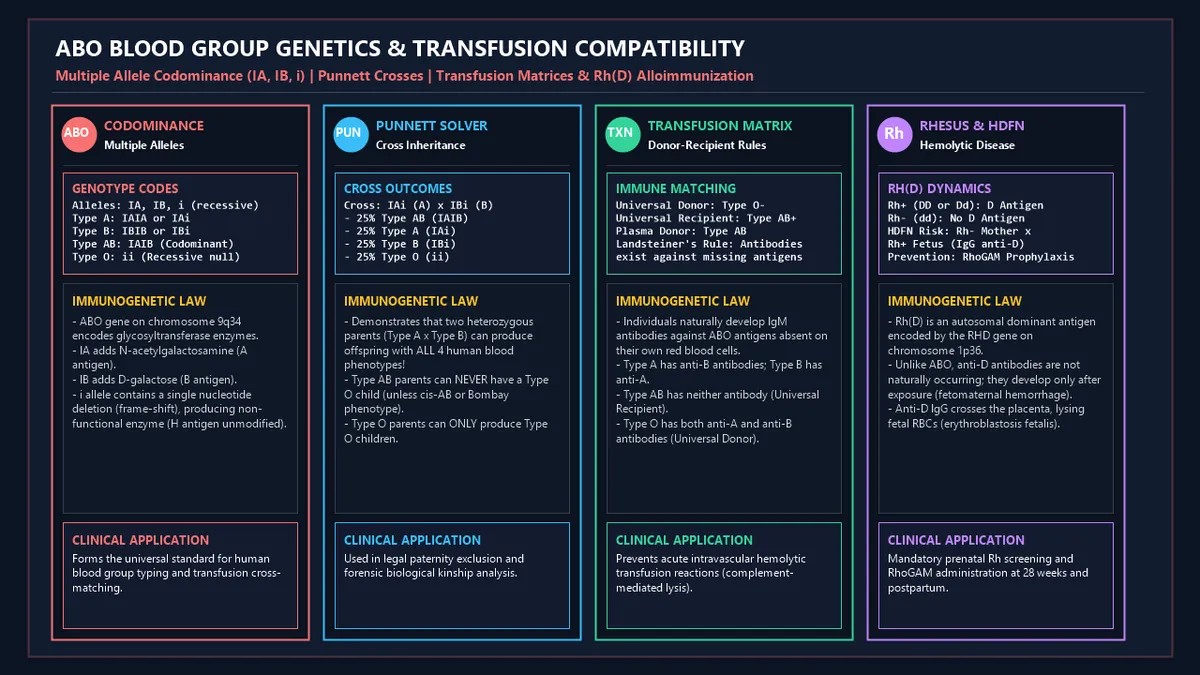
flowchart TD
    TRANSFUSION["Human Blood Product Transfusion Compatibility Hierarchy"]

    TRANSFUSION --> RBC["🔴 Packed Red Blood Cell (RBC) Rules
• Target: Donor antigens must NOT match recipient antibodies
• Universal RBC Donor: Type O Negative (O-) [No A, B, or D antigens]
• Universal RBC Recipient: Type AB Positive (AB+) [No anti-A, anti-B, or anti-D]"]

    TRANSFUSION --> PLASMA["🟡 Fresh Frozen Plasma (FFP) Rules
• Target: Donor antibodies must NOT attack recipient antigens
• Universal Plasma Donor: Type AB [Contains NO anti-A or anti-B antibodies]
• Universal Plasma Recipient: Type O [Cells have no antigens to attack]"]
8. Comparative & Standards Tables
8.1 Parental Blood Group Mating vs. Offspring Possibilities
| Mother Blood Type | Father Blood Type | Possible Child Blood Types | IMPOSSIBLE Child Blood Types |
|---|---|---|---|
| Type O | Type O | O only | |
| Type O | Type A | ||
| Type O | Type B | ||
| Type O | Type AB | ||
| Type A | Type A | ||
| Type A | Type B | All Types (A, B, AB, O) | None |
| Type A | Type AB | O | |
| Type B | Type B | ||
| Type B | Type AB | O | |
| Type AB | Type AB | O |
8.2 Global ABO & Rh Blood Group Frequency Averages
| Blood Group | Phenotype Description | Global Average Frequency | Caucasian | African Ancestry | Asian Ancestry |
|---|---|---|---|---|---|
| Universal RBC donor (Rh+) | 38.0% | 37% | 47% | 39% | |
| Type A with D antigen | 28.0% | 33% | 24% | 27% | |
| Type B with D antigen | 20.0% | 9% | 18% | 25% | |
| Universal RBC Recipient | 5.0% | 3% | 4% | 7% | |
| True Universal RBC Donor | 4.5% | 8% | 4% | 0.3% | |
| Type A (Rh-) | 3.0% | 6% | 2% | 0.5% | |
| Type B (Rh-) | 1.0% | 1.5% | 1% | 0.4% | |
| Rare Blood Group | 0.5% | 0.5% | 0.3% | 0.1% |
9. Practical Real-World Applications
Example 1: Forensic Paternity & Maternity Exclusion
A child with Blood Group O () born to a Type A mother () cannot have been fathered by a man with Blood Group AB (). Because an father passes either or in 100% of his sperm, he can never transmit the required allele.
Example 2: Emergency Trauma Blood Transfusion Protocol
When a trauma patient arrives in hemorrhagic shock without time for pre-transfusion cross-matching, the blood bank immediately issues uncrossmatched packed red blood cells (for women of childbearing age to prevent Rh sensitization) or cells (for adult males and post-menopausal females).
Example 3: Obstetric Antenatal RhoGAM Immunoprophylaxis
All pregnant women receive an Indirect Coombs Test antibody screen. If negative for anti-D antibodies, they are administered of Rho(D) Immune Globulin (RhoGAM) at gestation and a second dose within of delivering an infant.
10. In-Depth Case Studies
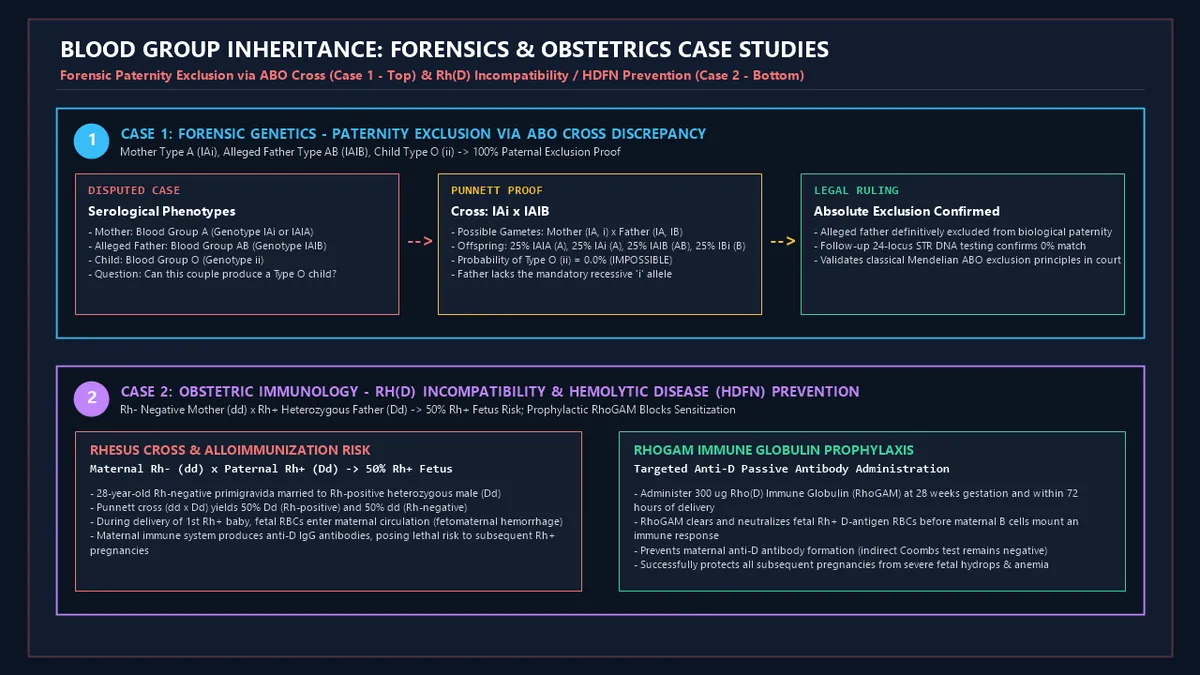
Case Study 1: Forensic Genetics — Paternity Exclusion via ABO Cross Discrepancy
- Legal Context: In a contested child support dispute, paternity is alleged against a male.
- Serological Test Results:- Mother: Blood Group A (Genotype )- Alleged Father: Blood Group AB (Genotype )- Child: Blood Group O (Genotype )
- Punnett Cross Proof ():- Possible Maternal Gametes:- Possible Paternal Gametes:- Offspring Genotypic Array:----- Probability of Type O () Child:
- Forensic Ruling: The alleged father is 100% excluded from biological paternity. A subsequent 24-locus short tandem repeat (STR) DNA profile confirmed non-paternity with 0.00% probability of inclusion.
Case Study 2: Obstetric Immunology — Rh(D) Incompatibility & Hemolytic Disease (HDFN) Prevention
- Clinical Presentation: A primigravida () with blood type is married to a male with blood type .
- Genetic Cross Formulation:- Maternal Genotype: $ii, dd$- Paternal Genotype: $ii, Dd$- Offspring Probability: and .
- Pathophysiology & Management:- The mother carries a 50% chance of carrying an fetus.- At gestation, maternal antibody screen (indirect Coombs) is negative (no pre-existing anti-D).- Patient receives prophylactic RhoGAM IM.- At delivery, fetal cord blood confirms the baby is .- Maternal Kleihauer-Betke acid elution test detects of fetal whole blood in maternal circulation.- A postpartum dose of RhoGAM is administered within , neutralizing fetal D-antigen cells before maternal B lymphocytes can mount a secondary IgG response.
- Outcome: The mother's antibody screen remains negative, completely protecting all future pregnancies from hemolytic disease.
11. Advantages of ABO Punnett Cross Modeling
- Pre-Transfusion Safety Verification: Confirms immunological compatibility between donor RBCs and recipient isohemagglutinins.
- Definitive Legal Paternity Exclusion: Provides clear Mendelian rules to rule out falsely accused biological fathers.
- Anticipates Obstetric Rh Incompatibility: Identifies pregnancies at risk for HDFN, prompting timely RhoGAM prophylaxis.
- Clarifies Complex Codominance: Illustrates how two heterozygous parents can produce children with all four blood groups.
12. Methodological Complexities & Rare Exceptions
- The Bombay Blood Phenotype (): Individuals homozygous for a null mutation in the FUT1 gene cannot synthesize the precursor antigen. Even if they possess functional or genes, they produce no A or B antigens and type serologically as Type O, but produce potent anti-H antibodies and can receive blood only from other Bombay individuals.
- Cis-AB Mutation: A rare crossover mutation where and transferase sequences are fused onto a single chromosome 9, allowing a "Type AB" individual to pass both alleles to a child on one gamete.
- Weak D and Partial D Variants: Genetic variations in the RHD gene where the D antigen is expressed in reduced quantities, requiring advanced molecular testing in obstetrics.
13. Common Mistakes to Avoid
1. Conflating Universal Red Cell Donors with Universal Plasma Donors:
Type is the universal Packed Red Blood Cell donor (no antigens), but Type is the universal Fresh Frozen Plasma donor (no antibodies). Transfusing Type O plasma to a Type A patient causes severe hemolysis!
2. Assuming an AB Parent Can Have an O Child:
Under standard Mendelian genetics, a parent with Blood Group AB () can never have a child with Blood Group O (), because the parent must contribute either or .
3. Believing Rh-Positive Parents Cannot Have an Rh-Negative Child:
If both parents are heterozygous (), each child has a of being ().
12. Frequently Asked Questions (FAQ)
What blood type is the true universal donor?
Type is the universal donor for Packed Red Blood Cells because its erythrocytes lack A, B, and Rh(D) antigens, meaning recipient antibodies will not attack the transfused cells.
What blood type is the universal plasma donor?
Type is the universal donor for Fresh Frozen Plasma (FFP) because plasma from Type AB individuals contains neither anti-A nor anti-B antibodies.
Can two Type A parents have a Type O child?
Yes. If both parents are heterozygous (), there is a that their child will inherit two recessive alleles, resulting in Blood Group O ().
Why is Type AB called codominant?
Because both the and alleles are actively expressed simultaneously, producing both A and B carbohydrate antigens on the red blood cell surface without one allele masking the other.
What is the purpose of RhoGAM?
RhoGAM (Rho(D) Immune Globulin) is an injectable passive antibody given to pregnant women to destroy any circulating fetal red blood cells before the mother's immune system can produce its own anti-D antibodies.
Can a Type AB parent and a Type O parent have a Type AB child?
No. A cross between and can produce only Type A (, 50%) or Type B (, 50%) offspring.
What is the Bombay blood phenotype?
The Bombay phenotype () is a rare genetic condition where the precursor H substance is missing, preventing A and B antigens from attaching. These individuals test as Type O regardless of their actual ABO genotype.
15. Expert Tips for Immunohematologists, Obstetricians & Blood Bankers
- Verify Maternal Rh Status at the First Prenatal Visit: Order an automated ABO/Rh type and antibody screen for every pregnant patient at booking; repeat antibody screening at .
- Always Administer RhoGAM for Threatened Abortions or Abdominal Trauma: Any fetomaternal hemorrhage event in an woman requires of anti-D prophylaxis regardless of gestational age.
- Differentiate Emergency Red Cell Triage: In massive transfusion protocols, reserve scarce units for females of reproductive potential (); use uncrossmatched blood for adult males to conserve inventory.
16. Summary Checklist
- ✔ Determine Parental ABO Genotypes: Identify heterozygous () vs. homozygous () states.
- ✔ Identify Rhesus Factor Zygosity: Distinguish ($DD, Dd$) from ().
- ✔ Construct Punnett Matrix: Calculate joint probabilities across all combined phenotypes.
- ✔ Verify Transfusion Safety: Match donor RBC antigens against recipient plasma isohemagglutinins.
- ✔ Evaluate Obstetric HDFN Risk: Flag mothers carrying fetuses for antenatal RhoGAM prophylaxis.
- ✔ Apply Legal Paternity Exclusion Criteria: Identify impossible parent-child blood group combinations.
Additional Technical Guidelines & Measurement Standards
When conducting calculations for ABO Blood Group Punnett Cross Solver, maintaining quantitative precision and verifying input parameter boundaries is essential for reliable scenario evaluation. Always verify that raw numerical inputs are measured using standardized instrumentation, and double-check unit conversions prior to applying outputs in commercial, industrial, or academic projects.
For quantitative unit conversions and scientific calculations, always maintain at least four decimal places of precision during intermediate arithmetic stages before rounding final results. When preparing technical reports, laboratory documentation, or financial forecasts, cross-verify all output variables against established international measurement standards (such as SI, NIST, and ISO metric benchmarks) to guarantee consistent analytical rigor across all computational workflows.
MathsLover.com delivers this interactive solver 100% free of charge to foster global mathematical literacy, educational accessibility, and data-driven problem solving across scientific, technical, and academic communities worldwide.